Backwards planning
We are all familiar with the idea of backwards planning, starting with the learning objectives and then designing the lessons that will help students achieve them. After a series of questions on the site about the design of the students' IA proposals, I began to wonder whether the same approach could be applied here.
Like the IA experiment in the previous curriculum, the proposal should be kept as simple as possible. Thinking backwards from their identified issue or problem can help ensure that each section is purposeful, coherent, and manageable for students.
What is important
The IA proposal must be an issue or problem for a population of interest to the student
The issue must possess solutions that can be suggested in the discussion
There must be relevant background research that will help the student identify the expected results of their research
What is not needed
It does not have to be an experiment; it can be an interview, survey/questionnaire or observation
It should not be a replication of published research.
It does not need a hypothesis.
Getting started
Forget about the introduction for a while, and start with a small group session on issues that matter to students and their population of interest. These issues should be able to be mitigated or even resolved through a suggestion for a future policy or future practice.
Thinking prompts for students
Who or what do I care about?
What is one of the problems faced by them?
Is this a problem that could be helped with a policy or practical change?
Background research
This does not have to be on the identical population to the student's chosen population of interest. Two relevant academic articles are needed from peer-reviewed journals. They do not have to take opposing views on the issue. The student may use other research as evidence for statements made in the IA proposal, but these two pieces have to be identified as the relevant background research.
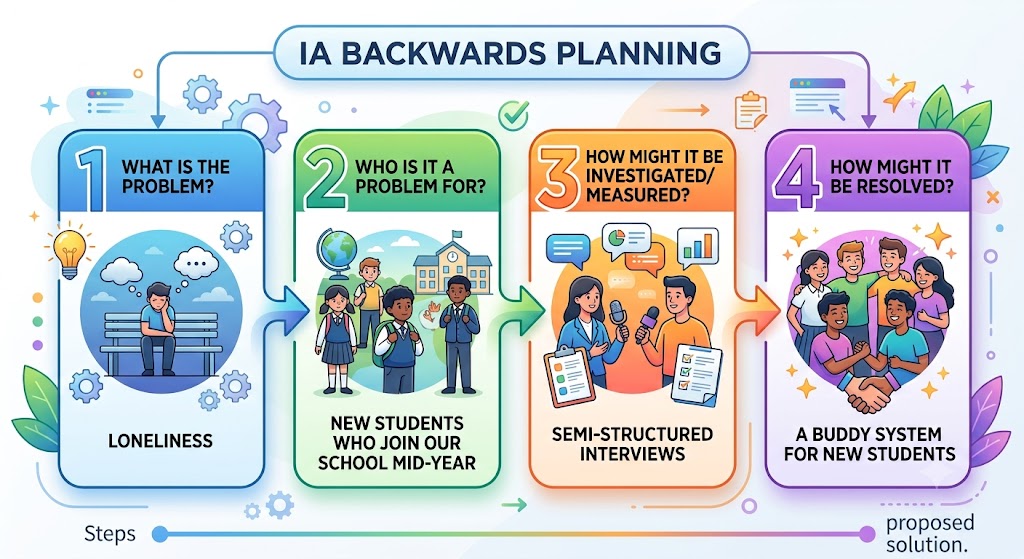
Once students have found these studies, then their research question, the expected findings of the IA proposal and the type of data collection tool needed will be easier to determine. See the example below.
The aim or research question
Students are allowed to identify their aim as a statement or a question. I find it easier to ask for research questions, but it does not matter if there is no question, so long as an aim is stated. The student has identified a problem for a specific population and has some idea of how to measure the effect of this problem and what a possible solution or partial solution might be. They do not have to think of their aim in a vacuum; it will present itself. Thinking of the example above, an obvious research question would be “How can new students to our school feel less lonely when they first start?” Or the aim would be “To investigate loneliness amongst new students and suggest a solution.” It arises from the background work that has been done before. See the student resources for examples of IA proposals.