Course plan: Sequential

There are several ways in which you could organize the IB Psychology course. And we also have different schedules in our schools. This page will look at a rather sequential approach, which may be the way that many of us will teach the new course until we have a sense of how much time will be required to address the content.
In the future, another page will be created with a more thematic approach, once all lesson plans are posted.
Decisions to be made
Before mapping out the course, some decisions need to be made.
- How will you integrate research methods throughout the course? Will you start off with a unit on research methods?
- Which unit will you start with?
- Which cognitive process will you teach? (memory, attention, language, perception)
- Which area of human development will you teach? (Cognitive, social, moral, language)
- Which disorder will you teach? (Depression, eating disorders, PTSD, OCD, anxiety disorders)
- Which health problem will you teach? (Obesity, drug misuse or abuse, social media addiction)
- Which aspect of human relationships will you teach? (social relationships, interpersonal conflict/aggression)
- Where will you teach motivation, technology, and culture?
- How will student inquiry be integrated into your course?
- When will you have students complete the IA?
My school schedule
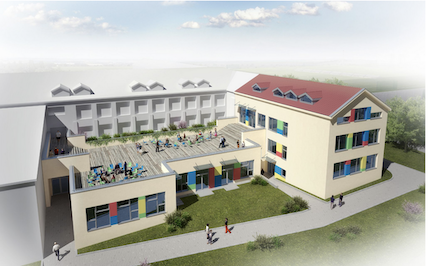
Before outlining a potential course map, a clarification of our school schedule.
At the International School of Prague, we have students for 65 minutes on an every-other day schedule. In 10 days, I will see my SL/HL class together five times and my HL class alone twice.
We have 38 weeks in the first year; 28 in the second year before students finish classes and begin revision.
A sequential approach
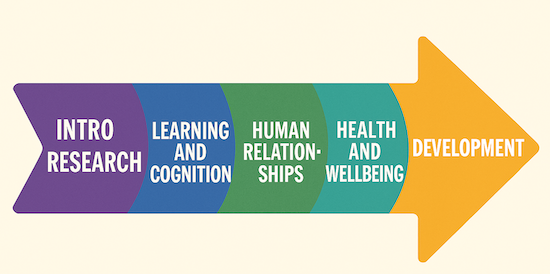
Unit 1. Introduction to research
SL/HL | Topic | HL | Topic |
| Week 1 | Introduction to psychology; what is an experiment? IV, DV, controls, random allocation | Week 1 | Extension of more examples of experiments |
| Week 2 | True vs quasi experiments; sampling techniques | Week 2 | An introduction to descriptive stats: mean, median, mode, standard deviation and IQR. |
| Week 3 | Limitations in experiments | Week 3 | Carry out experiment for data analysis |
| Week 4 | Ethical considerations in experiments; assessment |
Justifications/Reflections
This unit is very short. SL candidates are not required to know how to do a statistical analysis of an experiment. This unit introduces the course vocabulary, including concepts like bias, causality, and responsibility. Qualitative research methods will be introduced together as part of the practical in each unit.
As the experiment is recommended for the Learning and Cognition Unit, I will extend the teaching of the method in the first unit, using several examples in class.
Unit 2. Learning and cognition
Week | Topic | Week | Topic |
1 | Learning: Classical and operant conditioning | 9 | Environment and cognition (includes cognitive load theory) |
2 | Social learning theory | 10 | Biological factors: The role of the hippocampus (localization of functions) and neurotransmission |
3 | Assessment | 11 | Strategies for improving cognition |
4 | Introduction to a cognitive process | 12 | Assessment |
5 | The Multi Store Model | 13 | Dual Process Theory |
6 | Schema theory | 14 | Cognitive biases |
7 | Culture and cognition | 15 | Practical: Cognitive bias experiment |
8 | Assessment |
Justifications/Reflections
Each week may have 2 or three classes for teaching the content. This means that in weeks with “Assessment,” there will be one class for an IB assessment, or it could be more than one class for a project-based assessment.
Cognitive load will be introduced as part of the effect of environmental factors on cognition.
I will introduce neurotransmission in this unit.
For the practical, we will carry out an experimental study on anchoring bias or confirmation bias.
HL extension classes
In our school, we average one HL section a week, meaning that I should have 15 HL classes for this first context. During this time I will focus on motivation. I will also spend more time on data analysis. We will look at simple bar graphs and analyze data sets of experiments on motivation and cognition. There will also be at least one inquiry “project” where they will prepare a debate or pursue a topic of interest to practice interpretation of data. I will introduce questions 1 and 2 for Paper 3.
Unit 3. Human relationships
Week | Topic | Week | Topic |
1 | Social Identity Theory | 9 | Role of chemical messengers and the brain in human relationships |
2 | Social learning theory and group behavior | 10 | One cognitive theory of human relationships |
3 | Conformity | 11 | Communication |
4 | Compliance techniques | 12 | Improving relationships/Start interviews |
5 | Cultural dimensions (I-C) | 13 | Practical: Interviews on health |
6 | Etic and emic approaches | 14 | Internal Assessment |
7 | Assessment; start survey practical | 15 | Internal Assessment |
8 | Practical: Survey | 16 | Internal Assessment |
Justifications/Reflections
I have placed this unit at the end of year one so that we have learned about all three approaches before looking at the health and wellbeing unit.
Please note that communication and “improving relationships” has a lot of overlap.
I will have students carry out interviews to study one health issue. This will give them three of the four required methods so that they may start their IAs. We will discuss how interviews are similar to surveys/questionnaires.
Three weeks will be devoted to the IA. The goal is to have a rough draft written by the end of the first year of the course. You will notice that we have not yet done our practical for observations before starting the IA. Personally, I think that this is the method that is least likely to be used by students in their research proposal. It is possible, of course, to switch around the order of the units or to postpone the IA so that you have carried out all four practicals before starting the IA.
HL extension classes
We will explore transferability, bias, and credibility to answer question 3 on Paper 3.
We will also do a deeper dive into culture, focusing on other cultural dimensions and learning why it is difficult to draw causal inferences about culture. For the inquiry aspect of this unit, we may look at cross-cultural relationships or the role of cultural dimensions in marital satisfaction.
Unit 4. Health and well-being
Week | Topic | Week | Topic |
1 | Stress and health | 9 | Assessment |
2 | Social learning and health problems | 10 | Environmental factors in mental health |
3 | Prevalence of health problems | 11 | Culture and mental health |
4 | Prevention of health problems | 12 | Prevalence rates |
5 | Assessment | 13 | One biological treatment |
6 | Introducing one mental health disorder (diagnosis) | 14 | One psychological treatment |
7 | Genetics and mental health | 15 | Assessment |
8 | One Cognitive model of one disorder |
Justifications/Reflections
In this unit, I will introduce genetics. We will also review neurotransmission as we discuss one drug treatment for a disorder. Social learning is a review of earlier learning.
I always have students explore the origins of disorders by inquiry; they choose a disorder to investigate, then we come together to discuss the learning objective and the concepts.
This will be the first semester of Year 2. There will also have to be time included to wrap up the internal assessment.
HL extension classes
For this unit, students will carry out an inquiry into motivation, technology, or culture and its role in mental health. We will also learn how to answer the final question for Paper 3.
Unit 5. Development
Week | Topic | Week | Topic |
1 | Introduction to development; brain scanning techniques | 8 | Practical: Observations |
2 | Neuroplasticity and brain maturation | 9 | Attachment theory |
3 | Critical periods | 10 | Enculturation to social norms |
4 | Stage Theory | 11 | Acculturation |
5 | Continuous theory/sociocultural factors on development | 12 | Peer influence |
6 | Theory of mind | 13 | Childhood experience |
7 | Assessment | 14 | Assessment |
Justifications/Reflections
I will introduce brain scanning and neuroplasticity in this unit. Enculturation will give me a chance to review operant conditioning and social learning.
I have added acculturation here (instead of in personal relationships) as it fits well with enculturation of norms.
I think that critical periods and stage theories will overlap. I also believe that we will have discussed brain scanning techniques throughout the course, so this will not be the first time students hear about them. But here we will go into more depth about their limitations.
HL extension classes
My plan for this unit is to focus on the role of technology on development - specifically, the role of technoference. There will also be an inquiry-based project that will look at some other aspect of technology and development.