Paper 1C question bank
 For Paper 1, Section C, the goal is to discuss a learning objective from a context with regard to one of the six concepts. The content for these questions is located in tables 4.1 and following in the subject guide.
On the exam, students will choose between two questions - each from a different context (learning and cognition, health and wellbeing, human development, or human relationships).
The focus of assessment is on conceptual understanding and the ability to think critically about psychology. Knowledge of specific details of research studies is not assessed.
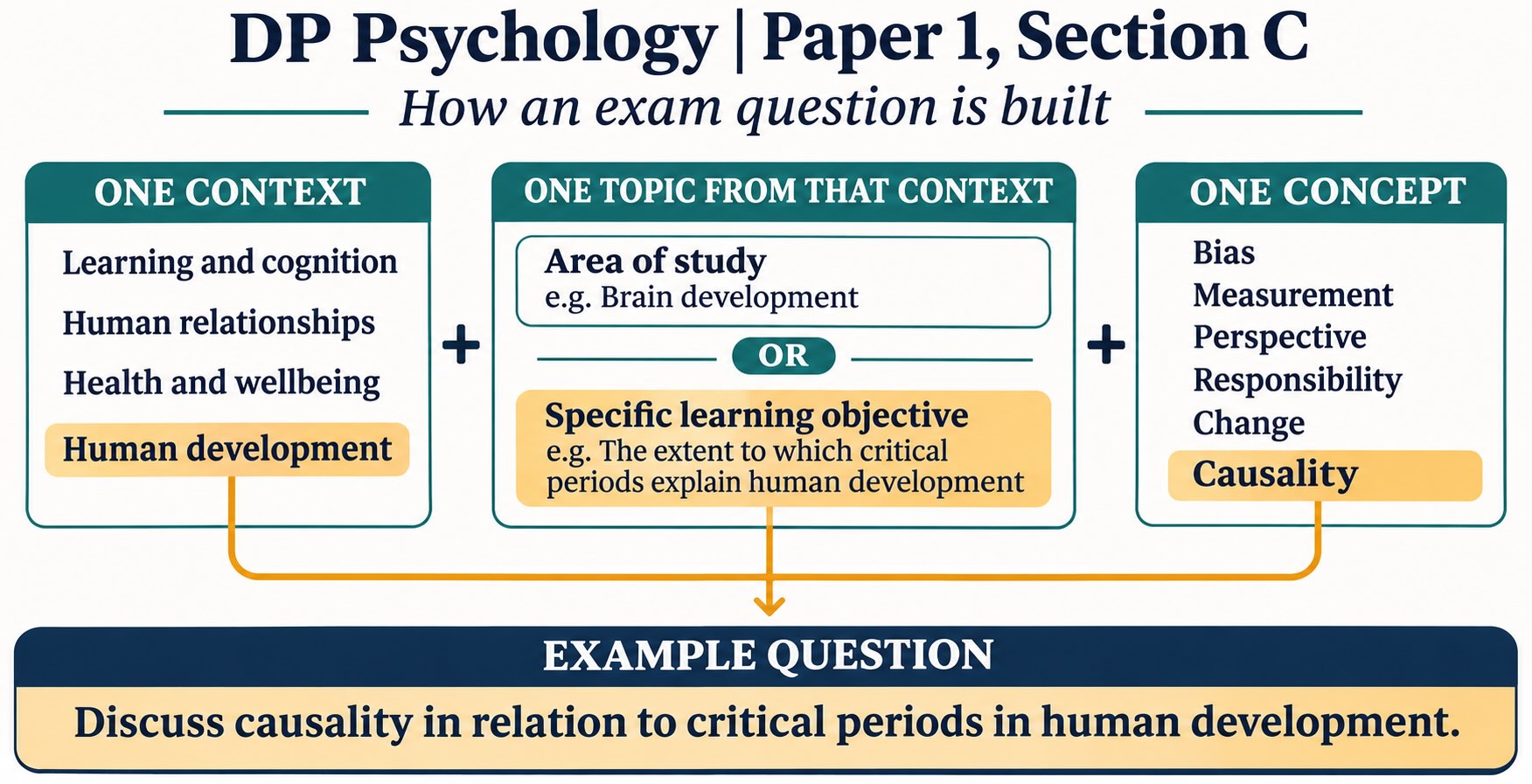
The questions below show the range of content that may be tested in Paper 1, Section C. Each exam question pairs an area of study or a specific learning objective from one of the four contexts with one of the six concepts.
Prepare all the content listed below across the four contexts. If you skip a context such as human development and one of the exam questions draws on it, students may have only one question they are prepared to answer.
One or more biological explanations of one mental health disorder.
The value of cognitive models in understanding one or more mental health disorders.
Prevalence rates for mental health disorders (this may be asked as differences within a population or between populations).
Cultural differences in approaches to mental health
The role of one or more environmental factors in one mental health disorder.
The effectiveness of one or more biological treatments of one mental health disorder.
The effectiveness of one or more psychological treatments of one mental health disorder.
The role of stress in health problems
The role of social learning in health problems
Prevalence of one or more health problems: why does prevalence change; why might there be differences between populations?
The effectiveness of one or more prevention or treatment strategies for one health problem.
The role of one or more chemical messengers in interpersonal relationships
One or more cognitive explanations of interpersonal relationships
The role of communication in interpersonal relationships
One or more strategies for improving interpersonal relationships
One or more biological factors in one or more cognitive processes
One or more cognitive models to understand one cognitive process.
The role of one or more cultural factors in one cognitive process.
The role of one or more environmental factors on one cogntiive process.
One or more strategies for improving a cognitive process.