P1B: Confirmation bias

The following sample focuses on the learning objective: The role of confirmation bias in decision-making.
You will need to show knowledge and understanding of confirmation bias and apply this specifically to the scenario.
The question
Lee is choosing between two apartments to rent. Apartment A is the one she prefers. It is near shops, restaurants, cafés, and public transport, which are important to Lee because she likes to go out and doesn’t drive. Apartment A also has a lot of traffic noise, and is smaller and more expensive than their second choice, Apartment B. However, they don’t think that’s important because Apartment B is a 20-minute walk from the nearest metro station and has only one small café nearby, though it is near a good supermarket.
When Lee looks at the photos of Apartment A that the agent has online, they see it would be perfect for them, and the excellent location makes it a little more expensive. They also believe the camera angle makes the apartment look smaller than it probably is. The more they read the agent’s details about Apartment A, the more they feel it is the one for them. They don’t read any more about Apartment B, and they decide to rent Apartment A.
Question: Explain the role of confirmation bias in Lee’s decision-making.
Sample response
Lee’s decision to rent Apartment A can be explained by confirmation bias. Lee already thinks that being close to the places they need is really important, so they focus more on the information that supports choosing Apartment A. Even though they read the details several times, they ignore some of the problems. For example, they tell themselves that the high rent is worth it because of the location and that the apartment only looks small because of the camera angle.
At the same time, Lee focuses more on the problems with Apartment B. They mostly ignore that it is bigger and cheaper, and that there is still a supermarket and café nearby. This shows confirmation bias because Lee pays more attention to the information that supports the choice they already want to make.
Why does this earn top marks?
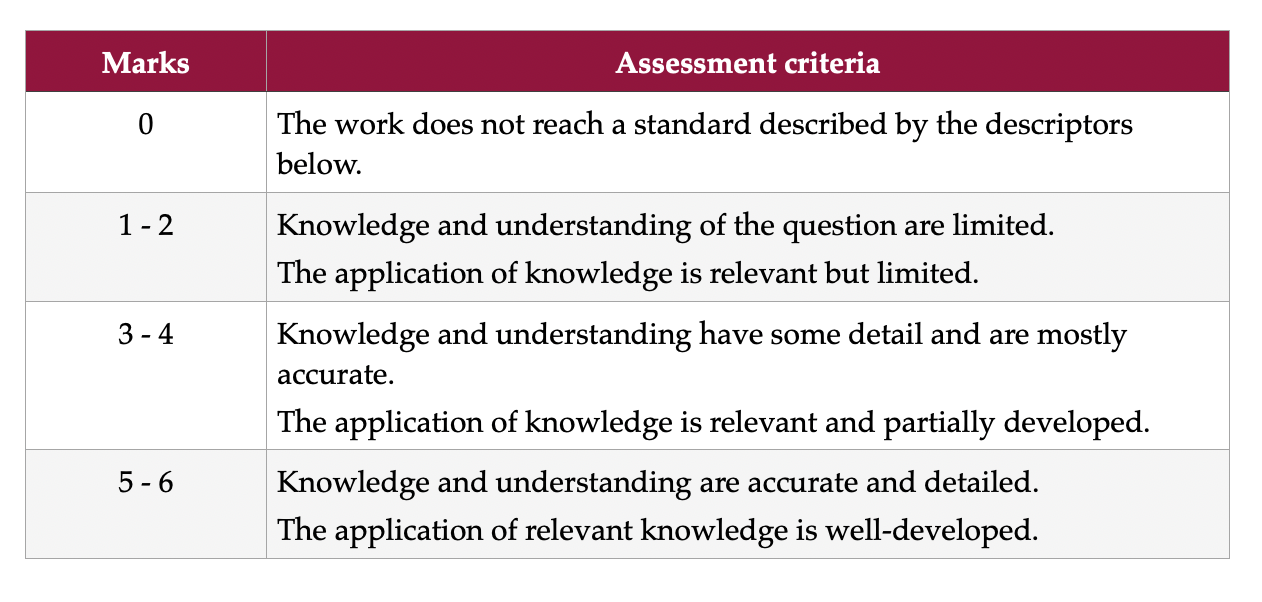
This response would earn 5–6 marks because it meets both parts of the top-band descriptor: accurate and detailed knowledge and understanding, and well-developed application to the scenario.
Knowledge and understanding: The response demonstrates accurate and detailed knowledge by identifying the mechanism by which confirmation bias operates: selective attention that confirms existing beliefs.
Application: The application is well-developed. The student shows not only how Lee focuses on the positive details of Apartment A, but also how Lee ignores the drawbacks, minimizing or justifying them to confirm their beliefs. The response also shows how the student ignores Apartment B's positive aspects and reads its details only briefly to focus on Apartment A.