Inquiry: Globalization and mental health

The following inquiry lesson asks students to explore the role of globalization on mental health. This also has a link to acculturation. This lesson focuses less on content and more on thinking about research. A key focus of the lesson is to consider how the role of cultural factors, such as globalization, are measured and how bias may affect the interpretations of the research.
Provocation

Start by showing students the first slide. Give them time to discuss their ideas.
Then go to slide 2. Potential answers to the question are listed below. The key is to get them to think about why it would be difficult to measure whether the disorder “spread” or whether there was simply a change in how and how frequently the disorder was diagnosed.
Potential responses
- Historical prevalence: Were people experiencing the same symptoms 20 or 30 years ago, even if they weren't diagnosed?
- Diagnosis rates over time: Has the number of diagnoses increased? Does this reflect more cases or more people seeking help?
- Changes in diagnostic criteria: Have doctors broadened the definition of the disorder, meaning more people now qualify for a diagnosis?
- Public awareness campaigns: Has increased awareness encouraged more people to recognize symptoms and seek treatment?
- Changes in risk factors: Have factors associated with the disorder, such as economic insecurity, social isolation or exposure to certain media, become more common?
- Healthcare access: Have more psychiatrists, clinics or screening programs become available, making diagnosis more likely?
Teaching

Students should use this presentation to guide their inquiry globalization and mental health.
There is definitely a change in the culture of depression in Japan, but it is brought about by several factors. Note that although Western influence may have given the Japanese a different understanding of mental health, many of the factors that drive depression are part of a long Japanese tradition - e.g., the culture of overwork that began in their economic recovery after World War II.
Inquiry: The globalization of mental illness

After you have shown the presentation on depression in Japan, divide the class into teams of 3 - 4 students. Each group should choose one of the mental and physical health problems below to investigate.
 Student task sheet: Globalization, health, and wellbeing
Inquiry questions
- Has globalization increased eating disorders, or made existing problems more visible and more likely to be diagnosed?
- Is hikikomori a uniquely Japanese phenomenon, a condition spreading through globalization, or a pattern of withdrawal that different societies classify differently?
- To what extent has globalization contributed to the worldwide increase in obesity?
- Has the globalization of gaming increased problematic gaming, or are we increasingly medicalizing certain behaviors?
- Is ADHD becoming more common, or are Western diagnostic frameworks being applied more widely?
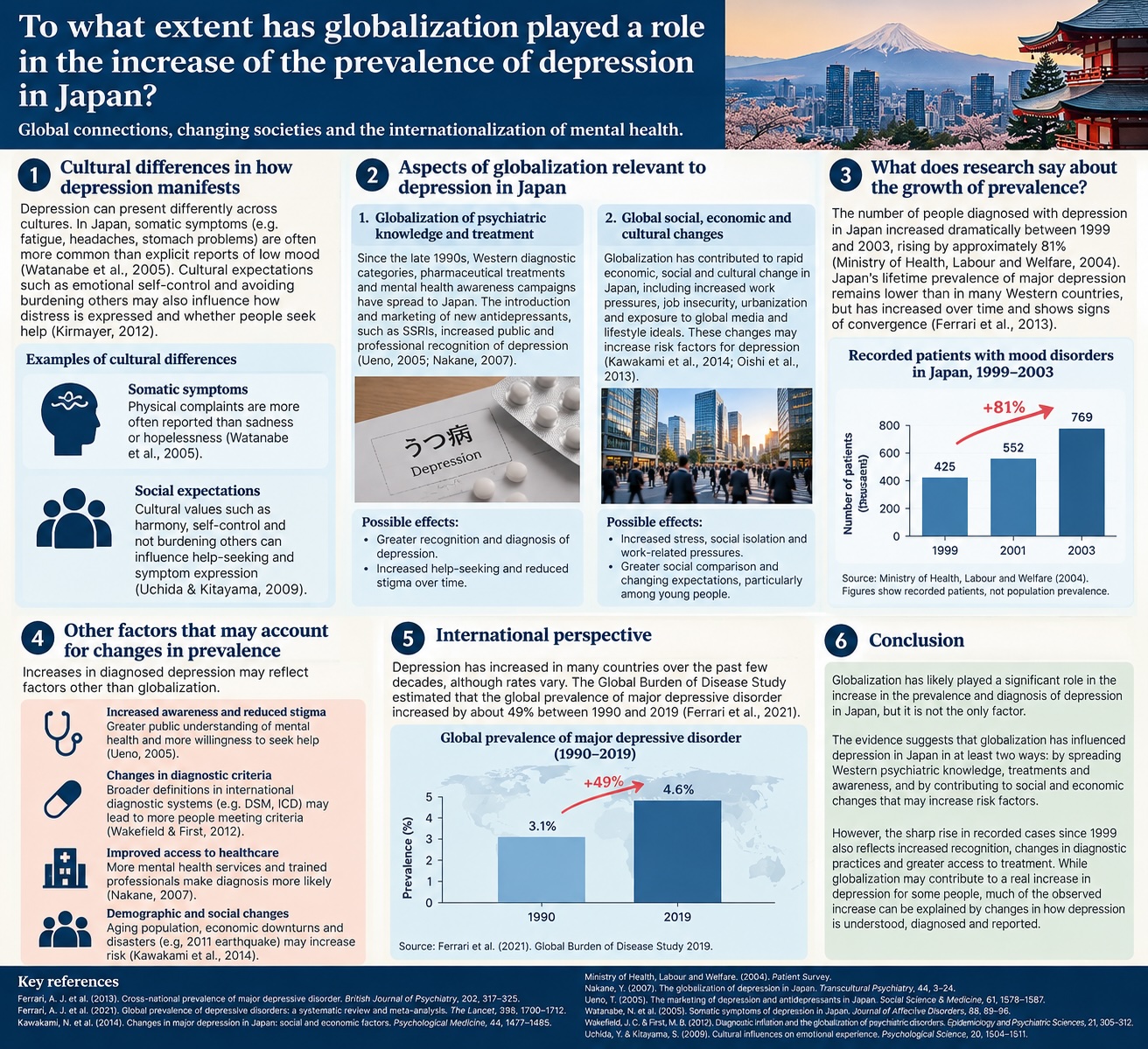
Students should produce a scientific poster that outlines their findings (with citations) to the following questions.
- Are there cultural differences in how the disorder or health problem manifests?
- Which aspects of globalization may be relevant to the disorder?
- What does research say about the growth in prevalence of the disorder in one specific country?
- What may account for change in the prevalence of the disorder besides globalization?
- What does research say about the growth in prevalence of the disorder internationally?
- What conclusion can you draw about whether globalization plays a role in an increase in the disorder?
Here is a sample of what a student may produce, based on the example of Japan and depression.
Teacher tip
To keep students from simply asking AI to create the poster, students should work together in a shared document. By reviewing the document's history, you can see their progress over time. Once they finish answering the questions, AI may be used to create the final poster. They could also use programs like CANVA, but AI would be less time-consuming.
Once all of the posters are completed, I have students do a gallery walk and discuss what they have learned.
Measuring globalization
This final activity asks students to focus on the concept of measurement with regard to globalization and to consider its role in establishing a causal relationship.
Potential answers for Slide 2
Question: What relationship appears to exist between globalization and depression?
There appears to be a positive correlation between globalization and the increase in reported depression rates.
- Country A has the highest globalization index (85) and the largest increase in reported depression, from 5% to 14%.
- Country B has a moderate globalization index (60) and a smaller increase, from 5% to 9%.
- Country C has the lowest globalization index (30) and the smallest increase, from 5% to 6%.
This suggests that countries with higher levels of globalization have experienced larger increases in reported depression.
However, this is a correlation, not necessarily a causal relationship.
Potential answers for Slide 5
Question 1: Does the original relationship between globalization and depression still appear convincing?
No, the original relationship is much less convincing. The original figures suggested that more globalized countries had higher rates of depression. However, standardized surveys reveal that depression prevalence is relatively similar across the three countries, with the least globalized country actually having the highest estimate.
This suggests that differences in measurement and reporting may have contributed to the original apparent relationship. However, the new figures do not tell us whether globalization has increased depression over time. To investigate that, we would need comparable prevalence data from earlier years.
Question 2: What may account for the differences?
Country A's reported rate (14%) is much higher than the standardized survey estimate (8%). Country A is highly globalized, and several factors could explain the difference:
- Greater awareness: International mental health campaigns may encourage more people to recognize and report symptoms of depression.
- Different diagnostic methods: The original reported figure may include people experiencing depressive symptoms who do not meet the criteria for a clinical diagnosis.
- Overrepresentation of certain groups: The original data may come from groups more likely to report symptoms, rather than a representative population sample.
- Changing diagnostic practices: The international spread of psychiatric knowledge may influence how depression is identified.
Globalization may increase the recognition and reporting of depression without necessarily increasing its actual prevalence.
Country C's standardized prevalence estimate (9%) is higher than its recorded rate (6%). Country C is less globalized, with limited mental health services and lower awareness of psychiatric diagnoses.
Possible explanations include:
- Limited healthcare access: Many people experiencing depression may never see a mental health professional.
- Stigma: People may be reluctant to seek treatment or disclose psychological difficulties.
- Cultural differences: Depression may be expressed through physical symptoms such as fatigue or headaches, which might not always be recognized as depression.
- Underdiagnosis: Healthcare professionals may have fewer opportunities for specialist training or access to diagnostic tools.
Lower recorded rates do not necessarily mean lower actual prevalence. They may reflect differences in recognition, healthcare access, and reporting.
Assessment

The following Paper 3 is based on the topic of globalization and mental health.
 Globalization and mental health