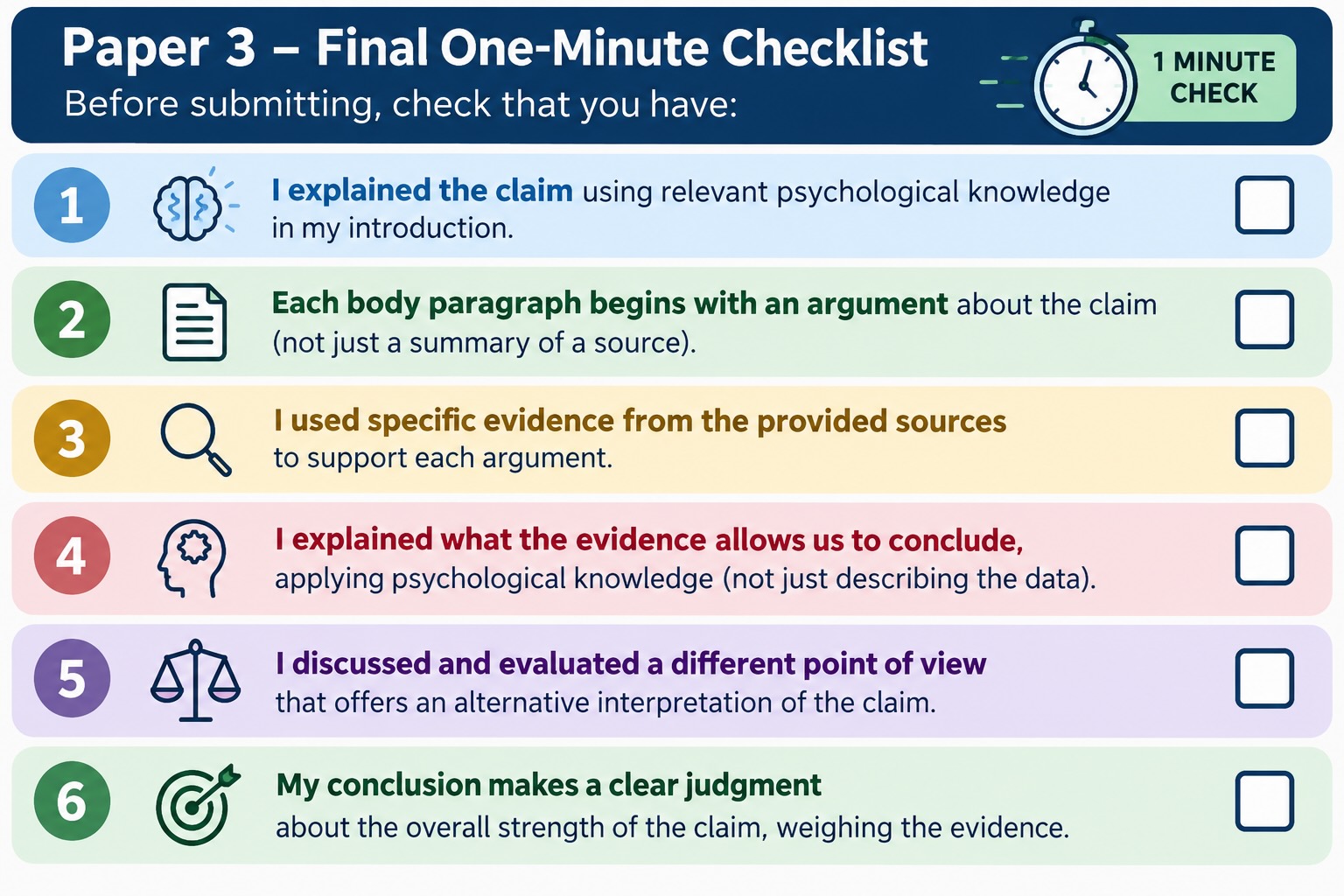
Tips: Paper 3

Below you will find advice on how to answer the questions for Paper 3. Remember, the goal of this paper is to use research findings to discuss a claim with regard to culture, technology, or motivation.
It is recommended that you spend a maximum of 10 minutes on question 1, 15 minutes each on questions 2 and 3, and then the remaining time on question 4.
8 Tips for Success on Paper 3
- Q1: Be specific when identifying problems with graphs. Don't simply state that a graph has poor labels or an inappropriate scale. Identify exactly what is wrong and explain how it affects the interpretation of the data. Focus on the graph itself, not general limitations of the research methodology (e.g., don't write about sample size or the ability to generalize the findings!)
- Q2: Explain what the data tells us about the claim. Don't simply describe patterns or compare statistics. Explain their significance. For example, a larger interquartile range (IQR) indicates greater variability, which may suggest that an effect is not consistent across participants.
- Q2: Always include a clear final conclusion. Even if conclusions are made throughout the analysis, a final conclusion is still expected. It should explicitly address the claim and explain the extent to which the data supports it.
- Q3: Apply research concepts directly to the source. Avoid generic explanations of how to reduce bias or improve credibility. Explain specifically how a proposed strategy would address an issue in the source and why it would improve the quality of the research.
- Q4: Use psychological knowledge to help evaluate the claim. Relevant theories, research methods, studies, and concepts can strengthen the discussion. However, knowledge should be used to explain or evaluate the evidence, not simply to demonstrate what is known about psychology. Detailed descriptions of studies are unnecessary.
- Q4: Analyze the evidence rather than summarize the sources. Explain what a source allows us to conclude about the claim. Consider the strength of the evidence, possible alternative explanations, and what cannot reasonably be concluded. Methodological strengths and limitations should only be discussed when they affect the interpretation of the claim.
- Q4: Make connections between sources. Don't evaluate each source in isolation. Identify where the sources support or contradict one another and explain how these relationships influence the overall strength of the evidence. Strong responses use the sources collectively to reach a judgment. (See tips for organization below)
- Q4: Identify and evaluate different points of view. Different points of view are not simply arguments for and against the claim. Consider how the claim might be interpreted differently depending on the population, context, or circumstances. Explain the value of these alternative perspectives rather than merely identifying them.
Suggested paragraph structure
There is no required structure for the response to question 4 on Paper 3. But what you want to avoid is summarizing and evaluating each of the sources. This is not the goal of the assessment.
The following structure will help you to meet the assessment requirements.
Paragraph 1. Introduction
Demonstrate your psychological knowledge by explaining what the claim means, identifying relevant concepts, and establishing the issue being debated.
End with a preliminary judgment about the strength of the claim.
Possible opening: “The claim suggests that… This can be understood through the psychological concept of… Although there is evidence supporting this relationship, a key weakness of this claim is…”
Paragraph 2. First analytical argument: Support for the claim
Begin with a topic sentence that directly addresses the strength of the claim. "The claim is supported by evidence suggesting that…"
Explain how evidence from one or more sources supports the claim. Apply relevant psychological knowledge to interpret the evidence, then evaluate how convincing it is.
Finish by explaining what this evidence allows us to conclude about the claim.
Paragraph 3: Second analytical argument: Challenging or qualifying the claim
Begin with a topic sentence that evaluates the claim rather than simply introducing another source.
"However, the claim is limited by evidence indicating that…"
Use evidence from the sources to challenge, qualify, or identify uncertainty about the claim. Consider relevant methodological or conceptual issues, such as correlation versus causation, confounding variables, or conflicting findings.
Explain how this evidence changes the strength of the overall argument.
Paragraph 4: Different point of view
Introduce an alternative interpretation or explanation of the claim. "An alternative perspective is that the relationship described in the claim may depend on…"
Consider whether the claim applies differently across populations, cultures, situations, or other conditions. Use the sources and psychological knowledge to explain and evaluate this perspective.
Finish by explaining how this alternative viewpoint affects the extent to which the claim can be accepted.
Simply describing the claim as reductionist, deterministic, or based on correlational evidence is not a different point of view.
Paragraph 5: Conclusion: Make an overall judgment
Answer the question directly: How strong is the claim? Weigh the supporting and challenging evidence, acknowledge the importance of the alternative perspective, and explain the conditions under which the claim is most convincing.
Analytical arguments vs. Point of view
Analytical arguments and different points of view are not the same thing.
- Analysis: The evidence is predominantly correlational, limiting the strength of the causal claim. This evaluates the quality of the evidence.
- Different point of view: Rather than technology directly causing poorer mental health, individuals experiencing psychological difficulties may be more likely to engage in certain forms of technology use. This offers an alternative interpretation of the relationship.