The trials that quietly changed our lives

If you visit the Financial Times online and sign up your students and yourself for free access to FT articles, you will find plenty of discussion on all matters psychological. This month's blog is based on an FT article on randomized controlled trials (RCTs). This is a very good example for teaching students about measurement, causality, and responsibility in psychology.
Randomized controlled trials
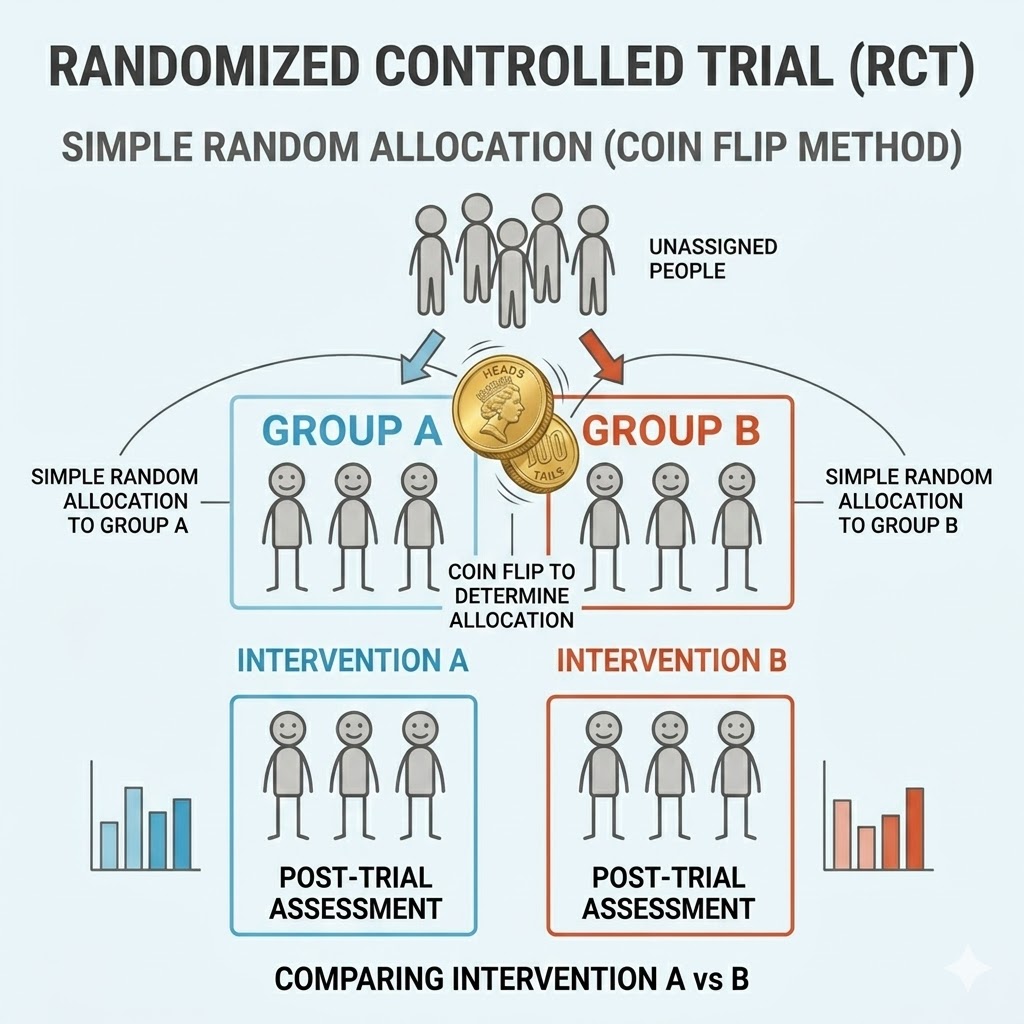
Randomized controlled trials (RCTs) are a type of scientific experiment used to test whether a treatment, program, or intervention truly causes a particular effect. In an RCT, participants are randomly assigned to different groups, usually an experimental group that receives the treatment and a control group that does not. Because the groups are created by chance, researchers can be more confident that any differences in outcomes are caused by the treatment itself rather than by other factors. RCTs are widely used in medicine, psychology, education, and social science because they are considered one of the most reliable methods for studying cause and effect.
The article explains the use of randomized controlled trials to test not just drugs, but almost anything. Students should click on the link to read The trials that quietly changed our lives, and then go to the school psychology class article to answer the questions. The questions and answers are, as usual, below.
Questions
- In the first paragraph, the author describes a randomized controlled trial (experiment). Identify the independent variable, the dependent variable, and one characteristic that shows this is a true experiment and not a quasi-experiment.
The independent variable (IV) was the type of glass used: toughened or regular. The dependent variables (DVs) were the level of violence and the number of injuries resulting from “glassings.” Initially, the study focused only on injuries, but it later showed a reduction in the number of attacks as well. Because participants were randomly allocated to the IV conditions, this was a true experiment, although there were still many extraneous variables.
2. Find one other example of a randomized controlled trial in the article and describe it.
Here are two possible examples:
- In the late 1940s, researcher Austin Bradford Hill investigated the use of streptomycin to treat tuberculosis. He randomly allocated patients to either a treatment group or a no-treatment group in order to test the effectiveness of the new antibiotic.
- In the 1950s, army doctor Thomas Chalmers randomly assigned recovering hepatitis patients to two groups: one followed the traditional prescription of two months of bed rest, while the other rested as they wished. The study tested the common belief that long periods of bed rest were necessary for recovery. Chalmers found that bed rest made no difference to the speed of recovery.
3. Give one example of how randomized controlled trials have benefitted a certain group of people through policy or practical changes.
The studies described above benefited people suffering from tuberculosis and hepatitis by improving understanding of effective treatments and recovery methods.
The domestic violence experiment benefited victims of domestic violence by helping researchers identify more effective interventions and responses.
The checklist developed for use by police at immigration checkpoints benefited both suspected terrorists and the police. Suspects were treated more fairly, reflecting the principle that individuals are innocent until proven guilty, while police officers received greater cooperation from interviewees.
4. Quantitative measurement begins with operationalizing variables, which means defining them in measurable terms. In the study into the effectiveness of domestic violence responses by police, what was the dependent variable that was operationalized and measured?
5. What were the three randomly allocated groups that were used in this trial?
The three groups (3 manipulations of the IV) were giving advice, sending the perpetrator of the violence away for a cooling-off period, or arresting them.
6. The author stated that “In drug trials, random assignment ensures that other influences – such as age or severity of illness – are spread evenly across the groups, giving more confidence that any difference in outcome is due to the drug.” Many researchers would claim that this statement is too positive about the benefits of random assignment. (See some of the comments below the article for examples of this.) Why might they claim that?
The laws of probability still apply when participants are assigned randomly. Just as a coin flipped 10 times may land on heads 7 times, a small trial may, by chance, result in one group containing 70% of participants who are older than the average age, many more women, or more people with severe illnesses. This type of “randomization failure,” or imbalance between groups, becomes less likely as the sample size increases.
7. Finally, while randomized controlled trials have many strengths, they also pose challenges when it comes to the researcher's responsibility. What are some of these challenges?
Participants in the control group, or the placebo group in drug trials, do not receive the benefit of the active treatment. Therefore, they may experience physical or psychological harm by omission. Although participants should be informed of this possibility before the trial begins, the risk of harm still raises ethical concerns. In many studies, once the experiment is complete and the treatment has been shown to be effective, researchers offer the treatment to participants in the control group as well.
Researchers may also face ethical dilemmas during a trial. For example, if evidence emerges halfway through a study that a new drug is saving lives, researchers must decide whether to continue the trial in order to obtain more reliable scientific data or to stop the study early so that the placebo group can receive the treatment.
The best-controlled studies are double-blind trials, in which neither the researchers nor the participants know who is receiving the active treatment. While this strengthens the internal validity of the findings, it can also create stress for participants, particularly those with serious illnesses, who may worry about whether they are receiving effective treatment.
Sometimes the side effects of the drugs may reveal which participants are in the experimental group. Researchers must then take care not to allow this “unblinding” to bias their observations or interpretations.
Researchers also have a responsibility to protect vulnerable populations, such as children, pregnant women, and older adults. However, excluding these groups from trials means there is often limited data about how treatments affect them, creating another important ethical dilemma.
References
Langley, B., Ariel, B., Tankebe, J. et al. (2021). A simple checklist, that is all it takes: a cluster randomized controlled field trial on improving the treatment of suspected terrorists by the police. Journal of Experimental Criminology, 17, 629–655. https://doi.org/10.1007/s11292-020-09428-9
Pearson, Helen (18 April 2026). The trials that quietly changed our lives. Testing claims matters more than ever in an age of misinformation, overconfident assertions and unsubstantiated opinions. Financial Times online, Accessed 10 May 2026 at https://www.ft.com/content/9b8eebc6-ed76-41cf-bc46-a1ef84613218
Sherman, L.W. & Berk, R.A. (April 1984). The Minneapolis domestic violence experiment. Washington, DC: National Policing Institute. https://www.policinginstitute.org/publication/the-minneapolis-domestic-violence-experiment/