Introducing research methods

While only HL students will sit the Paper 3 exam on data interpretation and analysis, all students need to be able to recognize, describe, and evaluate research methods across the four contexts. A suggestion is that for your introduction to research methods, focus on the four methods used in the class practicals and to answer questions on Paper 2, Section A.
Class practical research methods
- Experiments (true and quasi)
- Observations (naturalistic vs controlled; overt vs covert; participant vs non-participant)
- Surveys/questionnaires
- Interviews (structured, semi-structured, focus group)
Starting with the experimental method will allow students to make links between psychology and their science subjects. It is also the recommended method for the Learning and Cognition class practical, and this is the context that many of you will teach first. To avoid it being tedious for you all, have the students role-play the research methods.
True experiment
Split the class randomly into two and conduct a simple true experiment. An example could be memory for twenty unsorted words compared with twenty words sorted into several categories. Allow students to keep their answer sheets to analyse the data afterwards.
Give the key vocabulary and definitions: quantitative research, qualitative research, mixed methods, aim, hypothesis, independent measures design, independent variable, dependent variable, controlled variables. Working together or in small groups, the students should identify each of these for the experiment they have just done.
Quasi-experiment
Once you have explained the quasi-experimental method, ask students how they could take the unsorted words sheet and test memory for that by splitting the sample using a specific criterion in order to compare two groups. Let them come up with a relevant criterion (age, or coffee drinkers vs. non-coffee drinkers are the obvious ones).
Suggested questions to reinforce understanding:
- Were these examples of qualitative or quantitative research?
- How have the aim, hypothesis, independent and dependent variables changed between the true experiment and the quasi-experiment?
- Only the true experiment can claim to find a cause-and-effect relationship between the independent variable and the dependent variable. Why is that? (Students may need some help with this – they should think about the other things that age or coffee-drinking may affect apart from memory).
Other research methods
This can be repeated for the different types of observations, surveys/questionnaires and interviews. It ios up to you whether you do this now, or later, in each relevant context. There is no need to spend more than a double lesson on each at this stage. Students should be split into groups to role-play each method, as with the experiments. The vocabulary teaching and evaluation of each method follow the role-play. All data collected should be kept carefully for later analysis. You may prefer to teach about sampling techniques, research design and data analysis before moving on. If you do, the Experiment lesson plans will be helpful. Other research methods lesson plans will be available later in each context.
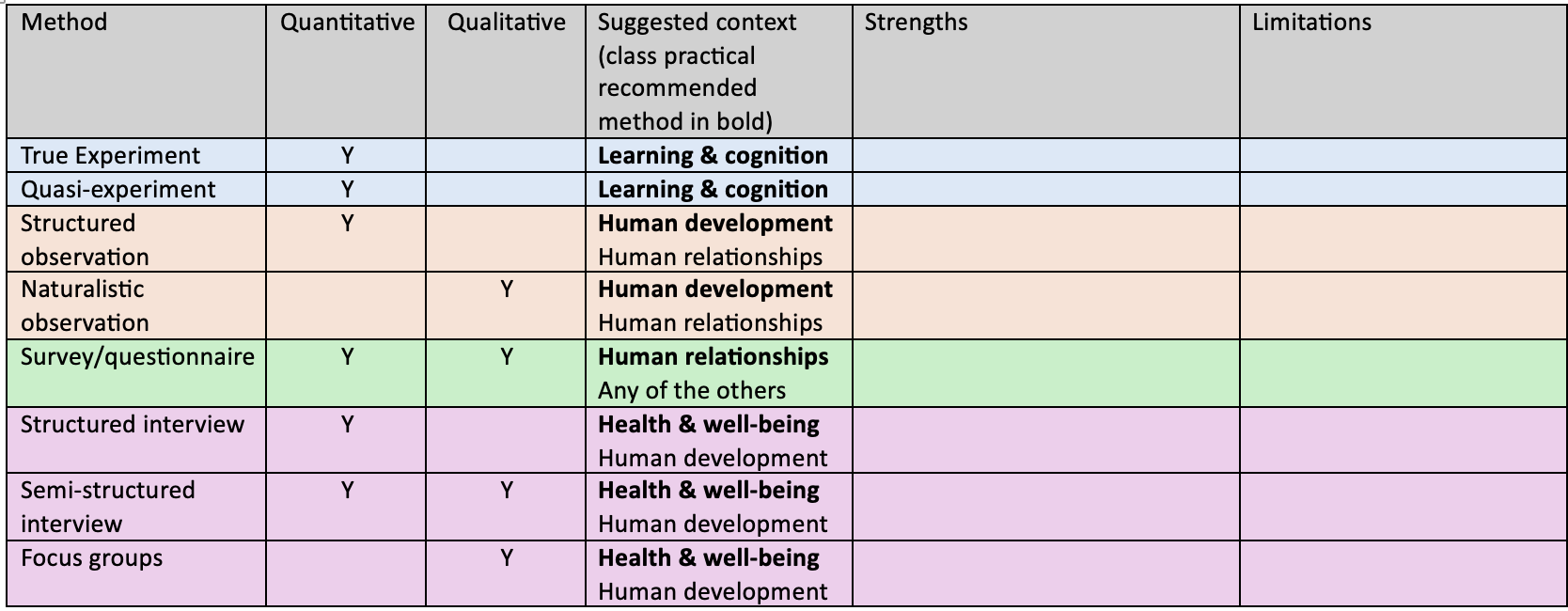
These are not, of course, the class practicals, but they are a taster of the challenges of conducting research. They can all be done within the classroom. At the end of one or two weeks of introduction to the methods, students should be encouraged to start completing the following table for their reference. I have completed some of the cells, but they could be given the table with just the method.
Upcoming post - Concepts and research methods

The next blog will give some ideas on how to integrate conceptual understanding with the research methods. This is just like the critical thinking that you may be more used to, but it helps to make it explicit to students. How is perspective relevant to the choice of methods, for example, or bias to the interpetation of data?