A concept-based curriculum
 Why a concept-based curriculum?
A curriculum based on concepts allows students to apply knowledge to unfamiliar situations and transfer learning from one context to another. Concepts like bias, measurement, and perspective were present in critical thinking in the previous course. Now, they are explicit in the new course as part of the learning framework. This is not extra content but a new approach that will free students from recalling many studies' details and allow them to focus on critical analysis and conceptual understanding.
Transfer of learning
Transfer of learning was first identified over a hundred years ago, and we have long accepted its use in everyday life. Every day, we transfer our cognitive and physical skills from one area to another. For example, if we can float, we can learn to swim, and if we speak two languages, the third one is usually easier to learn. The new psychology curriculum will help students to transfer learning between contexts and apply it to real-life scenarios. If psychology students understand how measuring human behavior is challenging when diagnosing a mental disorder (health and well-being), they can transfer this to understanding the difficulties of measuring conformity in group behavior (human relationships) and to critically analyzing media claims regarding research that is usually much more complex than a simplistic analysis suggests.
There is no prescribed way to apply concepts to the content or contexts, just as there was no prescribed way to use critical thinking in the previous curriculum.
Concepts are related to each other. For example, bias and measurement are both relevant to research methodology.
It is recommended that three to four relevant concepts should be selected when studying each context. There is no need to explicitly teach all concepts for a context. (Adapted from the Psychology Guide, p 20) As students develop competence in applying the six concepts, they should be able to transfer that learning to a discussion of any topic in psychology.
Examples from learning and cognition
| Concept | Content | Area(s) of study | Discussion question(s) |
| Bias | Cognitive approach | Cognitive biases in decision-making | Within the context of learning and cognition, to what extent do one or more cognitive biases affect our decision-making? |
| Bias | Research methodology | Cultural factors in cognitive processes | Research into cognitive processes using WEIRD (Western/white, educated, industrialized, rich, democratic) participants has been identified as biased. To what extent can such studies' methods and/or results be generalized to other populations? |
| Measurement | Research methodology | Methods used to measure cognitive processes | The measurement of one or more cognitive processes is often done through a controlled experiment. What are the issues of measuring a daily cognitive process with a true experiment? |
| Change | Cognitive approach | Operant conditioning and changing behaviour | What is the role of reinforcement in changing behavior? (This question pulls together what the two theories have in common and is a good discussion point that will also help HL students when they investigate motivation to change behavior.) |
| Social learning and changing behaviour |
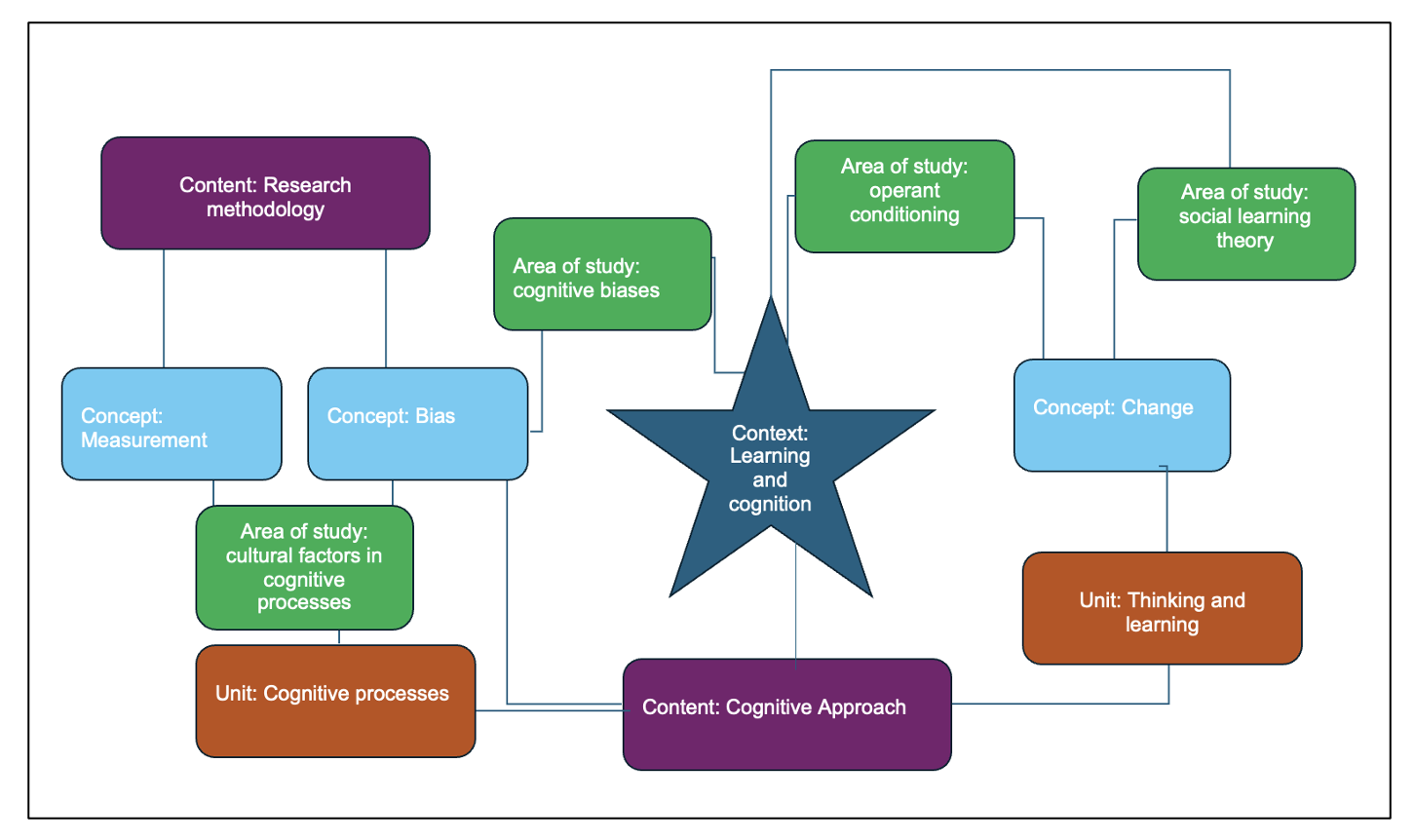
Looking at the diagram above, we can ask students to start with the concept of bias and explain how research into one cultural process is biased. This could be explored in the assumption that the cognitive process is universally experienced in the same way. This leads to inappropriate methods and materials being used in cross-cultural research that lead to research findings that lack internal validity. They could then investigate how this affects measurement. Encourage students to make their own relevant links, starting where they like on the chart.
This type of investigation into the concepts can be repeated for all contexts and will lead students to a deeper psychological understanding of the connections between contexts, content, and concepts.
Upcoming post

The next blog post will explore the role of the learning objectives for the biological, cognitive and sociocultural approaches. We will also ask why it is important to integrate the three approaches with the contexts rather than have them as a stand-alone core as they were in previous curricula?