Think-Ins
 What are Think-Ins?
Think-Ins are focused, three-hour online seminars exploring specific aspects of IB education. They provide an opportunity to share ideas, engage in professional dialogue and explore practical strategies that can be applied directly in your school.
Designed to be interactive, discussion-based and purposeful, Think-Ins offer a focused and productive use of your professional learning time.
Most sessions take place at 14:00 CET, making them accessible to colleagues across different time zones. Numbers are limited to 20 participants to encourage active participation and meaningful discussion.
All participants receive an InThinking certificate of participation.
Please note: Think-Ins are independent professional learning opportunities and are not IB-certified professional development.
Think-Ins taking place in November 2026
Focus On: IB Teaching – A Practical Guide for Teachers new to the IB
20 November 2026 – 14:00 CET. Click HERE to register.
Focus On: Writing a programme development plan
23 November 2026 – 14:00 CET. Click HERE to register.
Focus On: Essential strategies for a successful IB evaluation visit
24 November 2026 – 14:00 CET. Click HERE to register.
Focus On: Preparing for IB Authorisation, from requirements to readiness
25 November 2026 – 14:00 CET. Click HERE to register.
Descriptions of each Think-In
Think-In blurbs in detail below
Focus On: IB Teaching – A Practical Guide for Teachers new to the IB
Facilitator: Chris Wright
Length 3 hours over 1 day
Are you new to teaching the International Baccalaureate (IB)? Or have you taught successfully in another system and are now wondering “What actually needs to change in my classroom?” Moving into IB teaching is not simply about learning a new curriculum. It involves rethinking how we plan learning, engage students and develop their thinking. This practical Think-In will help you understand what makes IB teaching distinctive – and, importantly, what this can look like in your classroom.
In this Think-In, you will: Gain a clear understanding of the IB approaches to teaching and what they mean for classroom practice .Explore practical ways to: Lead learning through inquiry rather than simply deliver content. Develop conceptual understanding rather than focus only on knowledge. Use context to make learning meaningful and relevant. Respond to individual learners and their different needs. Consider how to adapt what you already do rather than feeling that you have to start again. Leave with practical ideas.
Focus On: Writing a programme development plan
Facilitator: Chris Wright
Length 3 hours over 1 day
The goal of this Think-In is to discuss how to write an effective programme development plan in preparation for an IB evaluation visit.
This Think-In is designed to guide you through the process of crafting your IB Programme Development Plan. As you prepare for your five-year IB evaluation, you'll need to document a key area of programme development—highlighting what your school has focused on since your last evaluation or authorization. This inquiry is central to your self-study and is crucial for demonstrating how your efforts have impacted student outcomes. In this Think-In, we will introduce you to the IB evaluation requirements and offer practical guidance for developing a comprehensive programme development plan. Together, we will explore how to identify and select meaningful areas of improvement, plan and implement strategies that foster positive change, and reflect on the results to inform future development.
Session 1 will focus on identifying a subject for your programme development plan, and completing the goal, rationale, and impact sections of the plan.
Session 2 concentrates on the ideas behind programme development planning and will help you use the IB standards and practices to help you structure the plan.
Focus On: Essential strategies for a successful IB evaluation visit
Facilitator: Chris Wright
Length 3 hours over 1 day
Join this Think-In and gain actionable insights to ensure your school shines during its IB evaluation visit. First, we'll explore the core principles of IB evaluation, which focus on continuous improvement and reflective practice. Grasping these concepts is essential for cultivating a culture of excellence and accountability within educational institutions. Following that, we'll cover the practical elements of programme evaluation planning. This includes setting clear objectives, identifying key data sources, and involving stakeholders in the process. Thoughtful planning ensures that evaluations are thorough and aligned with the goals of IB programmes.
Session 1: Master the core principles of IB evaluation and learn how to guide your staff through the preliminary review with confidence.Identify key ideas behind IB evaluation, Review the timeline and process, Consider who to involve in the school – and how to plan, Getting key documents ready.
Session 2: Get fully prepared for the evaluation day, including team roles, expectations, and effective strategies to engage your colleagues. Review questions for the meetings you will have, Draft your school profile for the report, Manage the programme development plan.
Focus On: Preparing for IB Authorisation, from requirements to readiness
Facilitator: Chris Wright
Length 3 hours over 1 day
Are you preparing your school to become an IB World School? This practical Think-In will help you make sense of the authorisation journey and, importantly, turn IB requirements into a coherent plan for your school. Rather than treating authorisation as a process of completing documents, we will explore how to build genuine school-wide readiness — developing the understanding, leadership, policies, curriculum, professional learning and practices needed to implement the IB programme effectively.
The emphasis throughout will be on practical application: where are we now, what do we need to do next, and how will we know that we are ready?
The Think-In will help you to: understand the key stages of the authorisation process and what schools need to achieve at each stage, identify where your school is now and the areas that require the greatest attention, turn the IB Programme standards and practices into a practical school improvement agenda, develop a focused action plan with clear priorities, responsibilities, timelines and evidence, consider how leadership, professional development, curriculum, policies and resources need to come together, prepare staff and the wider school community so that authorisation becomes a shared endeavour rather than the responsibility of the coordinator alone, think ahead to the verification visit and the evidence that will demonstrate that the programme is genuinely embedded in the life of the school.
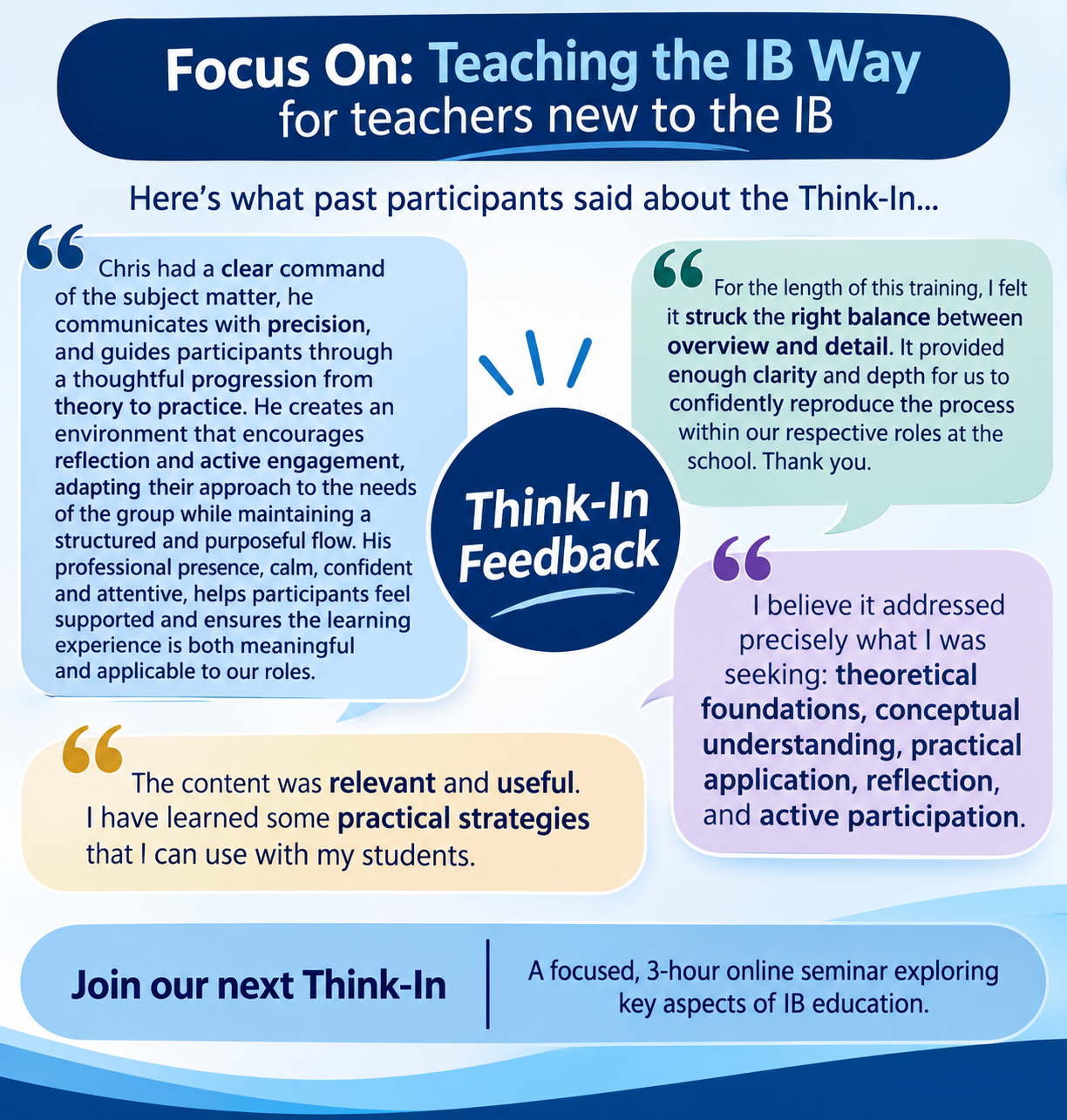
Feedback from previous Think-Ins