Integrating AI into IB teaching and learning: a guide for Heads and Coordinators
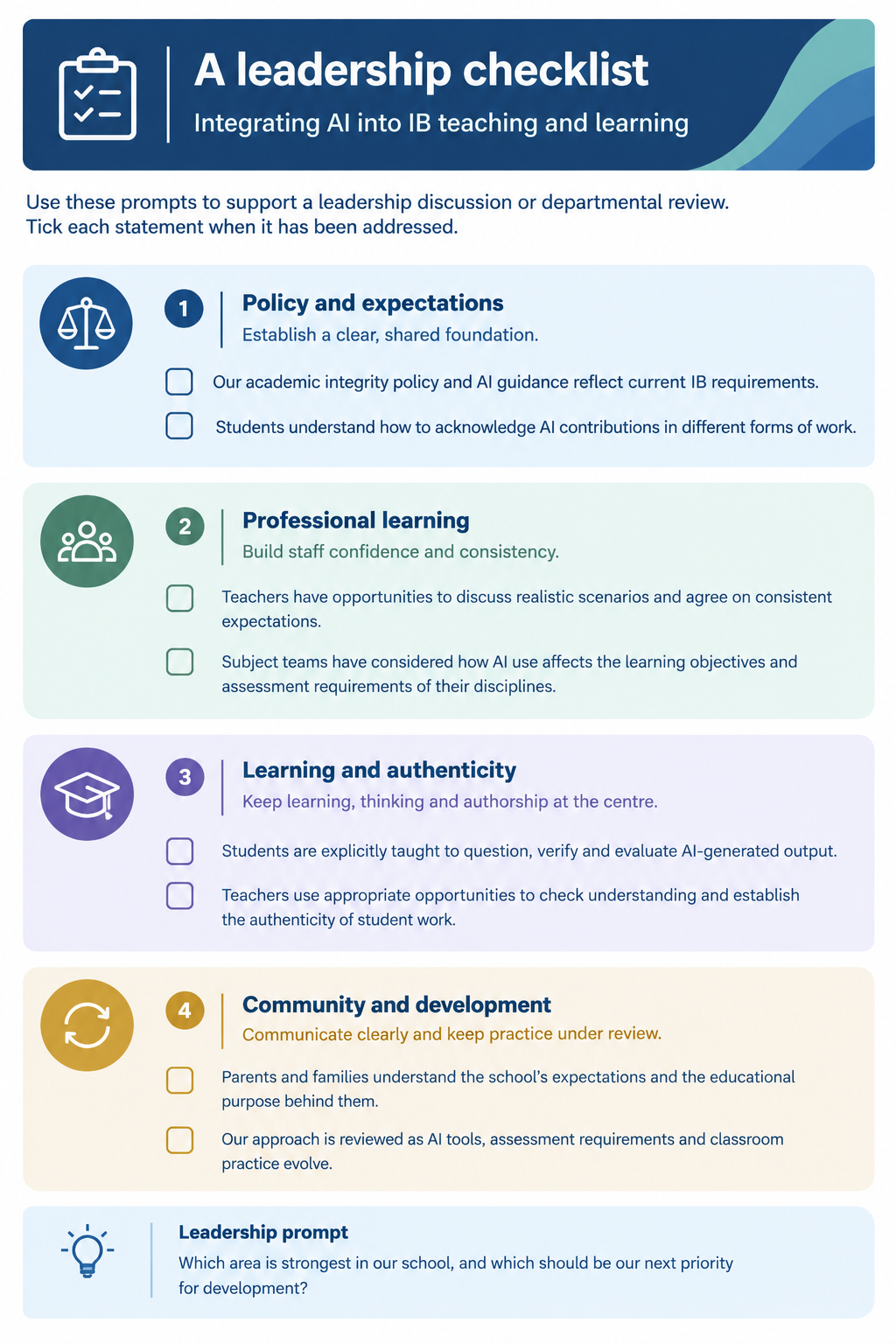
Moving from rules to responsible practice
Artificial intelligence is changing how students research, solve problems, write and develop ideas. For IB World Schools, the challenge is not simply to decide whether students may use AI, but to help them understand how to use it ethically, critically and effectively without compromising their learning or the authenticity of their work.
The IB's approach is one of critical and ethical engagement rather than a blanket prohibition. This creates an important leadership responsibility: schools need clear expectations, consistent practice and opportunities for students to learn what responsible AI use looks like across different subjects and assessment contexts.
This guide draws on work developed by Michael Brooke and Anna Dabska for the InThinking subject websites. It adapts the underlying principles for a Heads & Coordinators audience, focusing on how school leaders can translate academic integrity requirements into professional learning, classroom practice and a coherent whole-school approach to AI.
1. Start with the IB's expectations
Before developing classroom guidance, leaders and teachers should establish a shared understanding of the relevant IB requirements.
The IB's Academic integrity policy, particularly Appendix 6, explains that AI-generated material is not automatically prohibited. However, students remain responsible for their work and must acknowledge and cite AI-generated content appropriately. This includes text, images, ideas, code and other contributions.
Relevant resources on the IB Programme Resource Centre include:
- Academic integrity policy — the school's responsibilities, expectations and procedures, including guidance on AI.
- Evaluating 13 scenarios of artificial intelligence (AI) in student coursework — a useful resource for staff discussion and developing consistent judgements.
- Artificial intelligence: questions and concerns — the IB's explanation of its approach to AI tools.
- Subject guides and teacher support materials — guidance on authenticity, assessment requirements and the acknowledgement of AI-generated material in specific subjects.
Heads and Coordinators should check the current versions of these resources on the Programme Resource Centre and ensure that school guidance reflects the requirements applicable to the relevant assessment session.
2. Make expectations explicit before students begin
One practical approach is to introduce three foundational lessons, each lasting approximately one hour, during the first month of teaching. The sequence provides a useful model that can be adapted to different subjects and age groups.
Lesson 1:Understand the rules of engagement
Students explore the IB's position on AI, their responsibilities as authors and what constitutes authentic work. They practise acknowledging AI assistance through citations, references or other appropriate forms of acknowledgement.
Leadership question: Do students understand both what is permitted and what they are responsible for?
Lesson 2: Explore acceptable and unacceptable uses
Students examine scenarios involving AI assistance and consider how different uses affect authorship. They distinguish between using AI to explore possibilities, clarify understanding or generate feedback and relying on it to produce work that they are expected to complete themselves.
Leadership question: Can teachers explain and apply consistent boundaries across different tasks and subjects?
Lesson 3: Develop critical evaluation skills
Students investigate how generative AI can produce inaccurate, misleading or convincing but unsupported answers. They practise checking claims, testing suggestions against reliable evidence and verifying output rather than assuming that a fluent response is a correct one.
Leadership question: Are we teaching students to evaluate AI output, rather than simply use AI tools?
3. Establish a shared framework for AI use
A practical framework can help teachers and students discuss AI use with greater precision. Schools may find it helpful to develop a graduated scale that distinguishes between different levels of AI assistance, from exploring ideas and seeking explanations to generating material that risks replacing the student's own work.
The important principle for school leaders is that AI use should be judged in relation to the task, the learning objective and the assessment requirements, rather than treated as universally acceptable or unacceptable.
For example, asking AI to explain a difficult concept is different from asking it to produce an assessed response. Similarly, using AI to identify possible improvements to a draft is different from submitting AI-generated work as one's own.
When introducing a scale or classification system, schools should:
- Use subject-specific examples so that students understand the implications for different forms of work.
- Distinguish between permitted support, inappropriate assistance and work that no longer demonstrates the student's own learning.
- Explain how AI use should be acknowledged, including when it contributes ideas, content or other material.
- Revisit examples with staff to develop a shared understanding of the boundaries.
Any school-developed framework should be checked against current IB guidance and the specific requirements of the relevant assessment.