Developing collaboration

How do we develop collaboration in our team(s)?
“The most valuable resource that all teachers have is each other. Without collaboration our growth is limited to our own perspectives.” (Robert John Meehan)
“I can do things you cannot, you can do things I cannot; together we can do great things.” (Mother Teresa)
Collaborative working is at the heart of a professional learning community. It is also at the heart of the IB approach to professional learning. Research suggests that trust is an essential element of organizational culture that is both critical and routinely overlooked in creating and sustaining collaborative cultures. We look at some of the challenges of establishing a collaborative culture and the role school leaders play in establishing such a culture.
(Image source: Download Light Bulb, Team Spirit, Teamwork. Royalty-Free Stock Illustration Image - Pixaba)
Professional inquiry
- Why is trust so important in effective professional learning communities?
- How can we promote collaboration and effective teamwork?
- What are the causes of collaborative advantage and collaborative inertia?
- How can we build a climate of trust within our school?
WHY is collaboration so important?
This video (although the statistics are dated!) makes a good case for collaboration:
This visual represents the idea that it is important to collaborate and communicate effectively whilst viewing ideas from multiple perspectives. Collaboration develops empathy, depth of understanding and critical and creative thinking.

Watch this short extract from the documentary Collaboration:On the edge of a new paradigm. It is a documentary which explores how the internet is changing the ways we create knowledge, and how interdisciplinary collaboration is a requirement to face the grand challenges of today's society.
As you watch consider (a) the need for collaboration, and (b) why people resist collaborating.
Now read the following quotes which underline the importance of collaboration for teachers.
“…the best teaching emerges through the intentional collaboration of teachers united by a focused vision and flexible leadership. Such school communities are usually the ones most likely to retain those good teachers.” (Securing the 21st century teacher workforce: global perspectives on teacher motivation and retention, Edge et al., Wise, Qatar)
“The opportunity for participants to collaborate and learn together is critical to teachers’ development.” (Timperley et al., 2007, Professional learning and development: A best evidence synthesis iteration).
"Collaboration is about choosing the right people to work with, and then trusting them. You don't, however, have to agree about everything. Collaboration is sometimes finding the right way to disagree " (A Choreographer's Handbook" by Jonathan Burrow)
"I am a baseball fan (well actually a Toronto Blue Jays fan), but I tend to watch every baseball film, read a lot about baseball, which brought me to the following quote from Babe Ruth: “The way a team plays as a whole determines its success. You may have the greatest bunch of individual stars in the world, but if they don’t play together, the club won’t be worth a dime.” Working with so many different teachers of all the disciplines we can easily live in ‘silos’ and be working on or doing things in our classroom that everyone could benefit from hearing about. This quote is a call out to all those teachers working on independent projects to still share their findings, expertise – everyone learns from everyone. "(Leslie Miller)
WHAT does collaboration look like?

WHY is collaboration difficult?
The importance of building trust

“Establishing authentic human connection is essential for the trusted and respected leadership we need in our schools. How do we convey what American psychologist Carl Rogers calls ‘unconditional positive regard’?” (Liz Robinson, Speak from the heart (and the hand and head) Tes 14 June 2019 p38)
Although there may be pockets of high relational trust amongst groups of like-minded teachers research[1] suggests that many schools have weak levels of relational trust among the adults who work in them, with relationships between teachers and administrators being less trusting than relationships between teachers themselves.
This means that often teachers may have serious reservations about administrator-initiated change.
The graphic represents enablers and disablers of collaboration. Click HERE to find this graphic within the paper The essential guide to professional learning: Collaboration, AITSL (2017).
"Look up the word trust in your dictionary and you will find that it is both a noun, trust exists, and it's a verb, an action, I trust you. If you want to build trust with others remember this, the more of the verb we do, the more of the noun we get." (Kevin Eikenberry)
Learning engagement: The Collaborative Challenge
Watch the following two videos which explore the challenges of building trust and a collaborative culture.
Research suggests that there is a clear link between the individual, the team they work in, how they are led and their level of trust, to sustainable gains in productivity. In the report, Trust: the key to building well-being and performance in the workplace (2013), researchers identified eight key drivers for building trust throughout this chain. Employers need to consider all eight of these trust drivers to move towards optimal performance, researchers said. The drivers are:
- Belong and connect - The feeling that the employee feels part of and connected to their team and organization
- Voice and recognition – The individual’s ability to speak up in a way that allows them to influence decision making
- Significance and position – The employees sense that they have a clear and important role in their team
- Fairness – The understanding that individuals are evenly treated within their team and the organization
- Learn and challenge – The opportunity to learn and master new skills and achieve tangible results
- Choice and autonomy – The sense of control over workplace delivery
- Security and certainty – The sense of predictability and confidence in the workplace environment
- Purpose – The understanding of how an individual’s role contributes and is aligned to the team and organisation’s success.
Click here to access the full report.

Learning engagement: Drivers of trust
- What determines the level of trust in (a) an organization, and (b) in your school?
- Identify the drivers of trust. For each trust driver, consider the strategies for building trust and promoting collaboration.
- Are there any cultural factors that affect the trust drivers?
- What are the countervailing forces that we must overcome if a high trust climate is to be developed
- What is the role of leaders in developing a climate of trust?
- Do collaborative cultures suggest a more distributed leadership structure?
Learning engagement: IB Standards and Practices
This is an opportunity for you to review the IB Standard & Practices that focus on collaboration. It is often an area which schools find most challenging in providing evidence for.
 (Image source: Castellers Sport Team - Free photo on Pixaba) | PLCs: Core characteristics
|
WHAT is the role of the leader
"Creating, developing and sustaining a professional learning community is a major leadership and management task." (Creating and sustaining an effective learning community, Louise Stoll, Ray Bolam, Agnes McMahon, Sally Thomas, Mike Wallace,Angela Greenwood and Kate Hawkey, NCSL).
Developing collaborative cultures is the work of leaders. The leader has a key role to play in ensuring that collaborative working in professional learning communities succeeds over time. The leader needs to be seen to be an advocate for collaborative learning and actively supports the faculty in working in collaborative teams. The leader should also model the fact that they are a lifelong learner themselves, intellectually engaging themselves in professional learning experiences and articulating their professional growth.
In the following video Michael Fullan suggests that the leader should play the following three roles:
- Lead learner developing collaborative culture
- System player who creates network of learning
- Change agent who builds ownership
If you wish to explore these three themes in more depth Michael Fullan has written a helpful workbook, containing activities for a professional development session. It can be accessed by clicking here.
Professors Andy Hargreaves and Michael Fullan talk about the pedagogical leaders' role in developing professional capital. The original idea of capital comes from the economic sector - capital is something that adds value to net worth; f you want to get a return, you need to make an investment. Hargreaves and Fullan apply the term to the teaching profession and ask how we can add value to the professional capital in our staff rooms.
For a thought piece on professional capital click here.
Learning engagement
A longitudinal study Trust in Schools: A Core Resource for School Reform shows the central role of relational trust in building effective education communities. The report identifies four key aspects of trust to exist: respect, personal regard, competence in core role responsibilities, and personal integrity.
- Form four groups. Each group will brainstorm and write a strategy to achieve their chosen aspect as a leader.
- Each group rotate until they have had a chance to work at each aspect.
Learning engagement: The role of the leading in developing professional capital
- To what extent do the ideas of Michael Fullan and Andy Hargreaves resonate in your school?
- Do any of the ideas conflict with your own context?
- How are you developing professional capital within your school context?
- Review the leadership responsibilities as outlined below. What resonates with you? Which areas are your strengths and which areas for development?
- What does Hargreaves’ definition of professional capital tell you about your role as a pedagogical leader?
Leadership responsibilities (Image source: Download Ai Generated, Chess, Game. Royalty-Free Stock Illustration Image - Pixabay) |
|
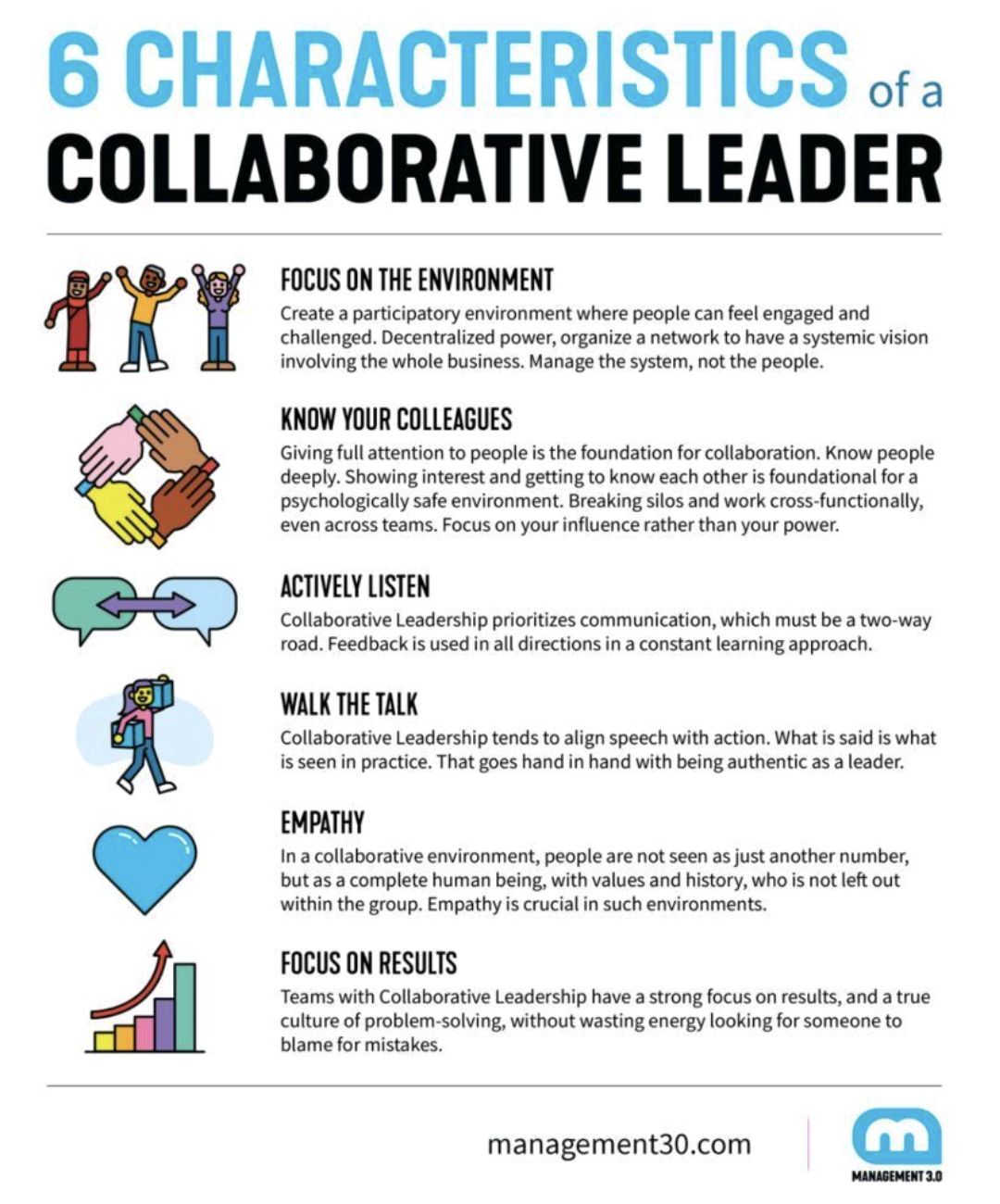
Read Collaborative Leadership: Engaging collective intelligence to achieve results across organisational boundaries - White Paper, Oxford Leadership, 2017.
Collaborative leadership is an increasingly vital source of competitive advantage in today’s highly networked, team-based, and partnership-oriented business environments. Yet few leaders have been trained to lead collaboratively, especially those at more senior levels who climbed the organisational ladder in a different era.
In this paper the authors describe key practices of collaborative leadership and identify critical leadership competencies associated with it, highlight common barriers and suggest next steps for companies interested in developing leaders who can collaborate to transform business for good. Their focus in this paper is on collaborative leadership of teams, but the same principles and practices apply to creating more collaborative cultures.
“By collaborative leadership, we mean the process of engaging collective intelligence to deliver results across organisational boundaries when ordinary mechanisms of control are absent. It’s grounded in a belief that all of us together can be smarter, more creative, and more competent than any of us alone, especially when it comes to addressing the kinds of novel, complex, and multi-faceted problems that organisations face today. It calls on leaders to use the power of influence rather than positional authority to engage and align people, focus their teams, sustain momentum, and perform. Success depends on creating an environment of trust, mutual respect, and shared aspiration in which all can contribute fully and openly to achieving collective goals. Leaders must thus focus on relationships as well as results, and the medium through which they operate is high-quality conversation…. In addition to the core capacities all leaders must have, they must now be able to build trust, align diverse interests, share power, and sustain high-quality lateral cooperation with their peers while facing intense pressure for performance. They must be powerful shapers of collaborative cultures, able to harness the collective intelligence and leverage the distinctive competencies of employees throughout their organisations to adapt and innovate with agility and speed. In larger industry or social contexts, they must know how to forge generative alliances with business partners or community leaders who have their own strategic agendas, organisational cultures, decision-making processes and egos. In essence, collaborative leadership involves a shift from “ego system” (It’s about me) to “eco system” (Its about us).
Practical tips for promoting high-quality collaboration:
- Forging a shared purpose that inspires all participants
- Crafting agreements for engagement and accountabilities
- Clarifying roles and decision rights
- Creating systems and processes for communication and coordination
- Harnessing collective intelligence
- Ensuring accountability for results
Core competencies of collaborative leaders are:
- Self-leadership
- Relational intelligence
- Team orchestration
- Networking
In addition to the core capacities all leaders must have, they must now be able to build trust, align diverse interests, share power, and sustain high-quality lateral cooperation with their peers while facing intense pressure for performance. They must be powerful shapers of collaborative cultures, able to harness the collective intelligence and leverage the distinctive competencies of employees throughout their organisations to adapt and innovate with agility and speed. In larger industry or social contexts, they must know how to forge generative alliances with business partners or community leaders who have their own strategic agendas, organisational cultures, decision-making processes and egos.
Reflection
In a professional learning community a model of shared leadership is central. In The Adaptive School: A sourcebook for developing collaborative groups, Garmston.R.J., & Wellman B.M speak of the four 'hats' or roles of shared leadership:
- Facilitating - to facilitate or direct the process of learning through dialogue, shared decision making and planning, or problem solving.
- Presenting - to teach. A presenter may adopt a number of stances - expert, colleague, novice - and use multiple strategies (e.g. study groups, lecture, simulations).
- Coaching - to help the group take action towards its goals through taking a non-judgemental stance and open-ended questions.
- Consulting - to have the expertise to be used by others.
APPLE: a culture of collaboration
This video is part of Apple's recruitment drive. It describes an organizational culture build around the importance of collaboration. How does it compare to your school culture? If you were to design a recruiter video what would be the key messages?
Footnotes
1. Goddard,R., Tschannen-Moran.M, & Hoy, A multi-level examination of the distribution and effects of teacher trust in students and parents in urban elementary schools. Elementary School Journal, 101(1) 2001
Aloha Lavina, Collaboration is not a meeting, The Learner's Toolbix (July 2019): a very useful article exploring the conditions for collaboration.
Promoting Collaborative Learning Cultures: Putting the Promise into Practice, Ideas into action, Ontario Ministry of Education, Bulletin 3: Winter 2013-2014. This issue of Ideas Into Action explores research foundations supporting collaborative learning cultures, and present a sampling of current findings and resources that will help school and system leaders deepen their understanding and practice of this core leadership capacity. It addresses the following inquiries:
- What does a genuine collaborative learning culture look like?
- Are we there yet? If not, how can we move beyond structural change and bring about this kind of deep cultural change?
- What are the necessary conditions for establishing an authentic collaborative learning culture? How can we evolve from an organization of individual learners to a true learning organization in which knowledge is shared, developed and applied and practice is deprivatized?
- How can we build networks beyond our own individual walls to embrace – and benefit from – a system-wide collaborative learning culture?
And how can we help ensure that the work of educators coming together results not only in more knowledge, but also significantly improved practice in classrooms?
Andy Hargreaves, Teachers and Professional Collaboration: How Sweden has become the ABBA of Educational Change, March 2, 2016. This is a geat little article which presents both the challenges and opportunities of professional collaboration. It ends with the following 8 tips.
- Identify, acknowledge and build on the ways that educators already collaborate.
- Establish the expectation that teaching is a collaborative profession, not an individual one. Teachers’ judgments must often be made alone but the basis of those judgments should be established by how teachers work together.
- Ensure that learning teams commit to doing some things early together rather than just talking about things. Action gives focus and purpose and it is through doing things together that ideas get developed and refined.
- Establish a norm of collective responsibility for participation and results. Move forward from a culture of “my class” and “my students” to “our school”, “our community” and “our students”.
- Identify and value the varying strengths of the team. Don’t expect everyone to be good at everything or collaborate in the same way. Some members will be “ideas” people; others will be better at organization and follow through. Some will be good at working with people; others at creating a virtual platform for colleagues to communicate. Some will be loud and “bubbly”; others will be quieter and more restrained. Find a way for all participants to contribute something of value.
- After taking time to build relationships, set a clear direction, and develop some indicators so you will able to see if you are making progress towards your goal.
- Make the learning teams into professional learning events, not just a series of meetings. Good meetings should be like good classes – actively engaging people in different ways. Design innovative and effective learning processes, bring tasty food, stretch and relax, and celebrate when you achieve your goals.
- Don’t be afraid to use protocols like Japanese Lesson Study, or acting as a critical friend with warm and cool feedback sometimes that structure the interaction so everyone can participate properly and so that active listening occurs.

Andy Hargreaves and Michael T O’Connor, Leading collaborative professionalism, Centre for strategic education, seminar series 274 (April 2018). This report addresses the following inquiries:
- Why should we collaborate? A straightforward rationale is provided
- How do people collaborate? The paper sets out several different collaborative designs that are intended as structures and strategies to improve collaboration among educators in ways that enhance equity and excellence in student learning.
- What kinds of collaboration are more effective than others? The paper advocates for a model developed in Ontario, called ‘collaborative professionalism’. Collaborative professionalism is rooted in deep relationships combined with deliberate design. Collaborative inquiry is built into the culture and life of the school and system.
The following video clips are useful to start discussions:
Video #1: What is colleborative professionalism?
Video #2: Where to start collaborating?
Video #3: The importance of relationships and deliberate design
Video #4: What role do leaders play?
Video #5: The different phases of collaboration
Jarrett & Huy, IKEA's success can't be attributed to one charismatic leader, 2018: The importance of collaboration: While IKEA’s late founder and CEO Ingvar Kamprad certainly deserves significant credit for his company’s success, researchers observe that IKEA’s success was the result of a team effort, powered by a culture of collaboration and employee engagement.
The 11 essential elements needed to achieve true collaboration: a great short blog, useful for discussion.
The Building Better PL: How to Strengthen Teacher Learning brief emphasizes the significance of peer collaboration in enhancing instructional practices. It highlights that structured, peer-to-peer interactions focused on improving teaching can lead to better teacher development and student outcomes. Such collaborations can include activities like peer observations, sharing teaching strategies, and engaging in joint problem-solving. These efforts create a supportive environment where teachers can learn from each other, refine their practices, and hold one another accountable for continuous improvement. The brief underscores that fostering a culture of collaboration among educators is essential for effective professional learning. Hill, H. C., & Papay, J. P. (2022). Building Better PL: How to Strengthen Teacher Learning. Research Partnership for Professional Learning, Annenberg Institute at Brown University.
You may like to use the Consensus Decision Making framework advocated by Seeds for Change. Click HERE.
Good summary of OECD research on importance of collaboration can be found in the article Teacher collaboration in challenging learning environments.
Great example of online collaboration
Look at how this conference went virtual during COVID 19 - an example of great sharing: Vietnam Tech Conference.