Multilingualism | Translanguaging

What is multilingualism and how should we nurture it?
Language and culture are intertwined. Language is a door to a culture. Learning another language is an opportunity to promote intercultural awareness. When we learn a different language we learn how to see and classify the world in a different way.
Languages develop as we find the need to communicate. They are socially constructed. On the other hand languages are a way of communicating society's expectations. A language is an essential part of a persons' personal development and identity. Language shapes our thinking. It plays an important role in constructing meaning.
(Image source: Download Translation, Keyboard, Computer. Royalty-Free Stock Illustration Image - Pixabay)
IB language tenets
The IB language tenets consist of fifteen statements grouped into four categories, emphasizing the IB's perspective on language development and pedagogy. They underscore support for multilingualism across all programmes, highlight its centrality in an IB education, and connect it with multimodality to foster multiliteracies, enabling learners to engage with the global community through diverse communication and expression channels. See the document IB Language tenets in MyIB, Programme Resource Centre.
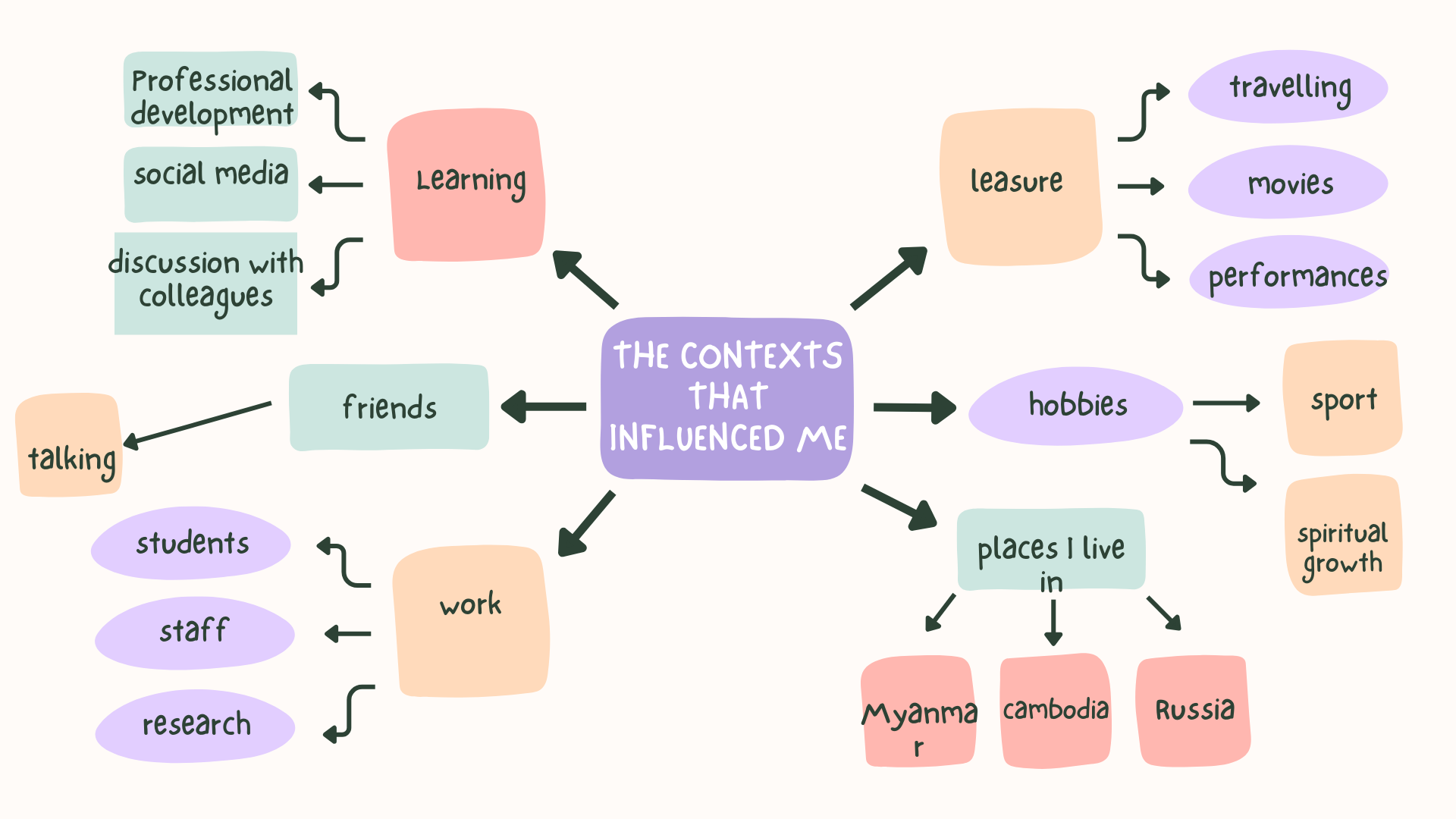
Language acquisition occurs within specific contexts. It's crucial to recognize that language isn't a solitary construct; rather, it's intricately woven into the social, cultural, and situational environments where it is utilized. Here is an example from Anna Enina,ELL Specialist., Yangon American International School, Yangon, Myanmar :
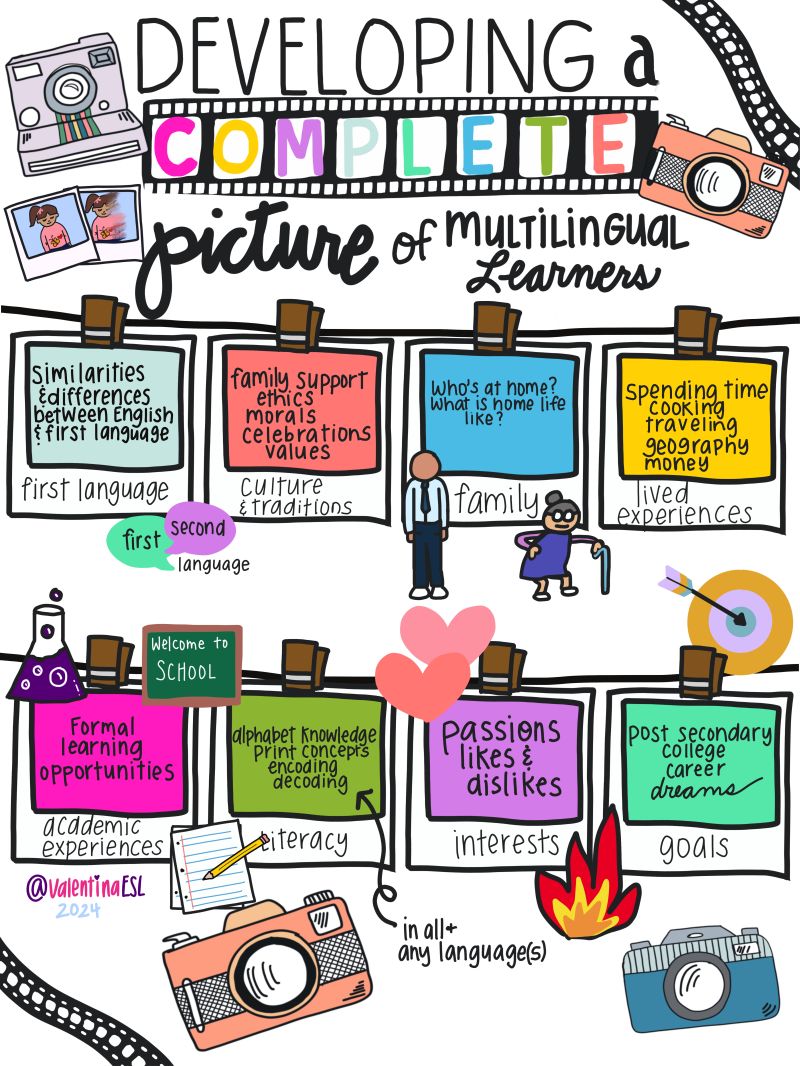
A linguistic repertoire encompasses all the linguistic resources individuals possess across their languages or dialects, including vocabulary, sounds, grammar structures, gestures, speech styles, genres, registers, and associated norms. These resources, regardless of the individual's level of proficiency, can be drawn upon and utilized to convey meaning in diverse contexts.
A language portrait serves as both an inquiry tool and a visual representation of an individual's linguistic abilities and life experiences. It encompasses the languages or dialects they speak and the diverse contexts they've encountered. Typically, it is presented in a multimodal format, combining visual elements like portraits or collages with verbal descriptions or explanations, such as written narratives, audio recordings, or sign language.
(Justin Zhang has produced an interesting pictorial of these concepts. Click HERE.)
Do you know the language portraits of the students you teach?
To produce a language portrait, follow these instructions:
- Reflect on the languages you speak and their cultural contexts, considering their significance in your life.
- Consider how language impacts your identity. Reflect on how it shapes your sense of self.
- Explore the connection between language and your cultural heritage. Think about how your languages tie you to your cultural roots.
- Contemplate how language affects your interactions and relationships with others. Reflect on the role language plays in shaping your communication dynamics.
Use these prompts to guide the creation of your visual representation of your language repertoire.
What role does language play in life?
This video was produced by the UNESCO Liaison Office in New York in 2010, on the occasion of the International Mother Language Day, to raise awareness on the importance on languages today and to draw attention to the fact that language diversity is under threat, not least from the internet.
Did you know? most of the world's population is bilingual or multilingual
Defining multilingualism: individual multilingualism is defined as the ability to communicate in several language contexts – regardless of the way in which the languages concerned were acquired or how well they are mastered.
Multilingualism as a connected system: individual multilingualism functions as a connected system (“one connected system, rather than each language being a separate system”; Cook 2008) in which the elements of the individual languages interact with and influence each other. Together, they comprise a single “integrated competence”.
Benefits of multilingualism: cognitive function | cultural awareness | employability | cross cultural communication and sensitivity.
Multilingual individuals exhibit greater empathy and understanding of others. See the great article on Multilingualism and Global Citizenship
Multilingual replacing EAL. Schools often see children who do not speak English as having something missing: a deficit approach. Having multilingualism as an approach opened up a whole realm of opportunities in the classroom and focused on the linguistic repertoire these children have, giving us an asset-based approach.
Multilingualism – the normal human condition. ‘Speaking two or more languages is the natural way of life for
three-quarters of the human race. [This] principle … has been obscured in parts of Europe as a consequence
of colonial history. We urgently need to reassert it, and to implement it in practical ways, for, in the modern
world, monolingualism is not a strength but a handicap.’ (David Crystal 2006:409) From "Cambridge Assessment English Perspectives The Impact of Multilingualism on Global Education and Language Learning" Dr Lid King

"Multiliteracies and intercultural understanding are highly important in real life as I believe that they may prevent conflicts both in a local and global scale. As I am a person who is coming from the country whose name is unheard and unrecognised by most interlocutors, hence, whose culture is not understood, I know how frustrating it is when some of them demonstrate narrow-mindedness and show no willingness or curiosity to learn about a variety of cultures on our planet making assumptions and projecting stereotypes. In such cases it does not really matter how smart and skilled interlocutors are, if they have not developed intercultural understanding and international mindedness. I can’t imagine how many conflicts could have been prevented and avoided if people of different nationalities and ethnicities simply respected, if not understood, each other’s cultures. That’s why I believe that this area is vital for the future of humankind as schools prepare students to become change agents to resolve real-world challenges.
As I speak four languages (at different levels of proficiency), I know how language affects thinking process and perception of the world providing a range of ways to convey thoughts and ideas. Therefore, multilingualism expands a scope of understanding and patience when communicating with other people, especially in the modern world of online learning and social media. For example, there are two forms of a pronoun “you” in Kazakh language – one is strictly formal and respectful to be used with elders and people of authority, and the other is more informal to be used among friends or colleagues. And elements like this explain culture a lot leading to development of intercultural understanding and open-mindedness. Consequently, multilingualism and multimodality have high practical value for establishing effective communication and successful connections, hopefully leading to a more peaceful and better world.
Multiliteracies and intercultural understanding are in the centre of the IB mission, and this is one of many reasons why I like the IB programmes. Development of this area is a significant aspiration for any school. It is not a job for one day, it is ongoing hard work of truly dedicated people that involves development of other areas as well:
- curriculum development e.g., moving away from eurocentrism.
- building resource library e.g., adding books written by authors of different race, gender, ethnicity, etc.
- leadership training and staff professional development e.g., how to recognise racism and promote respect towards different cultures.
- extra and cross curricular activities e.g., intercultural fairs where students can explore and demonstrate their cultural identities
- policy writing e.g., the language policy, the code of conduct, etc.
- pedagogy e.g., a range of learning experiences and teaching strategies which use local and global contexts and are aimed at developing intercultural understanding and international mindedness.
- community engagement e.g., activities and events organised/sponsored by PTA."
Raina Zhaparova, born in Kazakhstan (when it was still a part of the USSR), raised in Mongolia and now working in Hong Kong.
Translanguaging is a pedagogical approach that encourages students to use all of their language resources, including their native language(s), to enhance learning in the classroom. Here are eight strategies for developing translanguaging in classrooms:
- Explicitly encourage language use: Create a classroom environment where students feel comfortable using their full linguistic repertoire. Encourage them to express themselves in whichever language(s) they feel most comfortable in.
- Model translanguaging: Teachers should model translanguaging by fluidly switching between languages during instruction and interactions with students. This demonstrates to students that it's acceptable and beneficial to use multiple languages.
- Promote language flexibility: Emphasize to students that they can use different languages for different purposes. For example, they might use their native language to clarify concepts and then switch back to the classroom language for formal discussions.
- Group work and collaboration: Encourage collaborative learning activities where students can work together using their diverse language skills to solve problems, discuss concepts, and create projects.
- Language peer support: Pair students with different language backgrounds so they can support each other's language development. This allows students to learn from each other and build confidence in using multiple languages.
- Language resources in classroom: Display multilingual resources such as posters, books, and other materials that reflect the linguistic diversity of the classroom. This validates students' languages and provides support for their learning.
- Translanguaging tasks and assignments: Design tasks and assignments that explicitly incorporate translanguaging. For example, allow students to write essays or give presentations using a combination of languages, or ask them to translate texts collaboratively.
- Reflective practices: Encourage students to reflect on their language use and the effectiveness of translanguaging strategies in their learning. This helps them become more aware of their language choices and how they contribute to their academic growth.
- Students use translation tools on the internet e.g. Google translate.
Audit your own use of Translanguaging using this quick questionnaire on Justin Zhang's website.
The IB have produced a very succinct video called The language and learning cycle, which can be found in the cross programme section of the Programme Resource Centre (PRC). It explains in non-technical language why it is important to affirm each students' identity by allowing them to use their home languages in the learning process (what we call translanguaging). You may also wish to reference the IB publication Language and learning in IB programmes (available also on the PRC).
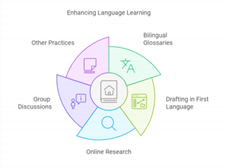
Examples of activities
- Bilingual/Multilingual glossaries:
- Create word banks in multiple languages for key topics.
- Encourage learners to develop personal glossaries.
- Drafting in first language:
- Drafting written tasks (e.g., essays) in their first language enhances content quality before translating to English.
- Online research:
- Conduct research in the first language for easier understanding of topics.
- Group discussions:
- Discussions in any preferred language among peers.
- Other practices:
- Note-making and note-taking in any language.
- Using subject-specific materials in the first language.
- Collaborative tasks in chosen languages.
Reference: The Bell Foundation - Great Idea - Translanguaging.
Schools are increasingly finding ways to integrate students' home languages, based on the belief that doing so enhances academic outcomes. At the International School of The Hague, one method involves using Google’s oral translation feature. Students speak into the app in their home language, which then provides an English translation, giving teachers insight into students’ thought processes and learning (Martin and McCracken, 2018). Meanwhile, the International School of London adopts a more comprehensive approach by offering daily 'home/native languages' lessons for all multilingual learners. With 25 languages currently supported, this practice reflects the school's commitment to fostering an inclusive, asset-based learning environment for its diverse student body.
How does this apply to IB examinations?
The Conduct for Examinations 2024 (section 10.0) states... 10.8 Candidates may take to their desk or table only the following items.
- "General stationery (for example, pens, pencils, an eraser, geometry instruments and a ruler)
- A bilingual translation dictionary is permitted for all subject groups (except studies in language and literature, language acquisition) including classical languages examinations. The dictionary must not contain notes of any kind and is only permitted if the response language of the examination is not the best language of the candidate; an electronic dictionary is not permitted)"
Reflection:
This year, I had a student arrive in my class from Libya. She was new to the school and had a strong understanding of English. For the first few weeks, she would observe more and participate less in the class. She was navigating a new school, trying to establish friendships with students who already have created friendships, and learning the expectations of the new school. I asked all students to bring a picture of their family to school so that I could post it in the classroom. When this student brought her picture, I noticed mom was wearing a hijab. I turned to her and asked if she spoke Arabic. The student shared that she did. I said, " Hello, How are you doing?" in Arabic. She smiled so wide, and her eyes lit up! She responded in Arabic, and I responded to her in Arabic.
After this interaction, the student's engagement level increased a lot. She was willing to take more risks and share her thinking during class discussions. I think this experience decreased her belonging uncertainty, and she began feeling that her whole self was recognized in her learning space. She has now made friends, and we occasionally speak Arabic. I believe it's essential for all students to have their teachers recognize all parts of their identities, which will positively impact their engagement. (Stratford Hall School, Vancouver, British Columbia, Canada)
Read this article or watch this video on The countries with the most linguistic diversity.
Watch this TED Talk and collect a list of reasons why it is important to be multilingual in order to inform a presentation to a parent stakeholder group.
Key points:
- ability to communicate - to speak to someone's heart - it is relational
- to view the world from different points of view and perspectives
- understand and appreciate each others' cultures, heritage and traditions
- languages open doors of information and opportunities
- create new worlds of global connection - a global community
Build a diverse community: with short term, long term residences.
- Admissions acknowledges language portraits and repertoires :importance of understanding students’ linguistic repertoires (those languages they use for both personal and academic purposes) when they join the school and endeavor to develop all of their languages. A language portrait document is created and shared with all staff. Ask questions to the community when they join the school like, “Where have you lived and studied?” and “What languages do you speak?” Informally assess the students english levels and confidence, attitudes and motivation toward language. Gives advice and support to parents
- Home languages: Make space in the curriculum for the student's personal language. Include the language of instruction and any other supported languages that are used actively to construct meaning, develop literacy and explore personal identity.
- Resourcing: Dedicate funds to teaching costs and professional development.
- Provide translation services, e.g.for families who may not speak the language of instruction you could provide a contact point in their home language for counselling services, admissions services, curricum etc. Use translation apps which can be found HERE.
- Language provision: For example, in one school from Early Childhood 1 (age 3), literacy in a home language begins and this continues until the end of their schooling, where an average of 78% students graduate with the bilingual IB Diploma. In the Primary Years Program (PYP), students all take either home language or additional language acquisition for a total of 160 minutes a week (over three days). In the IB Diploma Program (DP), students are able to continue with either two or three languages.
- Staff: Ensure staff model languag learning. How many are multilingual?
- Pedagogical leadership: Appoint a head of multilingualism, who would oversee the home language and literature, language acquisition and English language learning departments.
- Parent engagement: Engage with parent language groups. Give parent workshops to communicate the process of acquisition of multiple languages and the roles of parents and school in developing fluency and literacy. See translation services above.
- Staff development: Have ongoing discussions in staff professional development sessions about how the community speaks about language, which allows the community to be aligned with the underlying principles which drive their written language policy. Include teachers in the parent workshop in order to hear common questions and concerns
- Celebrate: For example, organise a week where a number of languages within the community are spotlighted and celebrated.
- Language in the DNA of a school: Take languages out of a classroom and include them in performances, signage and across other subject areas and learning experiences.
The IB believes it is important to continue mother-tongue study, especially when a student is attending school away from the culture in which that language is dominant. Mother tongue study is critical to accomplishing the third aim of the IB Diploma Core: to encourage the development of of students' self-awareness and sense of identity. Therefore the role of School Supported Self-Taught study should also be noted.

Wall of Quotes - the value of multilingualism
Use the Quotes that speak to me protocol to discuss the value of multilingualism in today's world and add to the list you began in the previous activity.
- Ask each person to individually look at the ‘Quotes that Speak to me’. Try to read everyone. Then choose the quote that most speak to you.
- Table groups - each person picks a relevant quote. Tell the “story” and significance of the quote to the rest of the group and explain how it exemplifies current and future practice.
Have a group discussion around the quotes. Which themes come out of your choices – how the quotes shape your life, how they may affect your work.
The Quotes
“In the lives of individuals and societies, language is a factor of greater importance than any other. For the study of language to remain solely the business of a handful of specialists would be a quite unacceptable state of affairs.” (Saussure)
"The individual's whole experience is built upon the plan of his language." (Henri Delacroix)
“To have another language is to possess a second soul.” (Charlemagne)
“If we spoke a different language, we would perceive a somewhat different world.” (Ludwig Wittgenstein)
“If you talk to a man in a language he understands, that goes to his head. If you talk to him in his own language, that goes to his heart.” (Nelson Mandela)
“One language sets you in a corridor for life. Two languages open every door along the way.” (Frank Smith)
“The limits of my language are the limits of my world.” (Ludwig Wittgenstein)
“Those who know nothing of foreign languages know nothing of their own.” (Johann Wolfgang von Goethe)
"Language is the blood of the soul into which thoughts run and out of which they grow." (Oliver Wendell Holmes)
“Learning a foreign language not only reveals how other societies think and feel, what they have experienced and value, and how they express themselves, it also provides a cultural mirror in which we can more clearly see our own society.” (Chancellor Edward Lee Gorsuch)
"A different language is a different vision of life." (Federico Fellini)
“If we spoke a different language, we would perceive a somewhat different world.” (Ludwig Wittgenstein)
“You live a new life for every new language you speak. If you know only one language, you live only once.” (Czech proverb)
“Knowledge of languages is the doorway to wisdom.” (Roger Bacon)
“One who speaks only one language is one person, but one who speaks two languages is two people.” (Turkish Proverb)
“Change your language and you change your thoughts.” (Karl Albrecht)
“Learning another language is not only learning different words for the same things, but learning another way to think about things.” (Flora Lewis)
“A special kind of beauty exists which is born in language, of language, and for language.” (Gaston Bachelard)
“Language is not a genetic gift, it is a social gift. Learning a new language is becoming a member of the club - the community of speakers of that language.” (Frank Smith)
"Language is a city to the building of which every human being brought a stone." (Ralph Waldo Emerson)
"The individual's whole experience is built upon the plan of his language." (Henri Delacroix)
"The love of one's country is a splendid thing. But why should love stop at the border?" (Pablo Casals)
"Speaking Spanish and Japanese has opened doors in my career and helped me bridge cultural differences, both in my personal and business life. During my football career I realised quickly what difference language skills can make" (Gary Lineker)
Use the "I used to think ... now I think" routine from Harvard's Project Zero Visible Thinking Routines to reflect on how your thinking has developed on the role of language and the importance of multilingualism.
Click here to access the routine.
Language and learning in IB programmes. Click here to access it.
IBO Language policy: (This document outlines the IB's commitment to multilingualism and its approach to language learning across its programmes)
Learning languages and the development of intercultural awareness. This is an excellent introductory video to illustrate how language and culture are intertwined, and the importance of learning languages in order to develop intercultural awareness. It can be found on the IB Online Curriculum Centre under Language and Learning.
IB Language Tenets, 2023
Developing and Supporting Multilingual Communities: This IBO presentation unpacks that what, why and how around developing and supporting multilingual communities
Reflections on Teaching Multilingual Learners. (Jechevarria.). 10 evidence-based practices for teaching multilingual learners.
IBO Research on Multilingualism: The IB conducts research on various aspects of multilingual education research in light of the ´multilingual turn´
Saad, S. Strategies to empower multilingual learners in the classroom
OELA Benefits of Multilingualism Chart: Great chart illustrating the cognitive, educational, economic and sociocultural benefits of multilingualism.
Gonzalez, V. (2021, May 10). Don’t let monolingual agendas lead multilingual learners. Rooted Linguistics: Serving Teachers of Multilingual Learners.
UNESCO’s Supporting Multilingual Approaches in Teaching and Learning: A good website which introduces key terms, including translanguaging.
Cultivating Bilingualism: The Benefits of Multilingual Classrooms | NAEYC
(PDF) Multilingual pedagogies in practice (researchgate.net)
British Council, Using multilingual approaches: moving from theory to practice A resource book of strategies, activities and projects for the classroom Kathleen Heugh, Mei French, Janet Armitage, Kerry Taylor-Leech, Necia Billinghurst and Sue Ollerhead. It offers strategies, activities, and projects for multilingual classrooms. The guide emphasizes leveraging students’ bilingual or multilingual knowledge while teaching English.
The Salzburg Statement for a Multilingual World: recognises that social inclusion happens when multilingualism is valued. Its principles recognise that support for social multilingualism by states and international organisations is central to intercultural understanding.
In “Drawing on Linguistic and Cultural Capital to Create Positive Learning Cultures for EAL Learners,” Hamish Chalmers and Eowyn Crisfield authors contend that acknowledging and appreciating the multilingual abilities and cultural insights that students bring to the classroom can lead to a more inclusive and effective learning environment. They emphasize several important points: (a) Asset-based approach: Viewing the home languages and cultural backgrounds of EAL learners as strengths rather than shortcomings can enhance their academic success and overall well-being.(b) Multilingualism in education: Schools should incorporate students’ native languages into the learning process to support cognitive development and academic success.(c) Inclusive practices: Adopting strategies that recognize and utilize the linguistic and cultural capital of EAL students can help cultivate a positive learning culture.