Change management tools
How do we bring about change successfully?
How can school leaders manage change and sustainable development in a constantly changing environment?
Change management is a structured approach to ensure that changes are implemented and embedded in the life of the school, and that the lasting benefits of change are achieved.
This section provides some useful tools that can help you manage change. The focus of these tools is often on the people involved. The change could be a simple and straight forward one or a strategic and systemic one.
Schools often use more than one tool. For example, they may use a systemic change model approach such as Kotter's eight-step change process but then also use a tool that focuses on the people involved in the change such as The Change Curve. Choose the tool you use with care - they all provide ways of helping you structure your thinking but you do not want to become a slave to a process which is not your own.
Th IB expects you to have a change theory when developing your programme. The title'change theory' is included in the IB template for programme development planning. This page explains what change management models are and outlines 10 well-known frameworks used to guide organisational change. It is aimed at helping leaders choose the right approach to manage transitions successfully. Click HERE.
Understanding Change
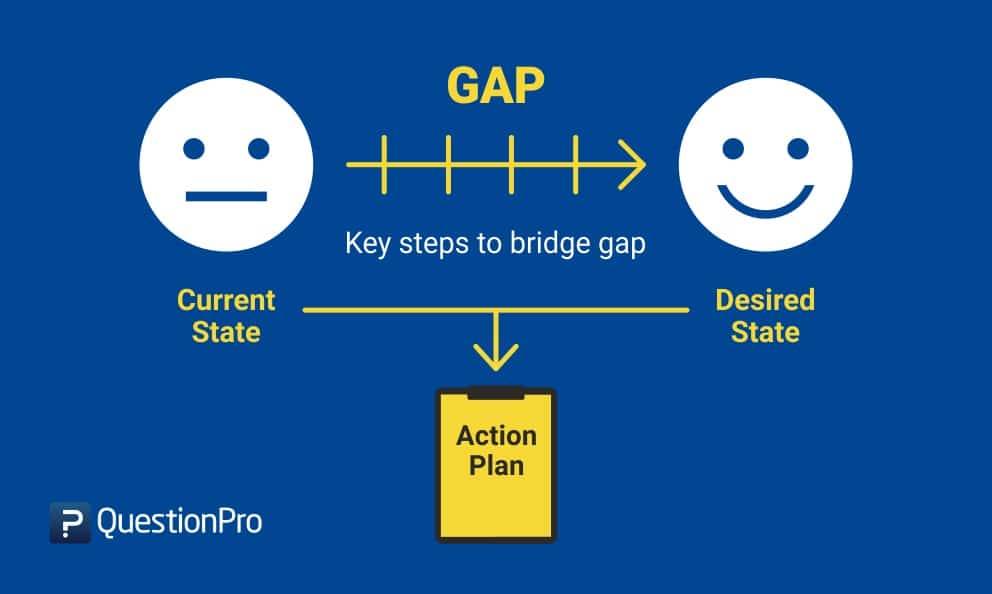
Gap Analysis
A gap analysis looks for the reasons you aren’t achieving certain goals. It considers where you are, where you want to be and looks for the reasons preventing your success. With that information, you are able to create an action plan that closes the gaps. (Forbes)
Click HERE for a more detailed explanation.

Lewin's Force Field Analysis
Kurt Lewin's Force Field Analysis is a powerful tool to use to help you understand what's needed for change. Kurt Lewin wrote that "An issue is held in balance by the interaction of two opposing sets of forces - those seeking to promote change (driving forces) and those attempting to maintain the status quo (restraining forces)".
Check this site for how to use it: mindtools.com
Lewin's Change Management Model

Kurt Lewin’s model is a practical way of understanding the change management process. It involves the three steps of unfreezing, changing and refreezing. A simple analogy is if you wish to change a lump of ice into a cone of ice. First you have to refreeze it, then change it and refreeze it. This model helps you see the change as a process with a clear end in mind. First you need to show that a change is needed, then move towards the new desired level of behavior and then embed the new behavior as the norm. Check this site for how to use it:mindtools.com
Lewin's model is not without its critics: they variously argue that (a) this linear model is too simple for our times which are characterised by constant and rapid change; (b) this model does not take sufficient account of the emotional impact of change on people; (c) the model does not discuss the role of leadership; and (d) it is a western-centric model. These criticisms are clearly described by Daniel Lock Consulting - click HERE to access his clear guide.
Futures Triangle
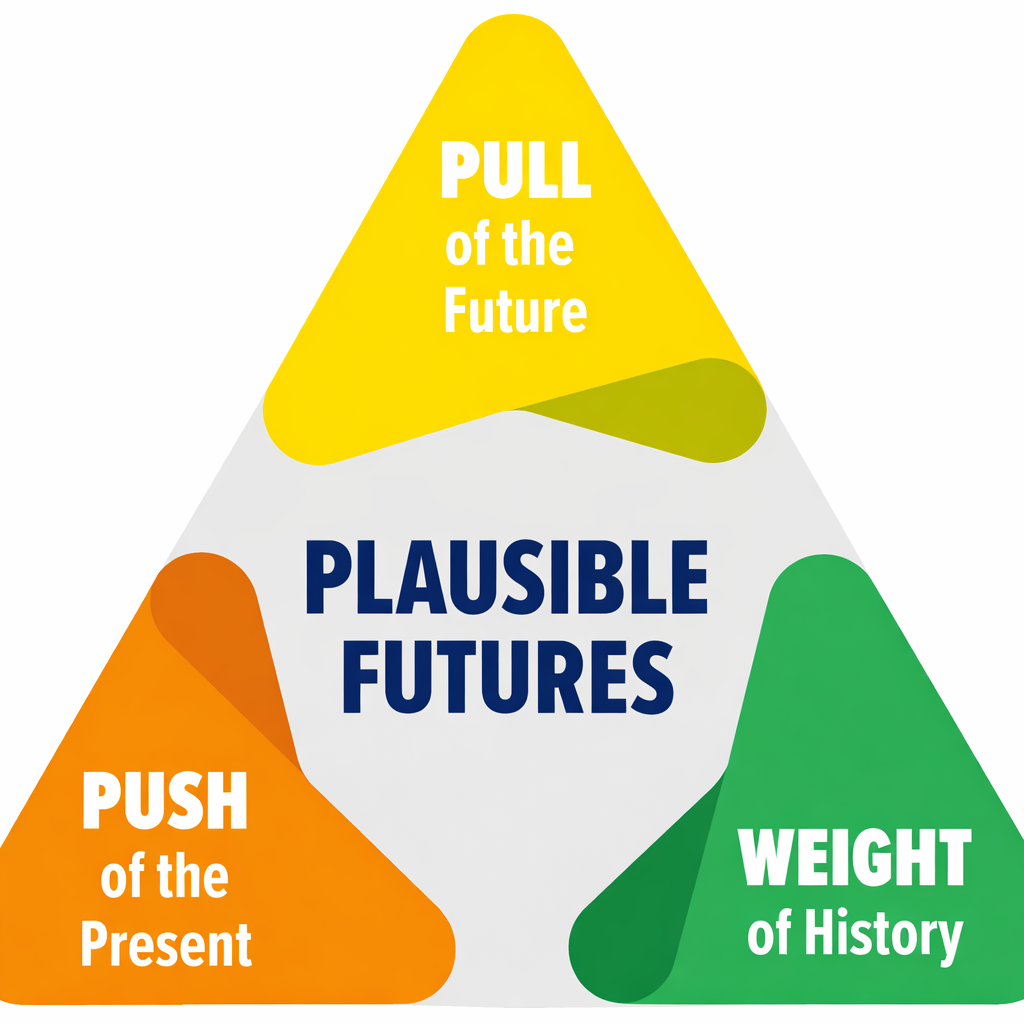
The Futures Triangle is a tool that supports school leaders in understanding and planning for change by analysing the interaction between the past, present, and future. It helps leaders move beyond immediate pressures to make more strategic, long-term decisions.
The model focuses on three forces:
- Pull of the Future – the strategic vision or desired outcomes (e.g. a more inclusive curriculum, improved student wellbeing, stronger outcomes, or digital transformation)
- Push of the Present – current drivers and pressures (e.g. accountability measures, staff workload, technological change, safeguarding needs)
- Weight of the Past – existing structures and constraints (e.g. timetables, legacy systems, established practices, organisational culture)
This protocol is particularly useful for school improvement planning, curriculum development, and change management, helping leadership teams balance ambition with practical realities.
Instructions
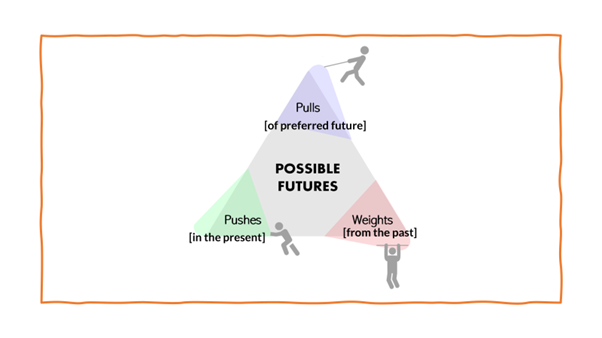
- Draw a triangle and label the three sides: Pull of the Future, Push of the Present, and Weight of the Past
- Identify key examples for each area (e.g. future priorities, current pressures, and structural or cultural constraints within the school)
- Organise ideas to highlight patterns, overlaps, and key themes
- Discuss how these forces interact, including tensions between vision, reality, and constraints
- Determine strategic priorities and leverage points to inform planning and decision-making
Check these articles:
Knowledge Works: Futures Triangle: A Tool for Examining Interactions of Drivers of Change | Session Lab: Futures Triangle
Beckhard and Harris's Change Model

This model states that if change is to be managed successfully people need to be dissatisfied with the current situation and want things to change. The solution you are proposing must be desirable, and the change a realistic and practical one. If all three are in place resistance to change can be overcome.
Check this site for how to use it:mindtools.com
Implementing Change
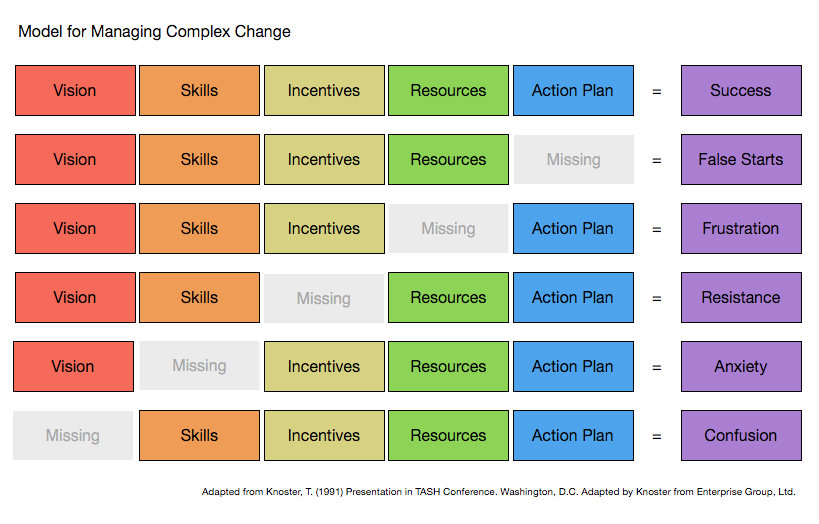
Knoster Model
The Knoster Model provides a structured approach to managing complex change in organizations. The Managing Complex Change Matrix assists in assessing the complexity and impact of a proposed change.
Consider using this model as a framework for your ‘kick off’ meetings prior to launching on a major project.
Leavitt's Diamond

This tool allows you to look at the potential impact of change on the whole organization (people, task, structure and technology) and describes how you need to plan change in a systemic and not piecemeal way.
Check this site for how to use it:brighthubpm.com
McKinsey's 7-S Framework

This framework identifies seven aspects of an organization that have to be aligned if it is to perform well. Three of these are 'hard' (strategy, structure, systems) and four 'soft' (shared values, skills, style, staff). The framework can be used to understand how each of these elements are related in any form of change process, be it restructuring, new leadership, or new focus.
Check this site for how to use it:mindtools.com

Kotter's eight stages of change
In this model Kotter describes eight change management activities that need to be done to effect change, and make it stick in the long term.
Check this site for how to use it:mindtools.com
Kotter's eight stages of change is more fully explained on his website http://www.kotterinternational.com/
The Change Curve

Change can make some people feel excited but others vulnerable. The change curve helps you understand how people will react to change so that you can help them make their own personal transitions. The change curve describes four stages people go through when they face change. It is a way of identifying the help people need when they are under-going change.
Check this site for how to use it:mindtools.com
See also the Change Cycle a six-stage model by Lillie Brock and Ann Salerno explaining predictable emotional responses to change.
Evaluating Change
Implementing change in a carefully considered way is as important as the specific change tool you use. Consider using a change management methodology checklist when considering which model to use. An example of one can be found here.