PSP Meetings: A practical guide for Programme and Evaluation Leaders

Inquire appreciatively
How best to prepare for the evaluation visit?
Good preparation is not about writing a long list of questions or trying to anticipate every possible discussion. It is about understanding the school's context, identifying areas worth exploring and preparing thoughtful questions that encourage professional dialogue and support further programme development. The IB recommends we adopt an appreciative inquiry approach.
Appreciative inquiry is an approach that starts by discovering what works well, understanding why it works and exploring how those strengths can be developed further. The ripple illustrates how recognising and building on successful practice can create a positive influence that spreads throughout the organisation.
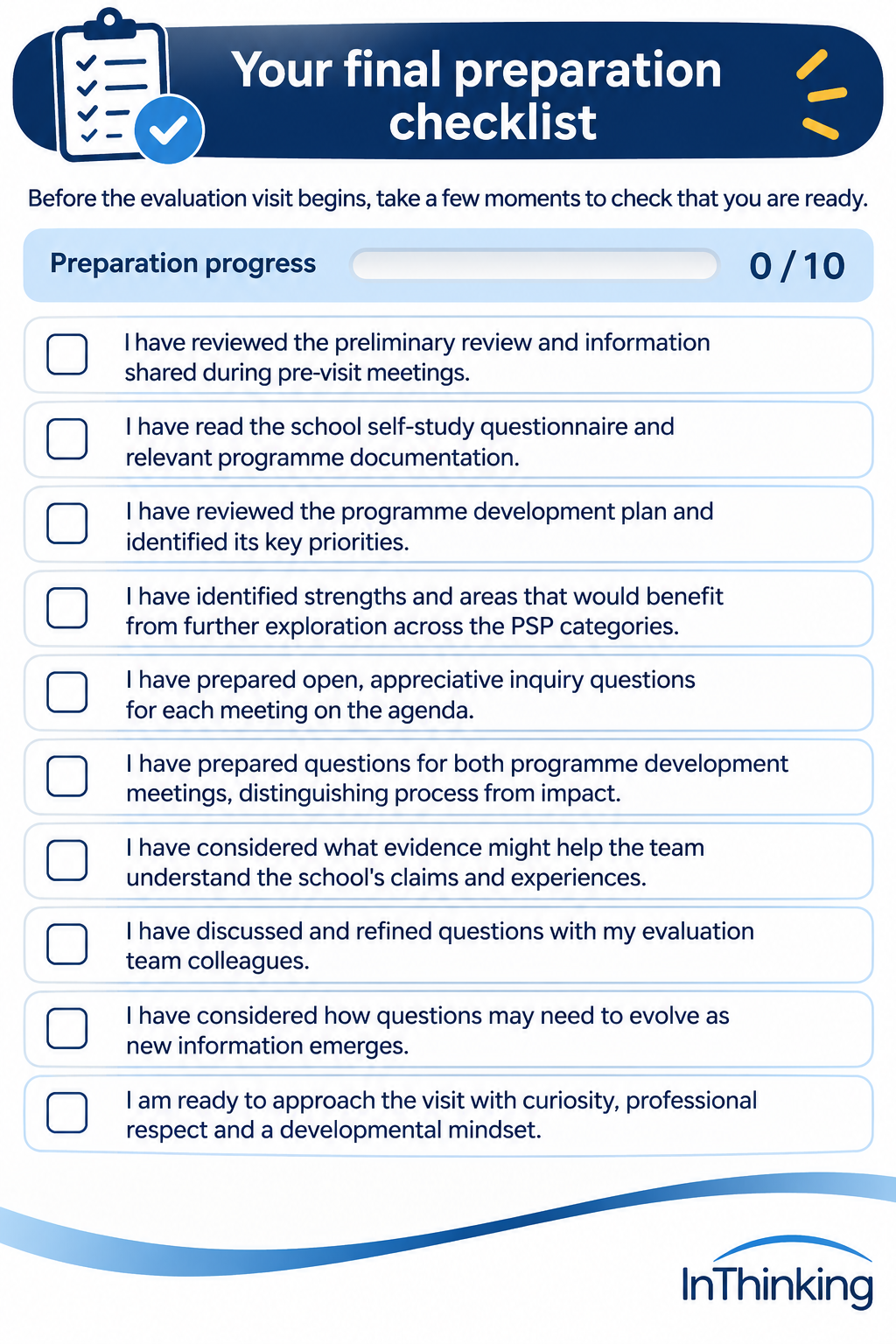
The following steps provide a practical reminder of what to do before the visit. On this page we will look at how to prepare for the meetings based on the IB programme standards and practices (Purpose, Environment, Culture, Learning). On the next page we will explore how best to prepare for the meetings focused on the programme development plan.
Step 1. Revisit the information already available
Before preparing questions, take time to develop a picture of the school and its programme(s). You will already have access to several important sources of information:
- Meeting with the schools' World Schools Manager (WSM) prior to the visit: What has the IB WSM shared about its context, priorities, challenges and recent developments?
- Preliminary review: What matters were identified for further consideration? What additional information or clarification has the school provided?
- School self-study questionnaire: What does the school say about its implementation of the programme and its alignment with the Programme standards and practices (PSP)?
- Programme development plan (PDP): What has the school identified as priorities for programme development? How has it approached these priorities, and what evidence of impact is available?
Read these documents alongside one another rather than treating them as separate sources of information.

Top tips
- Look for connections between what the school says, what it does and what it hopes to achieve.
- Identify recurring themes, apparent strengths and areas where you would value greater understanding.
- Notice where the school has provided evidence and where further exploration might be helpful.
- Avoid making assumptions based on a single statement or piece of evidence.
- Remember that documents provide a starting point for inquiry, not a complete picture of the school.
Your aim is to arrive with an informed understanding of the school's programme, while remaining open to what you will learn during the visit.
Step 2. Identify what you need to explore
Having reviewed the documentation, begin to identify the questions that will help the evaluation team develop a deeper understanding of programme implementation.
Consider each PSP category and ask yourself:
- What does the school appear to be doing well?
- What evidence suggests that this practice is having a positive effect?
- Where would further discussion help us understand the school's approach?
- Are there differences between what the school intends, what it implements and what students experience?
- What opportunities might exist for the school to build on its current practice?
Distinguish between information that is already clear and matters that genuinely need further exploration.
For example:
The school describes a strong culture of collaborative planning.Possible question: How does collaboration influence the consistency and quality of teaching and learning?
The school identifies student agency as a development priority.Possible question: What changes have teachers made to give students greater ownership of their learning?
Top tip: Focus on questions that add something to what you already know. Asking schools to repeat information contained in their documentation wastes valuable time.
Step 3. Frame appreciative inquiry questions
The evaluation team adopts an appreciative inquiry approach. This is not simply about being positive or avoiding difficult questions. It is about approaching conversations with genuine curiosity, recognising existing strengths and exploring opportunities for further development.
The questions we ask influence the conversations that follow. Appreciative inquiry encourages people to share experiences, reflect on their practice and consider what might be possible.
Rather than beginning with what is wrong, explore what is working, why it is working and how the school might build on it. For example:
Rather than asking, Why isn't collaborative planning effective?, ask: What have you learned about making collaborative planning effective across the programme?
Rather than asking, Why is student agency weak?, ask: Where are students demonstrating agency, and how might these experiences be extended?
Make your questions specific to the school. Draw on the school self-study questionnaire, programme development plan and other documentation. Adapt generic question stems to explore the school's particular practices, decisions, priorities and experiences. Avoid simply repeating statements from the documentation or asking questions that could apply to any school.
Explore the connection between the IB philosophy and everyday practice. For example, how are the mission, learner profile and programme values reflected in leadership decisions, policies, teaching and learning, and community engagement?
Importantly, distinguish between provision and impact. The existence of a policy, facility or well-being initiative does not, in itself, demonstrate effectiveness. Explore what difference it makes to teachers and, ultimately, to students' learning and experience.
The aim is not to avoid difficult issues, but to explore them in a way that builds trust, encourages honest reflection and identifies opportunities for development.
Useful question starters include:
- What are you most proud of in relation to...?
- What positive experiences have you had with...?
- How have you built on your successes in...?
- What have you learned from...?
- How do you know that...?
- What has made the greatest difference to...?
- How might you extend or strengthen...?
- What opportunities do you see for further development?
- What would you like to achieve in the future?
Top tips
- Ask open questions that encourage explanation rather than short answers.
- Show genuine interest in understanding the school's experience.
- Invite specific examples, evidence and different perspectives from students, teachers, leaders and parents.
- Connect the IB philosophy to what people actually do and what students experience.
- Distinguish between established practice, emerging developments and future aspirations.
- Explore the impact of provision and initiatives rather than assuming that their existence demonstrates effectiveness.
- Acknowledge that programmes develop in different ways according to their context.
- Explore challenges constructively without losing sight of existing strengths.
- Make sure your questions are connected to the school's documentation and the PSP.
Remember: Look beyond what the school says it does to understand what actually happens and what difference it makes. A programme strength is not simply something a school does well. It is a practice, decision or approach that makes a demonstrable difference to the quality of the IB education and, ultimately, to students' learning and experience.
Step 4. Prepare questions for each meeting on the agenda
Your questions are a preparation tool, not a script. Be ready to adapt them as the visit unfolds.
Top tips
- Prepare a small number of purposeful questions rather than an exhaustive list.
- Ensure that questions are appropriate to the knowledge and experience of those attending.
- Avoid asking different groups the same questions unless you deliberately want to explore different perspectives.
- Think about possible follow-up questions that might help you explore an interesting response.
- Agree with your colleagues who will lead particular lines of inquiry.
Links: