PDP Meetings: A practical guide for Programme and Evaluation Leaders
How best to prepare for the programme development meetings?
This practical guide is designed to help Programme Leaders (PLs) and Evaluation Leaders (ELs) prepare for and facilitate the two programme development meetings during an IB evaluation visit. It brings together the key ideas underpinning programme development planning, clarifies the respective roles of the EL and PL, and explores the different purposes of the two meetings. It also offers practical guidance on preparing questions, reviewing the school's PDP, facilitating meaningful conversations and evaluating the quality of the school's development process.
The starting point is to remember that programme development is about more than completing a plan. It is about understanding how schools bring about meaningful, sustainable change and how they know that it is making a difference. As the image suggests, programme development is not a linear checklist. It is a continuous process of understanding, planning, acting, evaluating and learning.
Step 1. Understand the thinking behind the PDP
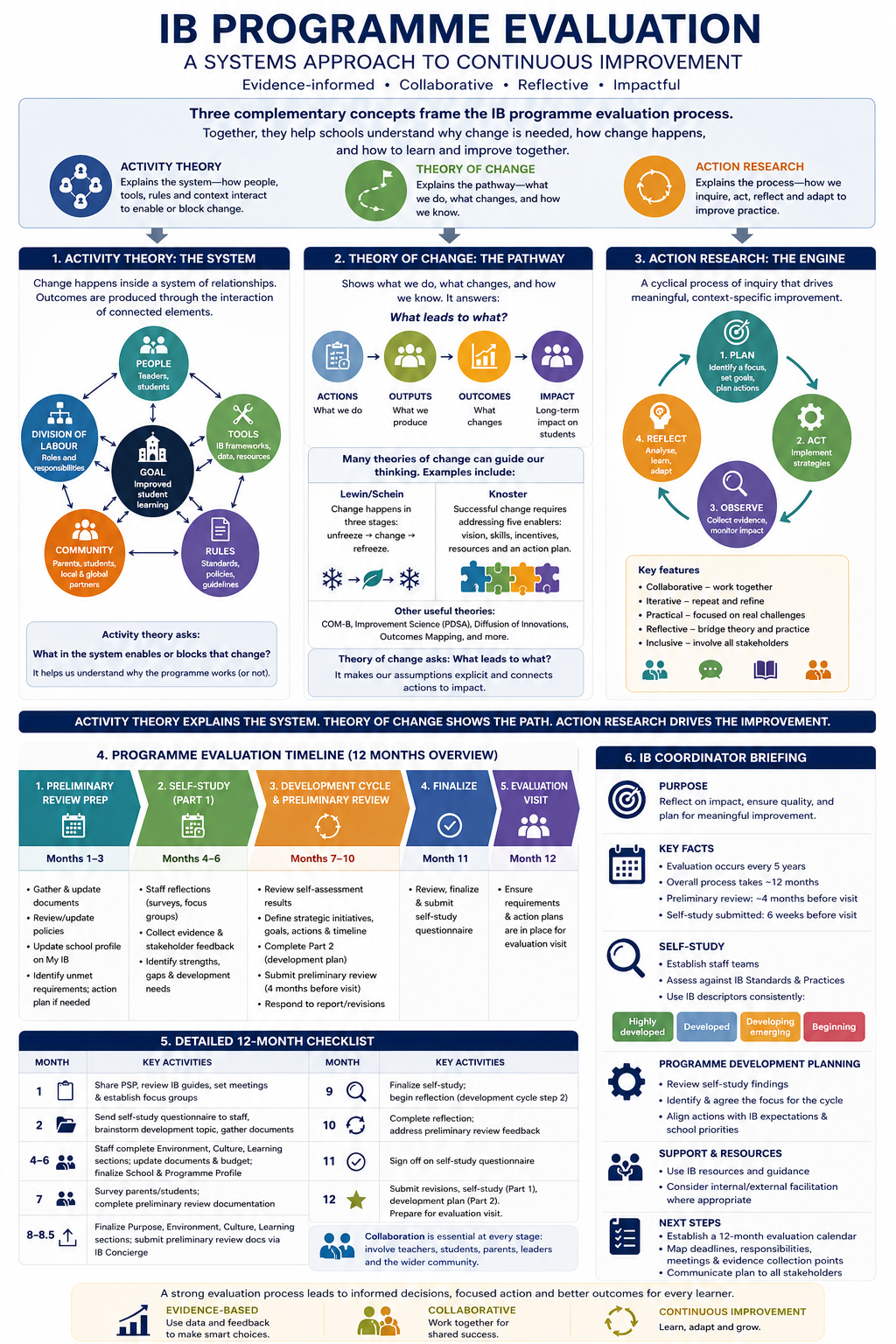
Three important ideas underpin programme development planning: activity theory, theory of change and action research. Together, these provide a useful framework for understanding how schools approach development and how they learn from their efforts.
Top Tips: Activity theory – understanding the system
Activity theory encourages us to look beyond individual actions and consider how different elements of the school system work together to bring about change.
Schools select four to eight practices for development within their PDP. These should be understood as interconnected, influenced by the school's purpose, people, culture, roles, rules and resources.
As PLs and ELs we should look for:
- Are the selected practices connected to the school's development priorities?
- How do people, roles, structures and resources support the intended changes?
- How do the practices connect and reinforce one another?
Remember: Look at how the different parts of the system work together, not just at individual actions.
Theory of change: During the visit, explore whether the school can explain the reasoning behind its priorities, the changes it expected to see and how it knows whether those expectations have been realised.
A useful reminder: Look for the connection between intention, action, outcomes and impact.
Action research: During the visit, explore how the school has monitored its development, involved people in evaluating progress and adapted its approach in response to what it has learned.
A useful reminder: Look for evidence that the school is learning from its actions, not simply reporting on activities completed.
Step 2. Understand the role of the Evaluation Leader
The IB programme evaluation manual identifies the Evaluation Leader (EL) or Team Chair as the meeting leader for the programme development discussions.
Why the Evaluation Leader? The EL is expected to understand schools as learning organisations, facilitate conversations with school leaders about learning and change, and demonstrate knowledge of IB implementation and change management.
In particular, the role description highlights several responsibilities that are directly relevant to these meetings:
- Strategic leadership: Understanding how schools make strategic decisions, manage resources and deliver their development priorities.
- Change management: Understanding the challenges schools face when introducing, embedding and sustaining change.
- Contextual understanding: Recognising how the school's social, cultural and economic context influences programme implementation.
The EL therefore brings an important perspective to these discussions: an understanding of how schools function as organisations and how they develop their capacity to improve.
The EL is not there to tell the school how to implement its PDP. Their responsibility is to facilitate a developmental conversation that helps the school reflect on its approach, recognise its strengths and consider how it might develop further.
Programme Leaders bring their programme-specific expertise and contribute to the shared exploration. The EL helps ensure that the discussion remains focused on the school's development processes, organisational learning and impact.
Step 3. Understand the purpose of the two meetings
The two programme development meetings have different but complementary purposes. Together, they provide an opportunity to understand the school's approach to development and the impact it has achieved.
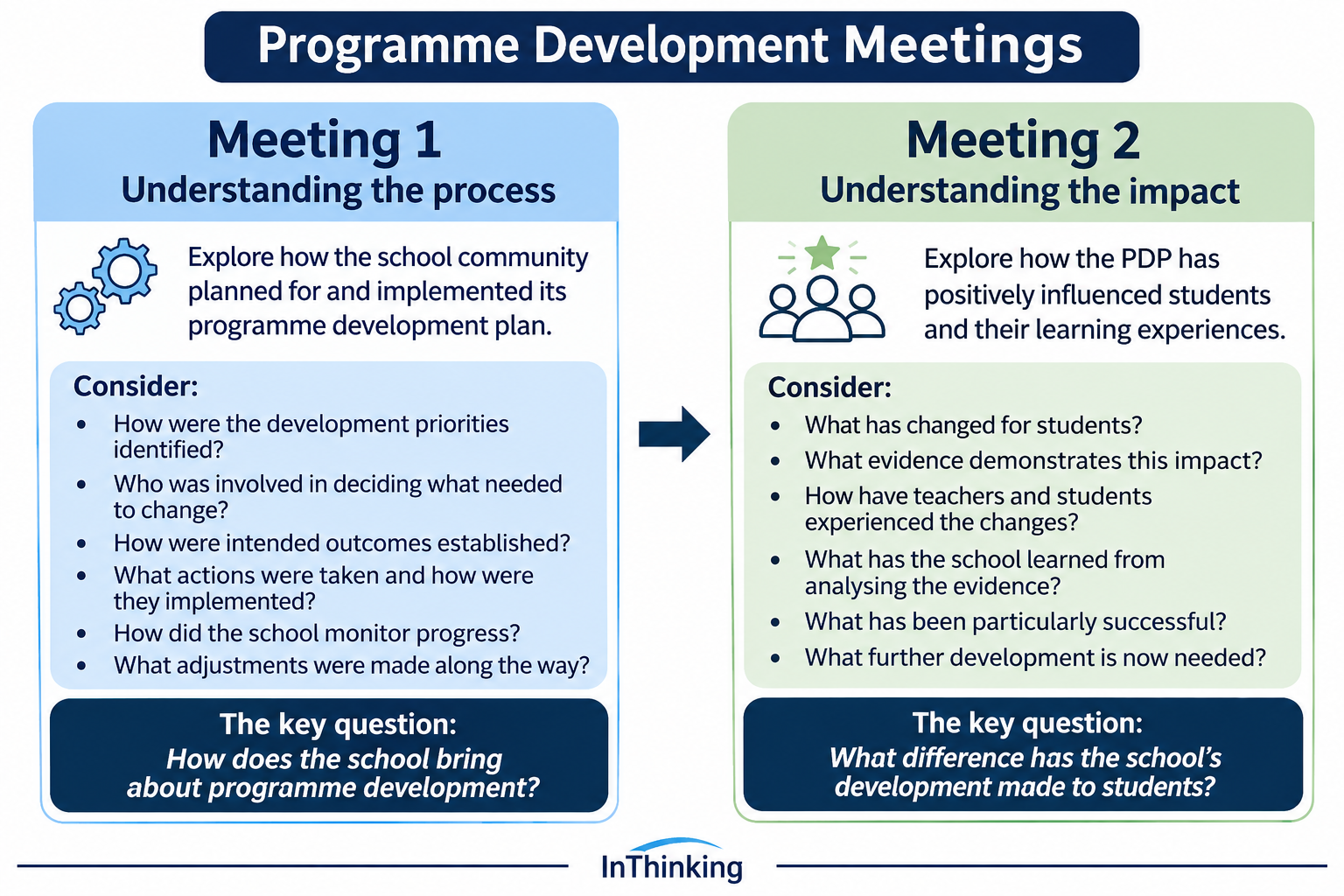
Remember that the two conversations should connect. The first explores the school's approach to development; the second explores the difference that development has made.
Step 4. Prepare your questions
Remember that the purpose of these discussions is to understand the school's development process, not simply to establish whether it has completed the activities in its programme development plan (PDP). Good questions explore how the school identified its priorities, why it chose particular actions, how it monitored progress and what it learned from the experience.
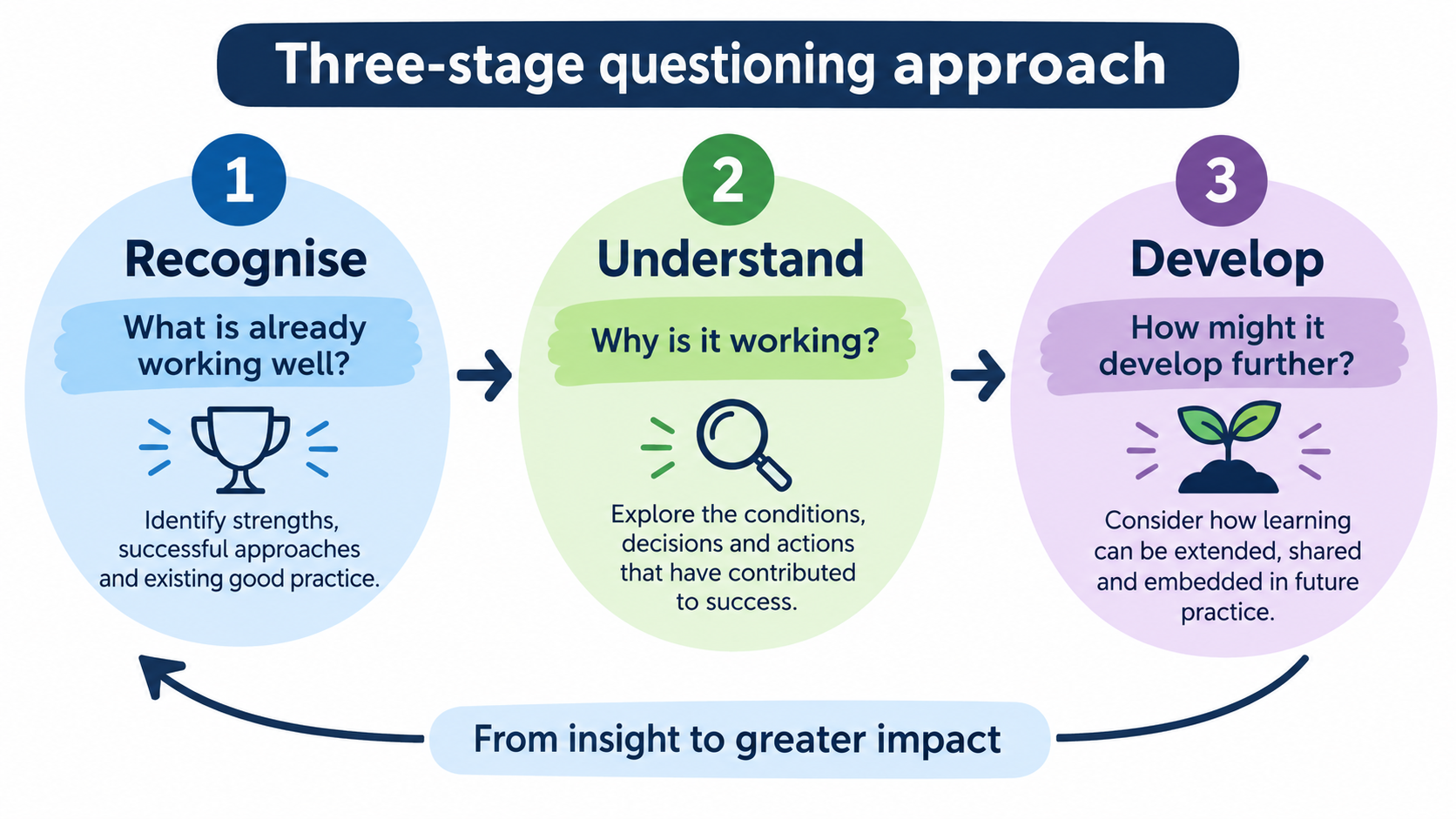
Adopt an appreciative inquiry approach: An appreciative approach means beginning with genuine curiosity about the school's experience, recognising what is already working well and exploring how existing strengths might provide a foundation for further development. Consider how you might reframe questions so that they invite reflection rather than imply a judgement. For example:
Instead of asking: “Why is inquiry still largely teacher-led?” consider asking: “What is already working well in developing inquiry, and how might the school build on this to give students greater ownership of their learning?”
Instead of asking: “Why is assessment still focused on tests rather than feedback?” consider asking: “Where are teachers already using feedback effectively, what difference is this making to students' learning, and how might this practice be shared across the programmes?”
The purpose is to encourage participants to explore their experience, identify what contributes to effective practice and consider how this learning might inform further development.
In particular, distinguish between evidence that an activity has taken place and evidence that it has made a difference. Completing professional development or introducing a new approach to collaborative planning demonstrates activity. Understanding how these changes have influenced teaching and learning, and ultimately students' experiences, requires further evidence and analysis.
Top Tips
For meeting 1: Planning and implementation
 Consider questions such as:
- What has the school learned from previous development initiatives that has helped it plan and implement this PDP?
- What led the school to identify these particular priorities for development?
- How did you use your school's context, experience and available evidence to identify and justify these priorities?
- How did you involve different members of the school community in shaping the PDP?
- What aspects of the planning process have worked well?
- How have you ensured that the planned actions have become part of everyday practice?
- What have you learned about managing and sustaining programme development?
- How have you adapted your approach in response to what you have learned?
For meeting 2: Impact and reflection
Consider questions such as:
- Which aspects of the development have been most successful, and what do you think has contributed to their success?
- What have you learned from approaches that have been less successful or have not produced the impact you anticipated?
- What changes in students' learning experiences are you most pleased with?
- What evidence has helped you understand the impact of your PDP?
- Can you share an example of how the development has made a difference to students?
- What surprised you when you analysed the evidence?
- What have you learned about the relationship between the actions you took and the impact achieved?
- What has the school changed as a result of analysing the evidence?
- How will these insights influence your next priorities for programme development?
A useful technique is to move from a broad question to a more focused follow-up:
- What has changed?
- Can you give us an example?
- How do you know?
- What does this tell you?
- What have you learned?
- What might you do differently next time?
Step 5. Review the PDP and identify areas to explore

As you read the PDP, consider the following:
Development priorities: Are the priorities grounded in the school's own context, experience and evidence? Is there a clear rationale for selecting them?
Intended outcomes: Is it clear what the school hoped to change? Are the intended outcomes focused on improvements to students' learning and experiences?
Planned actions: Do the planned actions connect logically to the intended outcomes? Is there a clear explanation of how the actions were expected to bring about change?
Involvement: Who contributed to identifying the priorities, planning the actions and implementing the PDP? How were different perspectives incorporated?
Evidence: What evidence has the school collected to understand whether the planned activities have taken place and whether they have made a difference?
Analysis: Has the school gone beyond collecting information to analyse what the evidence reveals? Can it distinguish between evidence of activity and evidence of impact?
Step 6. Facilitate a conversation, not a presentation
The school may choose to share artefacts, examples of practice or other evidence during the meetings. These can be helpful in bringing the development process to life. However, the IB guidance is clear that the meetings should remain discussions rather than becoming one-sided presentations.
As the meeting leader, help participants focus on explaining, reflecting and exploring.
A few practical reminders:
- Establish a relaxed and respectful atmosphere.
- Make sure the people involved in the PDP have an opportunity to contribute.
- Invite different perspectives rather than relying on one person to explain everything.
- Encourage participants to share examples and evidence.
- Build on participants' responses, following up on examples of effective practice to explore why they worked and how the learning might inform further development.
- Allow time for reflection and follow-up questions.
- Avoid trying to cover every possible question.
- Keep the conversation focused on the purpose of the meeting.
In the second meeting, in particular, keep bringing the discussion back to students. It is easy for conversations about programme development to become focused on policies, structures, resources and teacher activities. These are important, but they are not evidence of impact in themselves.
Explore what difference the development has made to students' learning, opportunities, experiences and outcomes. Encourage participants to explain how they know that a change has occurred and what evidence supports their understanding.
Remember: Evidence that an activity has taken place is not evidence that it has made a difference.
Step 7. Reflect on the quality of the school's development process
In preparation for writing the Evaluation Report, consider the quality of the school's development process:
- Planning: Has the school identified meaningful development priorities grounded in its own context and evidence? Is there a clear rationale for the intended changes?
- Implementing: Has the school engaged the relevant people and translated its intentions into practice? Have the planned actions been implemented and adapted where necessary?
- Monitoring and evidencing: Has the school collected appropriate evidence to understand progress? Can it distinguish between evidence that activities have taken place and evidence that they have made a difference?
- Analysing: Has the school critically explored what the evidence reveals about the effectiveness of its actions and their impact on students?
- Reflecting and adapting: What has the school learned? What has it changed as a result? Has this learning influenced wider organisational practice and informed its next development priorities?
Look for evidence that the school has used its findings to learn, adapt and improve. The strongest programme development stories demonstrate not only that change has occurred, but that the school understands why it occurred, what difference it has made to students and how it will sustain and build on that improvement.
The feedback should recognise strengths and identify areas for further consideration as the school continues its development.
Importantly, the evaluation team should consider the school's growing capacity for organisational learning. A school that can explain what it has learned, how it has adapted and what it intends to do next may demonstrate meaningful development even when some of its original ambitions remain ongoing.
An appreciative approach helps the evaluation team recognise not only what the school has achieved, but also how it has developed its understanding, learned from experience and strengthened its capacity to bring about further improvement.