Are we inclusive?

How learner centred are we?
Read this summary
What does it mean to be inclusive?
Inclusive education is about meeting the needs of ALL students in the classroom at the same time. Access and participation for every learner is an integral part of any education system. It means that we should plan for everyone having access to learning in a way that works for them. As every student learns differently, we must create flexible, barrier-free learning environments if all students are to become successful, lifelong learners. So how do we design learning to meet the diverse and variable needs of all students in our classroom?
Inclusive education has grown from being about ways to include students with special educational needs and disabilities to a holistic approach that is about all learners and a recognition that all learners are different and need to be treated equally. In an inclusive education environment, all children, regardless of ability or disability, learn together in the same age-appropriate classroom.
Inclusion is a wellness Issue: for every child and young person, feeling as though they belong, feeling confident and being engaged fully in their class and school activities is vital to their success at school. For example, inclusion is about, for example, an adopted child who may have a negative trigger in studying genetics in biology, or a student who prefers arts and crafts to playing sport and is picked on for such preferences. Inclusion is about meeting the needs of ALL students.
"Inclusion is an ongoing process that aims to increase access and engagement in learning for all students by identifying and removing barriers. Inclusion is an organizational paradigm that involves change. It is a continual process of increasing learning and participation for all students. It addresses learning support requirements and questions the broader objectives of education, the nature of pedagogy, curriculum and assessment. It is an educational approach to which all schools should aspire. Inclusion is facilitated in a culture of collaboration, mutual respect, support and problem-solving involving the whole school community." (Learning diversity and inclusion in IB programmes Removing barriers to learning, 2016)

The IB supports the following principles of an inclusive education. You will see that they challenge how we view the learner, their diversity, our role as teachers and the purpose of assessment:
- The starting point of all learning is that all students have strengths. We should focus on their abilities and not disabilities.
- It is important to listen to their input and insights into their learning.
- Teachers have responsibility for educating all students (irrespective of their specific needs).
- Learning environments need to be affirmative and responsive environments: they should promote a sense of belonging, safety, self-worth and whole growth for every student
- Learning diversity within and between students is regarded as a rich resource for building inclusive communities.
- Principles of differentiation apply: e.g., teachers should connect with students’ prior knowledge.
- Assessment should provide opportunities for students to demonstrate their learning and their successes should be celebrated.
[Learning diversity and inclusion in IB programmes, IB, 2016 (page 5)]

I have found this description comprehensive, and touches on many of the themes we look at on this page:
"The need to transform educational systems so that students feel that their cultural backgrounds, identities and narratives can be heard and are reflected in a curriculum that is student-friendly and responds to the local and global contexts that frame it.
Inclusion encapsulates several vital themes: decolonising the curriculum; understanding and teaching for neurodivergence; ensuring that school and university ecosystems respond to the needs of inclusion; child protection; anti-discrimination; diverse staffing; knowing - at an institutional level - how to onboard and support individuals bringing diversity to the community; designing professional development on culturally-responsive pedagogies and ensuring that educators are equipped to respect diversity in the areas of “income, gender, race or ethnicity, religion, language, culture, sexuality, political affiliation, disability, or any other characteristic that could be used to discriminate and exclude” (UNESCO, Reimagining our futures together: a new social contract for education, 2021, p. 12).
Another essential dimension of inclusion is relevance and student-centred curriculum design. Including learners in the journey of their own education means designing assessments that include a richer palette of human flourishing than abstract, academic high-stakes assessments alone. A truly inclusive school or university will give students agency to express their needs, dreams and desires through their learning. It is in this manner that an education for life and profession[1]al skills rises to the surface of imperatives for transformation: we can no longer produce a 19th Century styled abstract curriculum as an answer to the multitude of questions surrounding a young person looking for a school and university experience that will equip them to thrive in the world professionally and socially. Inclusion goes beyond feeling included in school, it’s about feeling included in the world through the education one has been given." (Conrad Hughes, Curriculum on the move: UNESCO-IBE, Thematic note number 17, 2023)
- With colleagues read through the statements on inclusion by the IB. Use one of the Harvard Thionking Routines to explore these statements, such as Connect | Extend | Challenge
- Which statement presents the greatest challenge to your current practice? Explore why?
- Define 'inclusive' and 'equitable'.
Each one of us has our own unique identity.
- Imagine introducing yourself to a person you are meeting for the first time. What is important for them to know about you, which makes you 'you'? How would you introduce yourself?
- Imagine you are introducing yourself to someone who is going to teach you: it could be a teacher, a sports coach or tutor. What do you want them to know about how you learn best? How would you introduce yourself?
Variability Matters
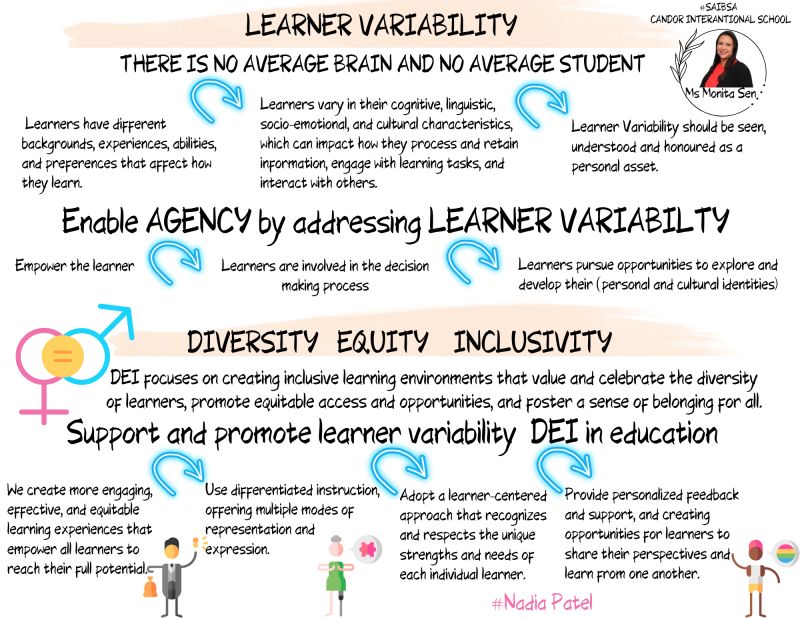
When you were introducing yourself you will have realised that no two people are identical. No two people learn in the same way. There is no average brain. “Variability is the dominant feature of the nervous system. Like fingerprints, no two brains are alike”. (UDL and the Learning Brain, CAST, 2018)
The Learner Variability Project by Digital Promise outlines four key domains of learner variability:
- Content knowledge: This encompasses the existing knowledge and skills a learner possesses in specific subjects like math or literacy. It's influenced by factors such as exposure, interest, and motivation, affecting how learners grasp and apply new information across different contexts.
- Cognition: Referring to mental processes and abilities like memory, attention, and metacognition, cognition varies based on developmental stage, genetics, and environment. It influences how learners process, organize, and regulate their learning.
- Social and emotional Learning (SEL): This domain focuses on emotional and social skills crucial for managing emotions, building relationships, and achieving goals. Skills like self-awareness, social awareness, and responsible decision-making are vital and influenced by factors like personality and emotions, impacting how learners handle stress, collaborate, and engage in learning.
- Student background: This encompasses personal and contextual factors like race, ethnicity, and socioeconomic status, shaping a learner's identity, culture, and experiences. It influences how learners perceive themselves, their peers, and their learning environment.
To learn more about these factors explore their models of learners at different stages of schooling.
THIS is a very straightforward guide to the four domains: Digital Promise: A Guide to Teaching Students about Learner Variability
"Learner variability is a term that embraces all students and does not exclude on the grounds of strengths, challenges, age, social status, economic status, language, gender, race, ethnicity or sexuality. Taking into account changing histories, circumstances and contexts, learner variability represents the shifting combination of strengths and challenges that learners experience. Within this understanding it is recognized that there is no average brain and thus no average student. Learner variability upholds that categorizing students according to diagnostic labels (ADHD, dyslexia, and so on) does not provide sound indicators of a student’s potential or appropriate teaching strategies." (Learning diversity and inclusion in IB programmes Removing barriers to learning, 2016)
"Variability in human development is the norm, not the exception. The pace and profile of each child’s development is unique. Because each child’s experiences create a unique trajectory for growth, there are multiple pathways—and no one best pathway—to healthy learning and development. Rather than assuming all children will respond to the same teaching approaches equally well, effective teachers seek to personalize supports for different children. Schools should avoid prescribing learning experiences around a mythical average. When they try to force all children to fit one sequence or pacing guide, they miss the opportunity to nurture the individual potential of every child, and they can cause children (as well as teachers) to adopt counterproductive views about themselves and their own learning potential, which undermine progress." (Linda Darling-Hammond and Channa M. Cook-Harvey, Educating the Whole Child)
Nadia Patel, PYP Coordinator at St. Mira’s School, Pune, Maharashtra, India, has produced this helpful overview of learner variability.
In the following video, Shelley Moore uses a great analogy of bowling to describe why planning for diversity and learner variability is good for everyone. In this analogy the ball is the lesson, the pins are the students.
“You have 10 pins and 2 balls and a lane. How is bowling like teaching? The ball is the lesson, the pins are the kids. We aim for the middle and do the best we can. The pins that are left standing we often get another chance of getting back to them but at the end of the day those two pins that are there staring at you are the kids who need most support. In professional bowling they throw the ball down the lane at a curve. It must enter at a curve because you will knock down more pins and create a biggest domino effect. In order to do that you have to change your aim – you need to aim for the pins that are the hardest to hit. We are taught to teach the head pins; we are not taught to teach the kids that are the furthest and hardest to get to. The thing that is critical here is that so often the support we design for the kids on the outside of the ring is often the supports that all the kids need.”
- How is bowling like teaching? Why do professional bowlers throw the ball down the lane at a curve? How does this relate to our teaching?
- How does she explain the value of diversity for all students?
Shelley Moore produces a series of five minute videos to help teachers nurture inclusive education. Click HERE.
In this video Tedd Rose explores the myth of the average learner.
How might his film provoke discussion or action in my context?
Consider some of the statements he makes in this talk:
- Learning is way more variable than a lot of people assume. That variability is essential when designing learning environments.
- Most people live in a world with a myth of the average learner. Neuroscience tells us that when it comes to the brain variability is the rule not the exception. That variability is harder to see sometime than foot size (i.e., the fact that we have different foot sizes).
- We need to design environments that meets the needs of this variability of the learner.
Consider how this resonates with the Theory of Multiple Intelligences espoused by Harvard Professor Howard Gardner, whose work documented “the extent to which students possess different kinds of minds and therefore learn, remember, perform and understand in different ways.” The focus is on each child’s abilities, and not their disabilities. Inclusive education asks us to tackle our own stereotypes, and to challenge and reverse any stigmas around disabilities. An inclusive teacher has an empathetic attitude towards the student, and works hard to ‘see’ each student.
"A deep sense of love and belonging is an irreducible need of all people. We are biologically, cognitively, physically, and spiritually wired to love, to be loved, and to belong. When those needs are not met, we don't function as we were meant to. We break. We fall apart. We numb. We ache. We hurt others. We get sick." Brené Brown |
We all perform best when we feel we belong. So, how do we create a sense of belonging in our classrooms for all our students?
As teachers, being inclusive means, we need to be proactive in ensuring that students in all their diversity (e.g., different socio-economic-cultural backgrounds, gender, abilities and disabilities etc) feel welcomed, respected, and fully able to participate in their learning. It is not only about creating a diverse environment but also about ensuring a culture exists where individuals can be their full selves.
The transcript of a film from Apple is: Open a door, and it opens all the others. Open a mind and see what happens next. No great thing, no beautiful invention, was created in a vacuum. It happens when we leave our comfort zone and come together. Embrace faiths, cultures, disabilities, differences. Embrace races, ages, ideologies, personalities, creating a tool or devise nobody saw coming. Humanity is plural not singular. The best way the world works is everybody in, nobody out. So, who we are made of is everyone. The truth is we don’t see things the same. The power is we don’t see things the same.
We all need to feel a sense of belonging. So how do we create inclusive learning environments?
- How do we design our learning environment in such a way that it creates a sense of belonging for all students? Consider physical characteristics (acoustics, lighting, air flow) as well as emotional characteristics (how do we welcome students, encourage them to feel safe {behavior policies}, and connected {to their peers and teachers}).
- How can lack of feeling you belomng affect your well-being? Discuss in relation to students you know.
For centuries, Western society has been built upon three distinct divisions: the disconnect between individuals and themselves, the divide between "the other" (or those perceived as different), and the detachment from the Earth. However, John A. Powell, a prominent figure in civil rights, structural racism, poverty, and democracy, and the Director of UC Berkeley's innovative Othering & Belonging Institute, argues that this perception of separation is flawed. He contends that we are intricately linked to one another. The pressing task before us is to confront the entrenched barriers that have been ingrained within us over time, and to recognize our inherent interconnectedness with each other and with all forms of life. This, he suggests, is essential for navigating the existential challenges we face and for fostering a more compassionate civilization.
Reflect
Where in your learning community may members (students, staff, parents) feel they do not belong? Here is an example from one school - yours make look very different.
Always check the labels
Does it make a difference if your teacher believes you are a high performer or a low performer | not a good student or a good student?
In 1963 experimental psychologist Robert Rosenthal from Harvard carried out an experiment on rats as part of his study on 'expectancy effects' - which became known as the self-fulfilling prophecy. He was actually carrying out the experiment on the handlers of the rats and not on the rats themselves. He wanted to find out if the expectations of the handlers themselves would affect how rats behaved. This experiment was then transferred to students in schools: seeing how the expectations teachers had of children would affect the children's academic performance.
Rosenthal titled his research paper "Pygmalion in the Classroom", named after the Greek legend of a sculptor who falls in love with one of his creations until his obsession brings the statue to life. Rosenthal's experiment demonstrated that children were transformed by the teachers' positive | negative expectations.
Reflect:
- We all label students - whether we mean to or not - it is an inevitable social process: what labels do we give?
- Once a label has been applied to a student it can be remarkably resistant to change: which labels do we need to change?
- How do we change? What climate do you establish in the classroom - what expectations do you have? When the climate is pleasant for students it is much easier for them to enjoy and engage with the work? What is the quality of the feedback we provide - students expected to achieve more are often given more frequent and valuable feedback - so are we doing this for all students? What work do we expect students to do - if we expect students to be able to achieve we always provide challenging work - ensuring that appropriate support is given to those who may at first struggle? What output do we expect from students? Do we always encourage high levels of responsiveness from each student? Teachers often encourage greater responsiveness from those students they expect more from - they give them longer to think about a question before moving on to another student and demand longer and more complex responses to homework assignments.
- Labels, as Rosenthal demonstrated, can have important real-world effects.
Think of a student who is struggling in your class:
- What do we believe they are capable | not capable of?
- Do we speak of their 'ability' or of their current and potential future performance?
- How do we differentiate to meet their needs? Do we create easier tasks or set the same task as high performers but provide more support for them?
- To what extent do we value 'getting it right' as opposed to 'taking risks and having a go'?
- What implications does this have for messages we give to parents | students?

What are barriers?
A barrier is an obstacle that stops a student engaging in learning. It is a place where students get stuck in their learning. As teachers we need to identify, minimise and remove barriers to learning and well-being hidden in our teaching.
- Look back over your own learning: can you identify any barriers you experienced? When and why did you experience these barriers?
- Reflect on this statement by the IB and identify any potential barriers to learning:
“It is the responsibility of the school and the leadership team to put in place processes to remove barriers to learning for every member of the school community. Barriers to learning may be found in the way schools are organized and resourced, their cultures and policies, the approaches to teaching and learning, the physical aspects of buildings and the ways in which individuals within the school community interact with each other.” (The IB guide to inclusive education: a resource for whole school development, 2019)
Identify the barriers
Barriers are often created when we offer single approaches to learning and assessment that don't allow flexibility. Reflect on how each of the following may form a barrier to learning and consider ways in which you intentionally identify potential barriers within learning experiences?
The IB have produced a helpful table of primary and secondary barriers in their document Access and inclusion policy (pages 7-9) that can be found on the PRC.
- Goals - are the learning goals engaging, relevant, related to what student's value?
- Classroom environment: is it welcoming? is it gender sensitive? is it culturally sensitive?
- Attitudinal barriers
- Prior knowledge of students: their absence of prior knowledge / understanding
- Vocabulary: mastery of key vocabulary / concepts: do you know what their starting points are, where their gaps are?
- Learning styles of students: what are their individual learner preferences, abilities and interests?
- Cognitive processing: language processing, executive processing, long-term retrieval, working memory etc.
- Stereotypes: what stereotypes do we have as teacher / they as learners? gender stereotypes, ethnic stereotypes?
- Bias: our own as teachers, and those of students
- Pedagogy: are we teaching the way our students learn or the way we learn?
- Assessment: what variety of assessment tasks do we offer? Is it focused on enabling students to demonstrate their learning?
- Culture: are we valuing the culture, language and identity of our students and ensuring that the material we teach is culturally relevant?
- Social / emotional challenges - reasons for engaging in the learning; low self-esteem, lack of confidence, low expectations of self; gender identity related; emotional disturbances.
Once we have identified potential barriers to our students learning, how can you / we proactively plan to minimise them?
Reference: How to break down barriers to learning with UDL
See also: The UK Government have produced a set of six posters with general guidelines for designing accessible web content. These posters are also useful considerations for general classroom planning and content design. They focus on autistic spectrum, screen readers, low vision, dyslexia, deaf or hard of hearing and physical or motor disabilities.
(Image source: Generated by deepai.org)
"Access arrangements must be considered in instructional planning as part of universal design for learning (UDL). To learn about UDL and how it can be used in the IB classroom, please refer to the publication Using Universal Design for Learning (UDL) in the IB classroom (IB, 2016)." (Access and inclusion policy, that can be found on the PRC)
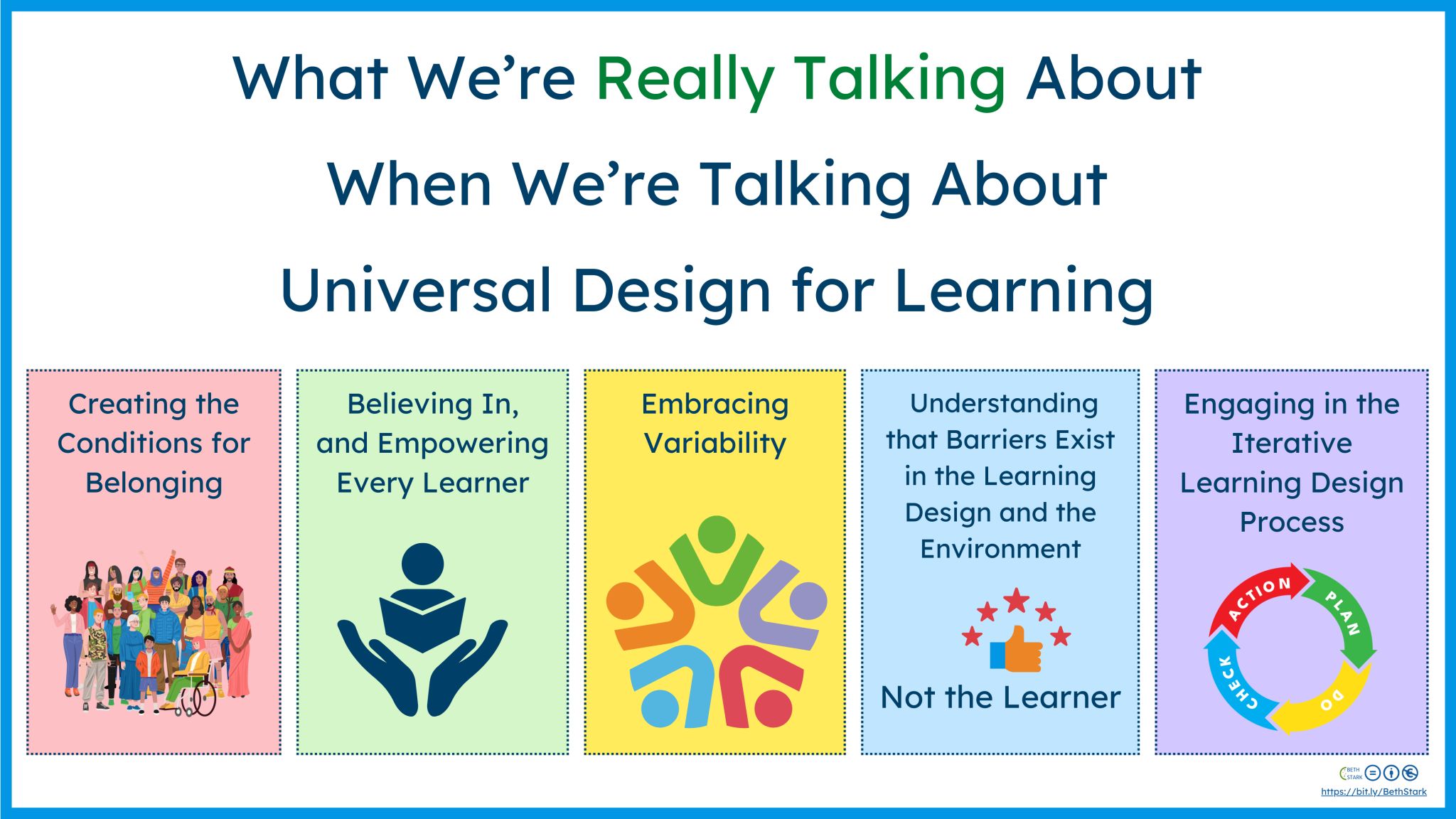
The three main principles of UDL were formed based on these three brain networks. They are:
- Engagement = the ‘why’ of learning: give students choices to fuel their interests and autonomy
- Representation = the ‘what’ of learning: present curriculum content in multiple media
- Action and Expression = the ‘how’ of learning: give students options for expressing what they know
UDL is a teaching framework that identifies barriers in the learning enviornment rather than in 'deficiencies' in the student.
The following video explores each of these principles.
- Which of these three principles (a) do you feel you are strong at, and (b) do you feel you need to develop further?
- Tools of the Trade: An innovative organization provides free tools and resources to make learning accessible to all students, Jones, 2015 – this is a good curation of tools provided by CAST.
- CAST have produced helpful tips on implementing each of these principles. Check one or all of the following out and share strategies with your team:
Top 10 UDL tips for designing an engaging learning environment
UDL tips for developing learning goals
UDL tips for designing learning experiences
The Ultimate Guide to UDL: UDL Resource Roundup
This article uses the analogy of a dinner party to compare differentiation strategies with UDL
With RTI, schools use data to identify students at risk for poor learning outcomes, monitor student progress, provide evidence-based interventions and adjust the intensity and nature of those interventions depending on a student’s responsiveness, and identify students with learning disabilities or other disabilities.
Resource: Essential Components of RTI – A Closer Look at Response to Intervention
MTSS stands for multi-tiered system of supports. It’s a framework many schools use to give targeted support to students. You may also hear it called the MTSS framework, the MTSS process, or the MTSS model.
To learn more go to their website: What is MTSS?
“Culture is an important aspect of a school because it shapes the social and intellectual environment in which students learn. A positive school culture can foster a sense of community, promote inclusivity and diversity, and create a safe and supportive learning environment. It can also provide a common set of values and expectations that guide students' behavior and help them to achieve academic success. In addition, culture plays a role in shaping students' identities and helping them to understand their place in the world. This can help to promote self-esteem and a sense of belonging, which are important for students' overall well-being.” (Dwayne Primeau, Principal at Osaka YMCA International)
"it is important to raise questions about inclusiveness - we often get carried away assuming other people are like us, so it helps to have a habit of asking to think deliberately of people and situations that are different and how we might adapt our opinions or approaches to include them." (Stefan Rashkov, MYP coordinator at Bulgarsko Shkolo)
Here are some top tips
Examine your beliefs: What is your ‘image of the child’? Do you believe all children are inherently intelligent, curious, and creative? Do you recognise their passions and capabilities? Do you trust them to learn for themselves and others? What do you believe about learning? How does learning take place? As a school and individually do you have an agreed and informed belief system about what learning is and how it takes place in a students' mind? Do you know individually and as a school which teaching practices are most effective in bringing about learning? How have you arrived at this understanding? Have you carefully examined the extent to which your practice aligns with your beliefs?

Be clear about your message: What messages are you giving out? School leaders are the ‘storytellers. Consider your key mantras / messages. Do your mantras draw attention to individual students, their diversity and variability? How do you show that you respect and value the diversity and variability every student brings?
Do you see every learner as an individual? How well are individual students' known - their learning styles, their barriers to learning specific things, their interests, and passions? Are you tempted to refer to the class as ‘they’ or do you always consider everyone's personal story?
- Recalibrate power: Who decides what is learnt - the teachers or the students? Who decides how students learn - the teacher or the students? Who makes most of the decisions about learning - the teacher or the student? Do you believe the learners can really lead the learning? Is initiative valued over compliance?
- Establish the learning culture: What is the language of your classroom? How do you talk about 'the work' of learning? Do you speak about tasks which have to be completed (and assessed) or do you all speak the language of learning? Is how we learn as much a part of the conversation as what we learn? Are students aware of who they are as learners? Are learning dispositions noticed and named? Do you and your students believe that reflection and metacognition are integral parts of learning?
- Set high expectations for all: How do you demonstrate that you have high expectations for all your students? How do the teaching practices and assessment processes in your school enable students to meet those expectations?
- Consider your school ecosystem: What understandings of diversity are operating in your school? How does this relate to diversity of learners? What are you doing strategically that values and addresses diversity? To what extent do your school’s assumptions and expectations about students open or shut down opportunities for students to learn?
- Watch your language: “Language is one of the most powerful tools we have as humans. It binds us. It instructs us. When used well, it creates a common understanding. And it’s essential for creating an environment where everyone feels welcome and included.” (Courtney Seiter) To what extent do you value and respect the diversity of students by ensuring inclusive language is used in all written and spoken communication? Check for deficit identifiers that lower expectations, affirm stereotypes or are discriminatory. For example, do you use the term 'dyslexic student' or 'Student with dyslexia'? Also use gender-inclusive language respects and acknowledges the gender identities of all people and removes assumption. Use ‘everyone’ / ‘all’.
As one school leader says, “My task will be to foster a culture that emphasizes finding solutions and possesses the ability to tackle problems, enabling us to welcome the diverse learning styles of each student and empower them to excel to their highest potential and beyond."
The following information sheet has been prepared by the New Zealand Government. It provides a helpful overview of key indicators of an inclusive school culture.
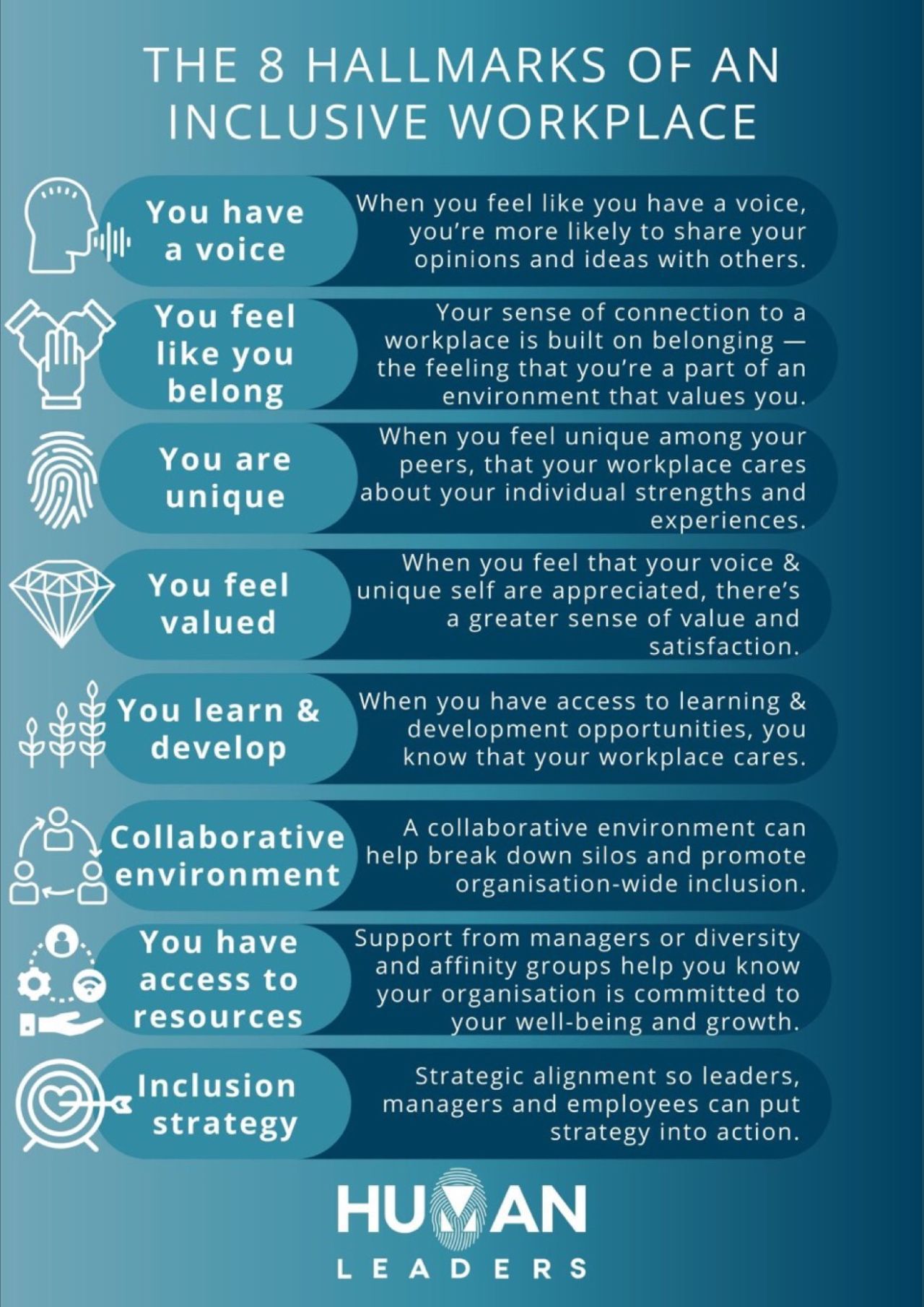
This infographic, although not specific to schools, explores what an inclusive work environment looks and feels like.
This infographic is helpful when considering a whole school policy:
An IB school should foster a dynamic school culture centred on holistic, inclusive learning communities. IB Standards and Practices relating to the Diploma Programme refer to five IB mandated policies. They are: Admissions Policy, Language Policy, Inclusion Policy, Assessment Policy and Academic Integrity Policy. These policies are important to both the authorization and five year evaluation processes since they are central to the implementation of the Diploma Programme.
Reflect: How do our policies become living and breathing things that reflect the culture and context of our particular school and not just copies of other schools' policies which are locked away in a handbook never to be referred to? Look up how the organization 'Character Lab' do this. They are not a school but have developed a 'Culture Book' in which they identify their key values and then give practical examples of 'what this looks like' and 'what this sounds like'. For example:
Value: Excessive Generosity
This means: We give without asking | We assume the best in others
What this looks like: Cleaning up messes - big, small and metaphorical | Receiving generously too.
What this sounds like: "Of course, I'd be happy to help you with this project!" | "Hey - I know you have back-to-back meetings today, so let me grab you some lunch.
Consider: How do I lead the implementation of these policies? What evidence do I look for that they are being implemented with fidelity? How do we make it clear what the policy looks like and feels like in practice in our school? What practical examples can we give of our expectations?
Look up examples using this LINK: Inclusion Policy
The PRC (Programme Resource Centre) on 'MyIB' contains some very helpful documents.
- Learning diversity and inclusion in IB programmes Removing barriers to learning (2016): very helpful section on pages 5-6 considering barriers to learning from multiple perspectives - a whole school approach.
- Meeting student learning diversity in the classroom Removing barriers to learning (2019)
- Access and inclusion policy (2022): very helpful list of barriers to learning on pages 6-9 and a decision tree tool to plan assess arrangements on page 12).
- Using Universal Design for Learning (UDL) in the IB classroom (2016)
- The IB guide to inclusive education: a resource for whole school development (2015) for a full set of reflective questions to guide schools when developing learning plans.
- Removing barriers to learning: what does inclusion mean for the IB? IB Blog, August 26, 2019
- Guide to Universal Design for Learning, New Zealand Ministry of Education: this is an excellent introduction to the subject.
- Leading schools that include all learners: Strategies to ensure all students are supported to engage, participate, and achieve in ways that honour and value diversity. New Zealand Ministry of Education:
- Inclusive Schools Network–ISN is a digital resource for families, schools and communities looking to design and implement effective inclusive schools. They offer a wide variety of resources including assessment tools, collaboration strategies, technology advice and much more.
- National Center for Learning Disability – NCLD advocates for people with disabilities offering programs and resources for parents, young adults, professionals, and educators. They also publish reports and studies on a range of topics related to disability and offer scholarship information for students with learning and attention issues.
- TASH – TASH works to advance inclusive communities through advocacy, research, professional development, policy and information and resources for parents, families, and self-advocates. They offer several different publications including a blog, annual reports, a podcast and more.
- International Forums of Inclusion Practitioners - a helpful website.
- The inclusion umbrella. To use the course all you have to do is (a) register to become a member of the IFIP (FREE) and log in. See here: https://lnkd.in/gg_n_D7J; (b) Click on ‘Courses’ and join ‘The Inclusion Umbrella’ here: https://lms.ifip.group/ Use the FREE ACCESS CODE: FDA68
- ECIS, Differentiation and Inclusion - a very good article to share with staff.
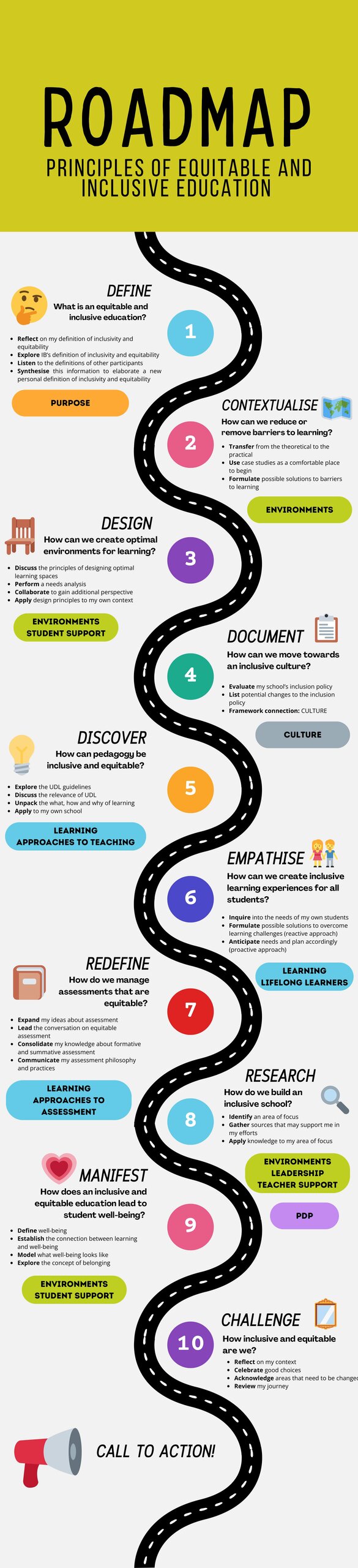
The IB offer a Category 3 workshop on Principles of equitable and inclusive education.
Key principles informing this workshop include:
- Learner variability: Acknowledging diverse learning needs and assessment methods.
- Equity and inclusion for all students: Recognizing barriers beyond formal needs statements.
- Equitable and inclusive learning goes hand in hand with universal design for learning (UDL): The three main principles of universal design for learning are: representation (the what of learning—giving students multiple ways to access material); action and expression (the how of learning); and engagement (the why of learning).
- Equity and inclusion involve the whole school community: Barriers to learning may be found in the way schools are organized and resourced, their cultures and policies, the approaches to learning and teaching, the physical aspects of buildings and the ways in which individuals within the school community interact daily.
- Equitable and inclusive education is a journey: The IB expects schools will all be in different places as they both increase access and engagement, and reduce or remove barriers to learning.
I am grateful to IB Educator Susana Arango Moreno, Colombia for this visual roadmap of the workshop.