Authorization requirement: Course outlines
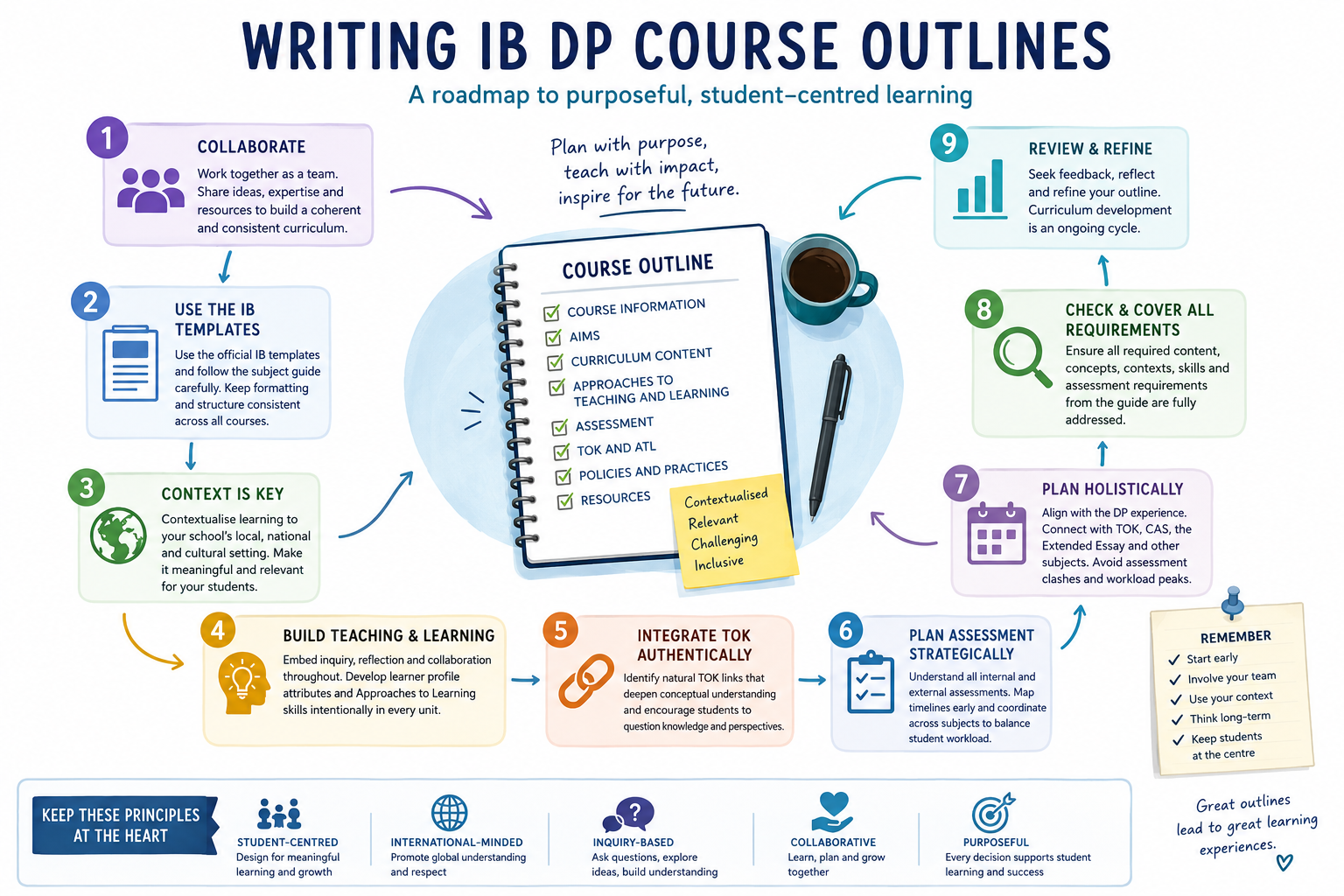
Course and core outlines are a key requirement during the candidacy phase. These outlines ensure that every course, along with the core components of TOK, CAS and the Extended Essay, is carefully planned in alignment with IB philosophy, programme standards and current subject guides. They also help schools demonstrate how teaching, learning and assessment will be delivered in a coherent and student-centred way within the school’s own context. Teachers are expected to draw upon their Category 1 workshop learning, subject guides and IB support materials when completing these outlines.
All outlines must be completed and submitted to the IB as part of the school’s Application for Authorization, before the verification visit takes place. Schools then receive feedback reports and are given the opportunity to revise and strengthen outlines where needed.
Because IB subject guides are reviewed periodically, schools must also remain aware of curriculum revision cycles and be prepared to update outlines when new guides are released.
This page provides you with guidance on how to go about writing these course outlines so that they meet IB requirements.

- Collaborate consistently: Train all teachers involved in outline writing in the principles of course outline development and agree shared expectations, terminology, planning structures and levels of detail across departments.
- Use IB documents: Follow subject guide requirements carefully while using consistent formatting and structure across all outlines. The IB has produced templates for course outlines in all subject groups, CAS and TOK. Use this template - it can be found on the Programme Resource Programme under the DP programme.
- Differentiate for SL and HL pathways: Plan course outlines with clear consideration of whether classes include SL students, HL students or mixed groups so that pacing, challenge and extension opportunities are appropriately structured.
- Map the programme holistically: Consider the wider Diploma Programme experience by coordinating timelines, connecting learning to TOK, CAS and the Extended Essay, and avoiding assessment overload at key points in the two-year programme. Identify meaningful TOK connections within subjects that deepen conceptual understanding and encourage students to question knowledge and perspectives naturally.
- Audit curriculum coverage: Check systematically that all required guide components, prescribed content and assessment expectations are fully addressed within the course outline.
- Contextualise learning: Ensure outlines reflect the local, national and cultural context of the school so that learning remains meaningful and relevant for students. You can specifically do this in your selection of resources.
- Indicate some local resources where possible (university or research lab or libraries, visits to relevant places -for visual art, for science courses, or to one or two businesses), for example - use of French and German government and local resources, theatre perhaps for English . This is in addition to the name of online resources and publications which will be a support for the teacher (and perhaps for students).
- Embed approaches to teaching and learning: Build inquiry, reflection and collaboration into course planning while intentionally developing learner profile attributes throughout units and learning experiences.
- Integrate CAS purposefully: Identify authentic opportunities for students to engage with Creativity, Activity and Service experiences that connect meaningfully to subject learning, personal growth and community engagement rather than treating CAS as an add-on.
- Embed learner profile attributes and school values intentionally: Plan learning experiences that explicitly develop relevant IB learner profile attributes and reflect school values, ensuring these are visible, purposeful and connected to unit objectives and student reflection.
- Use technology responsibly and effectively: Select digital tools and resources that enhance teaching and learning while ensuring all technology use aligns with the school's technology use policy, promotes digital citizenship and safeguards student wellbeing and data privacy.
- Plan for continuity of learning: Develop contingency plans for online or hybrid learning by identifying suitable alternative activities, assessment adaptations and digital resources that allow students to continue meeting learning objectives if face-to-face instruction is disrupted.
- Document and sequence IB assessment requirements clearly: Ensure each course outline explicitly states how internal and external assessments are introduced, developed, and completed over the two-year course, including timing, preparation stages, and support for students to meet IB assessment criteria.
- Think beyond authorization: Use the outline development process to strengthen long-term programme development, curriculum coherence and communication with the wider school community.
- Plan realistically around the school calendar: Build course outlines around practical scheduling considerations such as holidays, examination periods, study leave and reporting cycles to ensure the programme remains manageable and coherent.