How can we be more inclusive?
What are some of the issues we need to address in order to be more inclusive?
"Inclusion is not just about inviting others to the table; it's about ensuring that every voice is heard, valued " So how do we do it?
“As one school headteacher has put it, ‘I show the children the plants in the playground and I point out that even if I water them all in the same way, some will flower quicker than others, but all of them will flower. And all children will succeed even if some of them need more time’” (Le Monde de L’Education)
‘When a flower doesn't bloom, you fix the environment in which it grows, not the flower.’ (Alexander Den Heijer)
(Image source: Included Diversity Concept - Free photo on Pixabay )

This is a helpful discussion activity to use with both teachers and school leadership teams. It is a way of imagining.
Ask participants to imagine themselves in the shoes of students facing various inclusion challenges. Create scenarios or case studies that highlight different aspects, such as learning disabilities, cultural differences, or socio-economic disparities. Have participants reflect on how these challenges might impact a student's daily experiences, interactions with peers and teachers, and overall well-being within the school environment.
Afterwards, facilitate a discussion where participants share their reflections, insights, and potential solutions. Encourage them to consider the emotional and practical aspects of inclusivity, fostering empathy and a deeper understanding of the challenges faced by diverse learners. This activity promotes a holistic perspective on inclusion and can spark meaningful conversations about creating a more supportive and equitable school environment.

List of challenges: Consider the following list of challenges related to inclusion that you may face in the school environment. This list includes items such as bias, limited resources, parental engagement, resistance to diagnosis, and stakeholder involvement.
- Individual reflection: I review the list and rank the challenges based on your perception of severity and relevance within the school context. You can use a numerical scale (1 to 5, with 5 being the most critical) or any other method that suits your preferences.
- Group discussion: Form small groups or conduct a whole-group discussion where colleagues share their rankings and reasoning behind their choices. Encourage open dialogue to gain diverse perspectives on the challenges.
- Consolidate rankings: As a group, work towards consolidating the individual rankings into a collective prioritized list. Discuss areas of consensus and identify any challenges that may require further exploration or clarification.
- Action planning: Based on the prioritized list, initiate discussions on potential strategies and action plans to address the top-priority challenges. Encourage colleagues to brainstorm practical solutions and identify key stakeholders involved in implementing these changes.
- Documentation: Have a designated person or group document the prioritized list and the proposed action plans. This document can serve as a reference point for ongoing discussions and efforts to enhance inclusivity within the school.
(Image source: Checklist Check Yes Or No Decision - Free photo on Pixabay )

Do we recognise our biases? Bias perspectives among school members may hinder inclusivity, necessitating ongoing awareness sessions and training.
- Awareness raising: Developing policies and practices that address the intersectionality of different forms of discrimination, such as racism, sexism, and homophobia. Addressing community cognizance of inequality in all its forms including race, ethnicity, gender, socioeconomic status, disability, and sexual orientation.
- Limited budgets in some schools can impede equal access to resources and appropriate infrastructure for all students.
Insufficient parental engagement may hinder understanding and support for inclusive education, requiring increased efforts from schools to involve parents in awareness sessions and events. Some parents may resist diagnosing their children and providing necessary documentation for inclusive arrangements due to concerns about labelling or stigma.
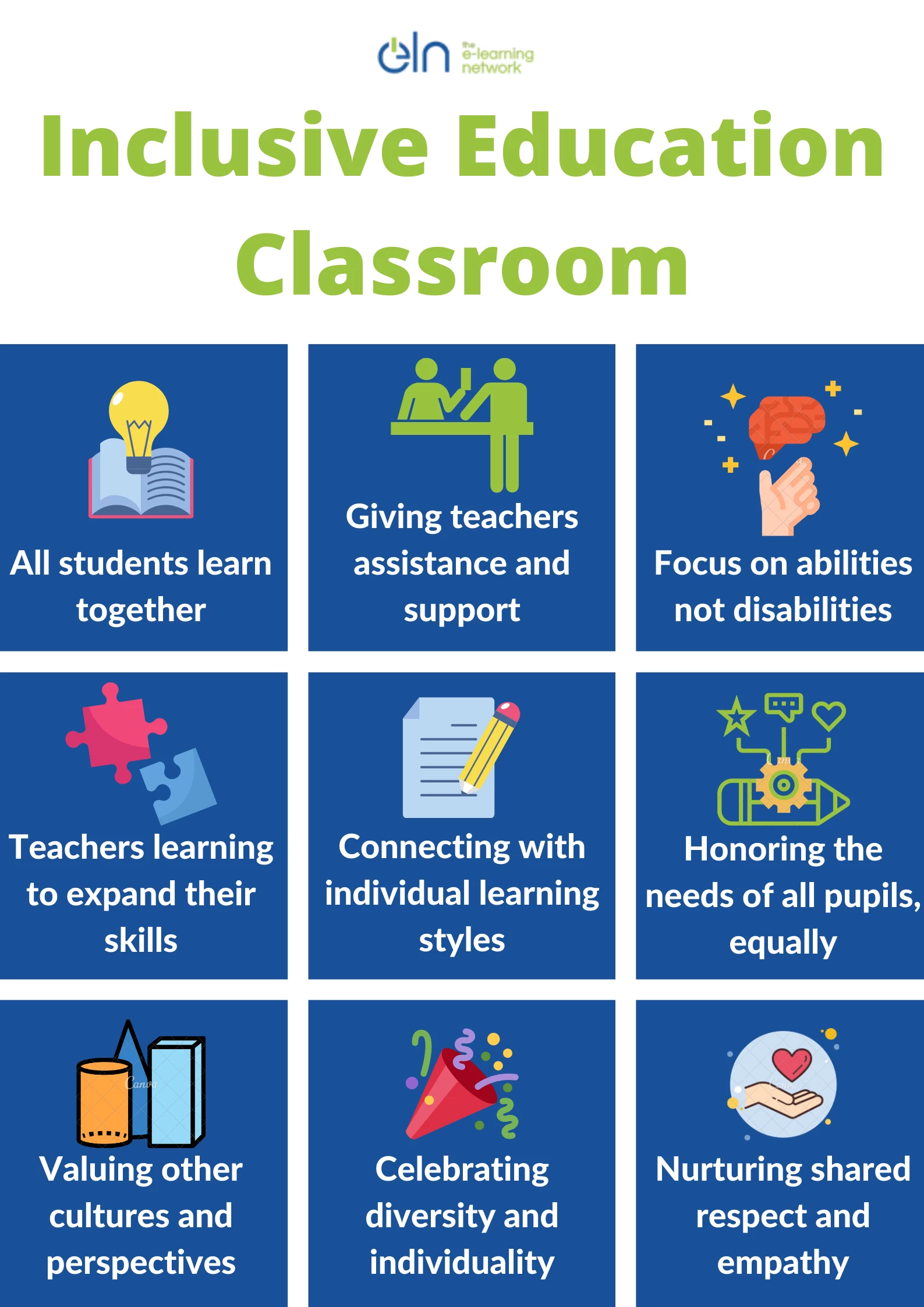
- Pedagogical challenge: Implementing inclusive education may challenge traditional teaching systems, necessitating a shift in mindset. This involves increasing awareness, educating stakeholders, providing necessary support and resources, and continuously evaluating effectiveness. Teacher training must allow the use of various tools such as Universal Design for Learning (UDL) or some other model that the school considers relevant, to adequately plan meaningful learning situations for students.
- Assessment: As we customize education for individual students, what should the structure of summative assessments look like? Shouldn't our starting point involve being flexible and adaptive to accommodate all students, regardless of their unique needs? What about DP assessments? If making the endpoint of these assessments inclusive isn't feasible, then it's crucial to ensure inclusivity throughout the learning journey leading up to them. This involves teaching students how to utilize the test to their advantage, providing them with a variety of test-taking strategies, and most importantly, creating an inclusive road to the exam itself. Teachers play a pivotal role in preparing students for assessments by helping them manage challenges, overcome barriers, and offering multiple paths to reach the same goal. The analogy of the journey to DP assessments underscores that while all students are aiming for the same destination, they can take different routes and approaches along the way to accommodate their individual needs.
- Contextual implementation challenges: Adapting inclusive principles to different contexts requires careful planning and collaboration among stakeholders. This challenge emphasizes the need for flexible strategies tailored to specific contexts and learner needs. Discussions on diversity, equality, inclusion, and justice in educational settings are subject to restrictions imposed by the Ministry of Education. These limitations may impact students' freedom to express their true identities, leading some to conceal their authentic selves.
- Mindset shift for inclusivity: Achieving genuine inclusivity calls for a fundamental change in mindset and a lasting commitment to a culture of inclusivity. This challenge urges us to reconsider and reframe our approach, valuing the unique contributions of every student. For example, what mindset and behaviours are conduits for change towards becoming more inclusive? What systems and structures are conduits of change for becoming more inclusive?
- Leadership and advocacy for systemic change: Pursuing true inclusivity may involve advocating for policy changes and systemic shifts. This challenge highlights the importance of actively engaging in reshaping structures and systems to embrace more inclusive education practices. What happens if leaders lack the understanding, inclusive mindsets, or skills to foster an inclusive culture in a school?
- The need for intentionality: How deliberate and intentional are we in our approach to inclusion and equity? In education, every step is a deliberate, ongoing process. Intentionality guides our path, while continuity ensures we take the necessary actions to reach our goals effectively.
This Checklist for an Inclusive Classroom Community is adapted from A Guide to Effective Literacy Instruction, Grades 4 to 6 – Volume Two Assessment, 2006, pp. 5–8.
Culturally responsive teaching is about making school learning relevant and effective for learners by drawing on students’ cultural knowledge, life experiences, frames of reference, languages, and performance and communication styles. This means making what students know, and how they know it, the foundation of learning and teaching interactions and curriculum. This is good for all students, but particularly so when there are significant differences between the world of the teacher and the world of the child.
Although the ASCD article “Essential Strategies for Inclusive Teaching” focuses on engaging black students, the points made in the article are relevant to all students. I especially like the conept of "warm demanding": "Holding students accountable to high expectations for learning and creating a supportive environment centered on high praise, scaffolded learning, and cultural affirmation goes a long way to engage and motivate Black students—all students, in fact."
- provide student voice and choice: engage students by involving them in shaping their learning topics and methods, which promotes autonomy and investment in their learning journey.
- utilize collaborative learning: foster motivation and engagement through group-based learning activities, especially beneficial for students from backgrounds that value communal and collaborative efforts.
- embrace “warm demanding”: blend compassion with high expectations, supporting students with empathy while also challenging them to reach their full potential and instilling confidence in their abilities.
- incorporate dynamic instruction: keep students interested and engaged with varied and interactive teaching methods that capture attention and maintain active participation.
- build strong family partnerships: actively involve families in the educational process to strengthen support for students and create a more inclusive learning environment.
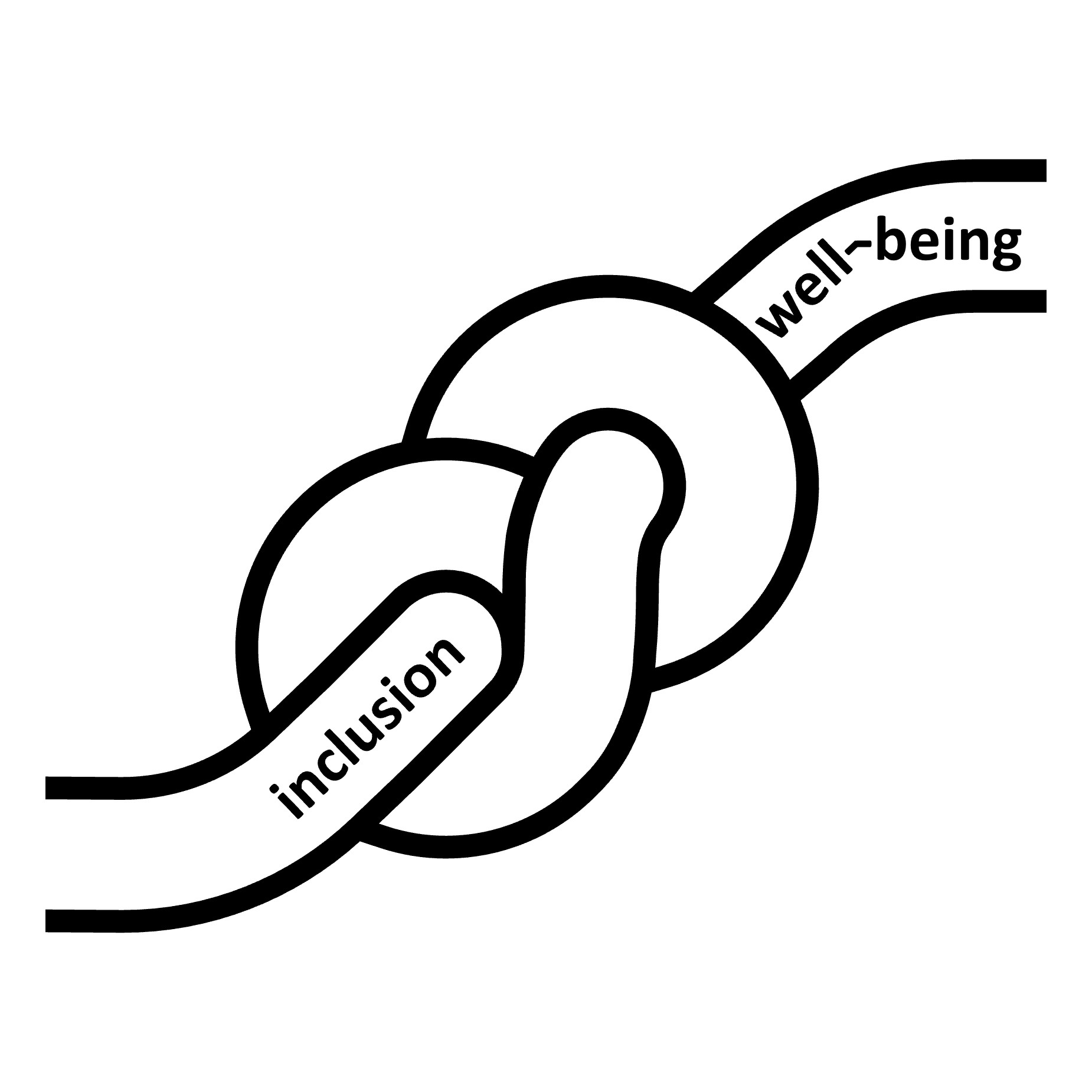
Note on the visual: Educational belonging can be seen as a bridge between inclusion and well-being
Fullbrook School worked with a company producing wall art to create this diversity and inclusion timeline.
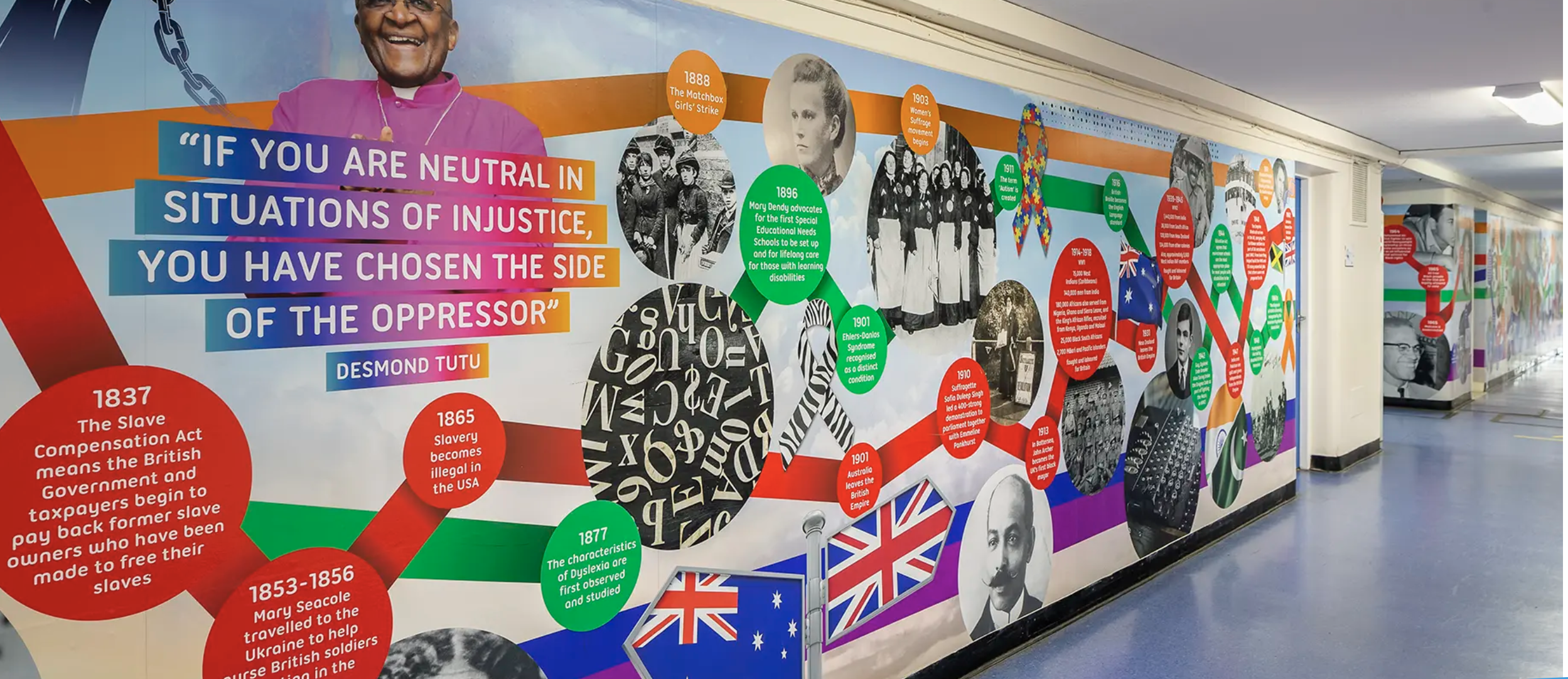
At Fullbrook School in the UK, a striking Diversity Timeline brings inclusion to life along the corridors. The colourful wall art charts milestones in diversity and inclusion across history, highlighting inspiring figures who fought oppression or championed equality. Through a mix of images and supporting information, the display offers students both a visual and intellectual experience—turning everyday spaces into opportunities for reflection. For those who, like me, enjoyed reading everything on classroom and corridor walls as children, this installation is both engaging and fascinating. It is also global in scope, drawing on examples from across cultures to illustrate progress in society. Inspired by this, I began to wonder whether my school could create a mosaic or tapestry art piece that celebrates the 40 nationalities represented in our student body, building the same sense of belonging and shared identity.
This raises some reflective questions for schools:
- How do our physical spaces reflect our values around inclusion and diversity?
- What kinds of displays or creative projects could help our students see themselves—and others—represented on the walls around them?
- How can visual storytelling encourage pupils to reflect on their own role in creating a more inclusive community?
- And, just as importantly, how can such projects go beyond decoration to become lasting reminders of empathy, respect, and the power of diversity?
What does true inclusion look like when students with disabilities are already in our classrooms—but still struggle to fully participate? At our school, we welcome students with a wide range of learning needs, including autism, Down syndrome, and slower learning profiles. While admission is not the challenge, ensuring meaningful participation, equitable access, and high-quality support within mainstream classrooms remains a pressing priority. The school continues to navigate the balance between segregation, integration, and full inclusion, striving to create an environment where every student can thrive academically, socially, and emotionally.
To explore solutions, we applied the “What If?” protocol, a forward-thinking framework that asks bold, systemic questions about inclusion. Rather than focusing on individual adjustments, this approach reframes inclusion as a design principle and considers questions such as:
- What if inclusion was built into every lesson from the start, using differentiation and Universal Design for Learning?
- What if support services were proactive, with co-planning, co-teaching, and early data-driven interventions?
- What if peers were trained as allies, learning empathy, collaboration, and inclusive communication skills?
- What if parents were true partners, sharing insights, attending forums, and contributing to progress discussions?
- What if leadership ensured coherence, aligning policy, professional development, assessment, and resource allocation to make inclusion measurable?
Reflecting on this process highlights its strength as a plan of action, not just a thought experiment. By identifying levers for change at classroom, systemic, and leadership levels, the exercise moves inclusion from aspiration to measurable practice. It emphasizes proactive support, shared responsibility, and a culture where every student is recognized as a contributor. Ultimately, the “What If?” protocol provides a roadmap for the school to evolve into a fully inclusive community—one where academic ambition, collaboration, and compassion coexist seamlessly, and where inclusion is a culture of participation, not a question of placement.
Stratford Hall in Vancouver has updated its learner profiles to reflect racial, cultural, neurodiverse, and LGBTQ identities, ensuring students see inspiring role models. The school’s commitment to equity is also visible in the images displayed on its walls, representing the diversity of its students.
Additionally, the Anti-Oppressive Education Committee works with coordinators to create an inclusive curriculum that connects learning to real-life experiences.
What might a professional development programme for staff look like which aims to explore, develop, and implement inclusive, equitable, and anti-oppressive practices. Participants will:
- Deepen awareness of diversity, equity, and inclusion (DEI) principles and their impact on student learning and well-being.
- Examine biases and systemic barriers within the school environment.
- Develop practical strategies to create inclusive classrooms and curricula that reflect diverse identities and experiences.
- Empower educators and students to challenge discrimination, promote allyship, and foster a sense of belonging.
- Engage in critical reflection to ensure DEI practices move beyond tokenism and are meaningfully embedded in school culture.
- Build confidence in addressing complex issues such as intersectionality, microaggressions, and decolonising the curriculum.
- Encourage collaboration among educators, students, and school leaders to co-create an equitable learning community.
Here are some suggestions of individual sessions to consider:
- Belonging in the classroom: creating inclusive learning spaces
- Unpacking bias: recognising and challenging our assumptions
- The power of representation: inclusive curriculum and role models
- Beyond tokenism: embedding diversity in everyday teaching
- Anti-oppressive education: moving from awareness to action
- Listening to student voices: co-creating an equitable school culture
- Intersectionality in education: understanding overlapping identities
- From bystander to ally: responding to discrimination and microaggressions
- Decolonising the curriculum: rethinking what and how we teach
- Restorative practices: fostering equity through conflict resolution