Change Management

Understanding change
"The notion of change is an extremely complex one and has been characterised as messy, uncertain, nearly chaotic, a disturbance, unmanageable, and even stressful and unpredictable process." (Antony Geralis)
Change and innovation are an essential part of schools. After all the core business of schools is learning. This includes the need for school leaders to continuously learn about best practice from any source and to rapidly convert this learning into action. However, we all know the dangers of the school leader coming back from a visit or workshop full of bright initiatives which fall flat as soon as they try and introduce them into their own context.
Whilst it is in the nature of schools as learning organizations to continuously evolve to ensure that it prepares its students to flourish in a fast changing world it is the challenge of the school leader to manage this change so that progress is sustained and people do not suffer from initiative fatigue.
In this section of the website we will:
- Recognize that individuals have different perspectives and contexts when facing change.
- Identify the challenges and risks of implementing change within schools.
- Understand how facilitative leaders can manage risk to support productive change.
(Image source: Change New Beginning Risk - Free photo on Pixabay )
This is a great little parable which many people have found helpful in facing organisation and / or personal change.

“Who Moved My Cheese?” by Spencer Johnson is a parable about change. Set in a maze, it features four characters: two mice named Sniff and Scurry, and two Littlepeople named Hem and Haw. They all search for “Cheese,” representing their desires in life.
- Sniff who sniffs out change early
- Scurry who scurries into action
- Hem who denies and resists change as he fears it will lead to something worse
- Haw who learns to adapt in time when he sees changing can lead to something better
The mice employ a straightforward trial-and-error method, while the Littlepeople use more complex strategies. When their favourite cheese vanishes from Cheese Station C, Sniff and Scurry quickly adapt and search for New Cheese. In contrast, Hem and Haw resist change, leading to frustration. The book highlights the importance of embracing change and adapting to life’s challenges.
Haw learned from Sniff and Scurry to not over complicate things. They kept life simple. When the cheese changed, they moved with the cheese.
The parable offers a useful starting point for thinking about individual responses to change. But school leaders face a more complex challenge: they are not simply managing their own response to change; they are leading a community in which people will respond differently.
Haws Summary
- Change happens – they keep moving with the cheese
- Anticipate change – Get ready for the cheese to move
- Monitor change – Smell the cheese so you know it’s getting old
- Adapt to change quickly – the quicker you let go of old change the sooner you can enjoy new cheese
- Change – Move with the cheese
- Enjoy the change – Savor the adventure and enjoy the new cheese
- Be ready to change quickly and enjoy it again and again – They keep moving with the cheese
Understanding how people respond to change
The Who Moved My Cheese? parable provides a simple way of thinking about how individuals respond to change. But, as school leaders, we also need to recognise that people respond to change in different ways—and that effective leadership requires us to work with these differences rather than simply trying to overcome resistance.
Ildar Iliazov's article, “The 5 ways staff respond to change – and how to work with all of them,” offers a useful framework for thinking about the different responses we may encounter within a school. Read the article: The 5 ways staff respond to change – and how to work with all of them — Ildar Iliazov, Tes, 31 July 2026.
Ildar Iliazov argues that school change rarely follows a simple, linear process because staff experience and respond to change differently. He identifies five groups: supporters, who engage early and create momentum; fence-sitters, who are not resistant but need convincing and are crucial to whether change gains scale; constructive critics, who challenge ideas and help identify unintended consequences; resisters, who may feel threatened and need to be listened to and supported rather than simply pushed into compliance; and friends, whose existing relationships with leaders can become complicated as professional responsibilities change. Iliazov argues that leaders should not treat all staff in the same way, but understand these different perspectives and work with them.
"Setting up a Theory of Change is like making a roadmap that outlines the steps by which you plan to achieve your goal. It helps you define whether your work is contributing towards achieving the impact you envision, and if there is another way that you need to consider as well." (DIY: Development, Impact & You)
Theory of change tool: click HERE.
What is change management? A short introduction.
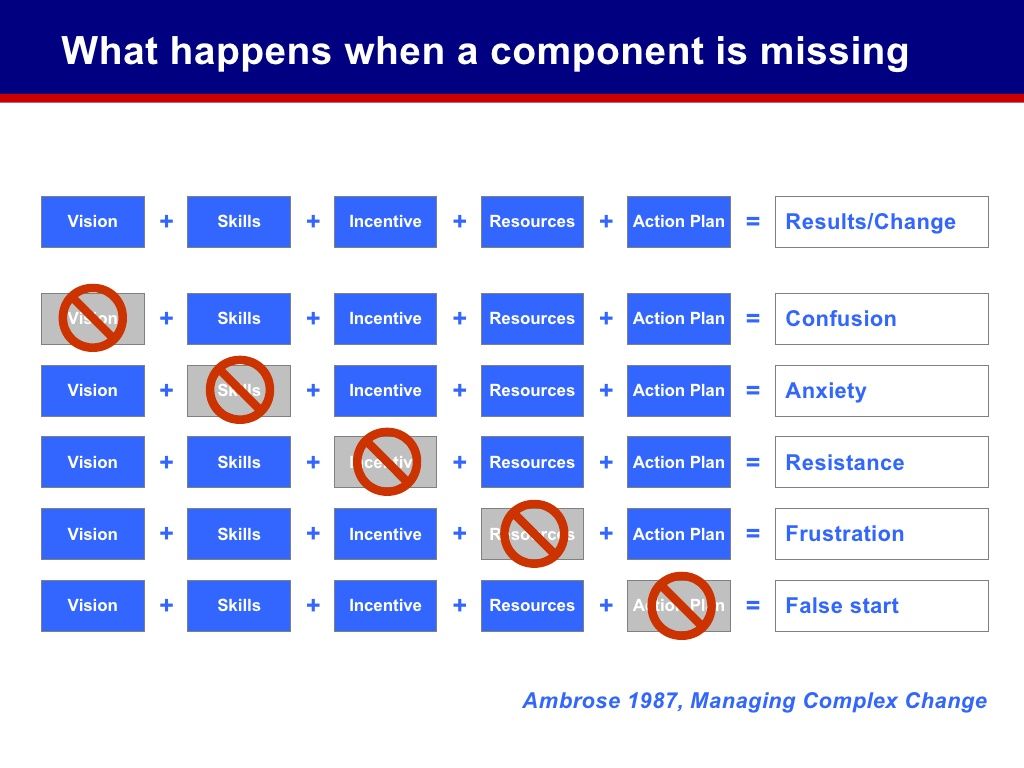
Delores Ambrose's change strategy matrix comprises five vital components:
- Vision: Establish a compelling future state to provide direction and unity, avoiding confusion during the change process.
- Skills: Equip individuals with the necessary capabilities to effectively participate in the change initiative and overcome potential anxiety.
- Incentives: Offer motivating rewards and benefits to encourage acceptance and minimize resistance to the proposed changes.
- Resources: Ensure access to essential physical and emotional resources required for the successful implementation of the change.
- Action Plan: Develop a clear and well-defined plan of action, preventing false starts and ensuring steady progress towards the desired outcomes.
Change management is crucial to the success and sustainment of any process or initiative, although all too often leaders underestimate the importance of the people side of change and tackle it at the last minute, if at all. Consider the “influence model:
- Understanding and conviction
- Reinforcement mechanisms
- Confidence and skill-building
- Role modelling

Acknowledgment: Infographic from McKinsey & Company and McLean & Company