Candidacy: Induction of staff to IB

New to the IB? Not sure where to begin?
Stepping into the IB can feel daunting. Each programme—PYP, MYP, DP, and CP—has its own language, structures, and expectations, and even highly experienced teachers often need time to find their bearings.
This induction course is designed with coordinators in mind. It offers a series of short, practical learning activities that you can adapt to your school’s context, timelines, and staff experience. You can dip in where it matters most or build a longer induction pathway over time.
The materials support you in leading purposeful staff induction, taking teachers quickly to the heart of IB philosophy and pedagogy. Through hands-on activities, participants develop confidence in IB thinking, curriculum design, and classroom practice—while also gaining a clear sense of how the IB works as a coherent whole.
The course is aligned with the IB Standards and Practices (2014), providing a clear, manageable framework for candidate schools preparing for authorisation and for building sustainable practice beyond it.
Note to coordinators
In this induction, we focus on the heart of the IB, framed around the IB Standards and Practices. These “big ideas” can sometimes get side-tracked, but they are central:
The IB is more than a curriculum; it is a programme driven by a bigger mission beyond individual subjects.
Teacher collaboration is essential for learning progression across the programmes.
The five mandated IB policies are not just paperwork—they shape everything we do in the classroom.
Each programme is distinctive, and understanding these differences is key to effective teaching.
Standard A: Philosophy - The IB Mission and International-Mindedness
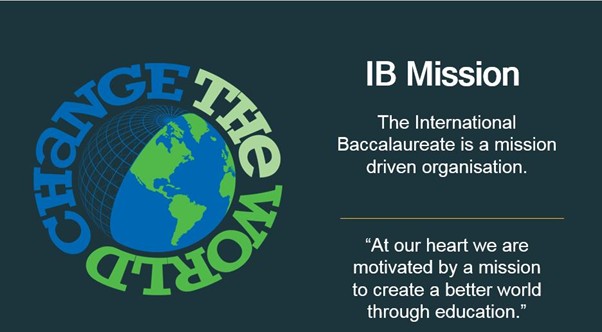
The International Baccalaureate (IB) is a distinctive educational framework because it is grounded in a powerful and explicit mission: to develop learners who contribute to creating a better and more peaceful world. Central to this mission is international-mindedness—the understanding that people hold different perspectives, cultures, and beliefs, and that these differences can be respected, learned from, and valued. This mindset is foundational to IB education and informs curriculum design, pedagogy, assessment, and relationships across the school community.
The IB mission statement reads:
“The International Baccalaureate® aims to develop inquiring, knowledgeable and caring young people who help to create a better and more peaceful world through intercultural understanding and respect. To this end the organization works with schools, governments and international organizations to develop challenging programmes of international education and rigorous assessment. These programmes encourage students across the world to become active, compassionate and lifelong learners who understand that other people, with their differences, can also be right.”
Activity: Exploring the IB Mission (Authorisation Focus)
Read the IB mission statement carefully.
Discuss and highlight:
- Key words or phrases that stand out.
- How the mission emphasises international-mindedness, intercultural understanding, and respect.
- Where the mission reflects values beyond academic success, such as compassion, agency, and lifelong learning.
Collaborative reflection:
- How does the IB mission align with your school’s current mission and vision?
- Where are there strong connections? Where are there differences?
- What changes, if any, might strengthen alignment between the school’s mission and IB philosophy?
- How could clearer alignment impact school culture, identity, and long-standing traditions?
(Optional activity: Compare the IB mission and the school mission using a Venn diagram or other visual tool.)
Activity: IB Learner Profile
The IB Learner Profile translates the mission into lived dispositions and behaviours for both students and adults.
Reflect:
- Which Learner Profile attributes do you already demonstrate in your professional or personal life?
- Which attributes would you like to develop further as an educator or leader?
Application to teaching and school culture:
- How can each attribute be intentionally nurtured in students through curriculum, pedagogy, and assessment?
- What classroom routines, learning experiences, or school practices support the development of international-mindedness alongside other Learner Profile attributes?
- How might adults in the school model these attributes in professional dialogue, collaboration, and decision-making?
Standard B1: Leadership and Structure - The culture of an IB school
During IB candidacy, leadership is less about monitoring compliance and more about creating shared understanding and coherence. IB policies are one of the key ways school leaders ensure that the IB philosophy moves from intention to lived practice. This activity explores how policy supports teaching and learning—and how leadership enables that work to be consistent, meaningful, and sustainable.
IB policies: from paper to practice
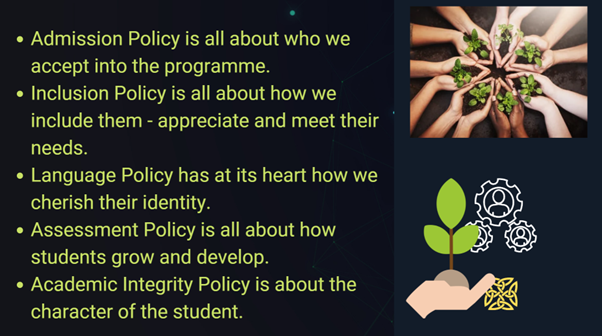
The written and unwritten rules of an IB school are articulated through the five IB-mandated policies, which sit at the heart of IB culture:
- Admissions Policy – who we welcome into the programme
- Inclusion Policy – how we support and value diverse learner needs
- Language Policy – how we affirm identity and multilingualism
- Assessment Policy – how students learn, grow, and demonstrate understanding
- Academic Integrity Policy – how we develop ethical learners
These policies are not abstract documents. They shape everyday decisions, interactions, and expectations in classrooms across the school.
Activity: Bringing IB policies to life in my classroom
This activity is designed to help translate IB policy requirements into observable classroom practice, while also highlighting the leadership structures that support consistent implementation.
Step 1: Read and translate
Working with a partner, choose one IB policy
- Read the policy
- Complete the sentence:
“If the IB says this, then in my classroom I need to…”
Focus on practical, visible actions rather than general intentions.
Step 2: Make it visible
Select one key expectation from the policy and describe:
- What this looks like in day-to-day classroom practice
- What this sounds like in teacher and student language
(For example: feedback routines, student support strategies, assessment practices, classroom norms.)
The aim is to move policy from documentation to lived experience.
Step 3: From classroom practice to whole-school coherence
With your partner, reflect on the wider system that supports this policy:
- How does this expectation rely on shared understanding across the school?
- What leadership actions or structures help make this practice possible (e.g. time, guidance, collaboration, consistency)?
- What might happen if this policy were interpreted differently across classrooms?
This step highlights how leadership and systems ensure continuity and coherence, as outlined in Standard B1.
Creating an IB culture is not about perfect implementation from day one. It is about building collective capacity, shared purpose, and consistent practice over time. When policies are clearly understood and thoughtfully enacted, they become one of the most powerful tools for sustaining the IB philosophy in classrooms and across the school.
Standard C: Curriculum - Transdisciplinary | Interdisciplinary | Disciplinary learning
How learning develops
The International Baccalaureate (IB) continuum offers a coherent progression in how students learn, moving from transdisciplinary to interdisciplinary and disciplinary approaches across the PYP, MYP, and DP/CP.

In the Primary Years Programme (PYP), learning is transdisciplinary. Students explore broad, real-world themes such as How the World Works, integrating knowledge and skills from multiple disciplines to inquire into big ideas and authentic questions. Like a cake, learning is blended into a unified whole, fostering inquiry, agency, and holistic understanding—while resting on strong subject foundations.
The Middle Years Programme (MYP) emphasises interdisciplinary learning. Students intentionally connect two or more subjects to explore shared concepts or problems, such as linking Science and Individuals & Societies to examine sustainability. These connections matter because real-world challenges do not sit within single subjects; interdisciplinary learning helps students transfer knowledge, see patterns, and apply understanding in meaningful contexts. Like a stew, disciplines remain distinct while enriching one another.
In the Diploma Programme (DP) and Career-related Programme (CP), disciplinary learning comes to the fore. Students develop depth, rigour, and expertise within individual subjects, like a carefully prepared single dish, while still drawing on interdisciplinary thinking and real-world application.
Linked page: IB Continuum
The IB Learning Continuum in Practice
This activity helps colleagues understand transdisciplinary, interdisciplinary, and disciplinary learning and apply these approaches to the age group they teach, while recognising how learning develops across the IB continuum. The IB continuum reflects how learners develop — from integrated understanding, through purposeful connections, to increasing subject specialism.
Step 1: Which approach fits your learners?
Read the short curriculum overview and are shown the three images:
Cake (blended learning)
Stew (connected disciplines)
Single dish (subject depth)
Discuss:
Based on your experience of the age group you teach, which approach feels most appropriate and why?
What can learners at this age do well, and what do they still need support with?
Where do you already see elements of the other two approaches in your teaching?
Step 2: What does this look like in your classroom?
Reflect:
Think of a unit or lesson you teach.
How does it reflect the dominant approach for your learners?
What is one practical way you could strengthen learning at this stage (e.g. clearer concepts, better connections, deeper subject focus)?
Step 3: Seeing the continuum
Every teacher plays a role in the IB continuum by teaching appropriately for their learners while contributing to a coherent, holistic journey.
Discuss:
How does your teaching prepare students for the next stage of learning?
Why is it important that students experience all three approaches over time?
APPROACHES TO LEARNING: Students as lifelong learners
Approaches to Learning (ATL) are central to everything we do in the IB. They are not optional add-ons; they are the essential skills students need to learn how to learn, work effectively with others, and succeed in an increasingly complex world. Often described as the key “soft skills” that employers and higher education value—such as communication, collaboration, and self-management—ATLs equip students for life beyond the classroom.
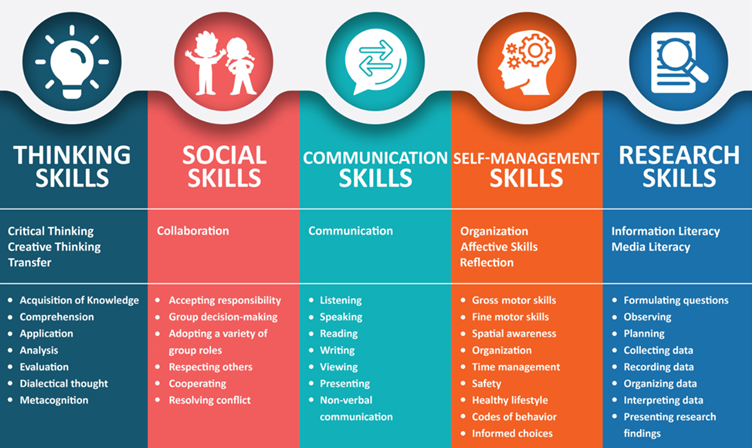
Their role develops across the IB continuum:
PYP: Students become aware of these skills.
MYP: Students acquire them through explicit teaching and practice.
DP/CP: Students amalgamate them, applying them independently in complex tasks and projects.
ATLs provide a common language for learning, linking skills to content, making learning visible, reflective, and transferable. They are essential for developing active, self-regulated, and internationally minded learners.
“Through approaches to learning in IB programmes, students develop skills that have relevance across the curriculum that help them ‘learn how to learn’. Approaches to learning skills can be learned and taught, improved with practice and developed incrementally. They provide a solid foundation for learning independently and with others.” – IB, ATL across the IB continuum
Step 1: Skills for life
The purpose of this activity is for you to consider how these skills are skills for life and are central to IB education and not just “extra things to teach.”
Individually reflect on your own professional or personal experiences:
- Which of these skills have helped you learn new things, work with others, or solve problems outside the classroom?
- Can you think of examples where lacking one of these skills made a task more difficult?
In pairs, discuss: - How might students use these skills beyond school—in further education, work, or daily life?
- Which skills do you see as most essential for success in an increasingly complex and connected world?
Step 2: Exploring skills in the classroom
- Choose one of the five skills. Identify specific classroom behaviours or student actions that demonstrate this skill.
- Suggest practical strategies or activities that could help students develop and make the skill visible.
- Example for “Communication”: students summarising ideas in a pair discussion, presenting to the class, or using a shared digital forum.
- Example for “Self-management”: students using planners to track tasks, setting goals, or reflecting on progress
Quick professional learning PowerPoints on key IB topics: These resources are designed to provide you with concise, impactful insights into key IB topics. Whether you’re looking to deepen your understanding of IB principles, enhance your teaching strategies, or stay updated with the latest educational practices, these PowerPoints are here to support your professional growth.
10 slides series - introduction to IB big ideas
The IB in 10 slides
IB Learner Profile in 10 slides
International Mindedness in 10 slides
Approaches to Teaching - in 10 slides
Approaches to Learning in 10 slides
IB Leadership in 10 slides
The Programme Development Guidance for Diploma Programme Candidate Schools (IB, 2024) provides coordinators with many activities they can use with colleagues in walking them through the authorisation process. What I really like about this document is that it provides hands-on activities to involve the whole DP team in considering the implications of being a DP school. These activities would form a great schedule for a years’ meetings / workshops.
As well as mini-workshop activities, each section contains a list of questions to discuss – these provide great professional inquiries.
For example:
At the beginning of candidacy:
- Evaluate mission alignment (between the school mission and IB mission) by creating a Venn diagram as the basis for discussion (page 4).
- Explore the DP model through examining, in jigsaw style, key IB documents and sharing understandings (page 5-6).
- Examine the role of the DP coordinator by designing a blog / infographics to parents (pages 7-8).
- Familiarise the whole team with the Programme standards and practices through a World Café activity (pages 9-10)
- Update the school action plan in light of the journey towards authorisation and implementation of the programme (pages 11-12).
In mid-candidacy phase (ideally after completing professional development):
- Integrate the Learner Profile into unit planning using a Harvard Project Zero thinking routine to Connect – Extend – Challenge with what you currently do (pages 13-14).
- Develop understanding of and strategies for integration of international mindedness into lessons (pages 15-16).
- Discuss how to use an inquiry-based approach to lessons through viewing an IB Nano and reading key IB documents (pages 16-17).
- Reflect on the extent to which the IB approaches to teaching and learning are integrated into our planning and delivery through use of the self-reflective tool (pages 18019).
- Build enthusiasm for CAS through amending course outlines (pages 20-21).
- Acquaint with EE guidelines through creation of a student-friendly handbook and marking EE samples (pages 22-23).
- Develop an understanding of the role of TOK through reflecting on the difference between trans -, inter – and disciplinary knowledge and then identifying knowledge questions in their subject (pages 24-25).
- Evaluate the advantages of collaborative planning (pages 26-28).
- Align the five IB mandated policies to school practices through exploration of key IB documentation and drafting of school policies based on IB guidance – this section contains a wealth of IB material for rich discussions (pages 29-40).
- Review required facilities (e.g. science laboratories, art studios/spaces, examination storage, IT resources) through making a case (a justification) for any resources that are required (pages 41-42).
- Explore the important role of the library and librarian through subject teachers reviewing current resources and considering any additional resources that will be required (pages 43-44).
- Consider the budget through identifying which standards and practices have financial implications and reviewing required and desired resources (pages 45-46).
- Review the timetable schedule to determine whether the current schedule can accommodate DP requirements or whether changes need to be made (pages 48-49).
- Course and core outline development (pages 50-51).
- Explore assessment through identification of purposes of IA and identification of any changes that teachers may need to be make in the subject to meet these requirements (pages 52-53).
- Develop a clear plan for guidance and counselling through the development of a plan to support students in the DP in selection of DP subjects and post-secondary planning (pages 54-55).
- Marketing your DP: Develop an action plan for marketing the programme once authorized (pages 57-58).·