IB language tenets

What does it mean to say every (IB) teacher is a language teacher?
To say that every IB teacher is a language teacher is to recognise that language is not simply the responsibility of those who teach language subjects. It is fundamental to how students access, construct and communicate knowledge in every discipline. Whether students are investigating scientific concepts, interpreting historical sources, exploring mathematical relationships or analysing literary texts, they are learning through language. Each subject has its own vocabulary, conventions, forms of communication and ways of thinking. Teachers therefore have a responsibility to make these explicit, helping students understand not only what to learn but also how to use the language of their discipline to question, explain, interpret, analyse and communicate ideas. As the IB publication Language and learning in IB programmes makes clear, language is central to the construction of meaning and knowledge, and all teachers share responsibility for students' language development.
This responsibility extends beyond teaching subject-specific vocabulary or correcting grammar. It involves creating learning environments in which students can develop the academic language, literacy and communication skills needed to participate confidently and successfully in learning. It means recognising and valuing students' diverse linguistic backgrounds, drawing on their existing language knowledge, providing appropriate scaffolding and creating opportunities to engage with increasingly sophisticated texts, ideas and forms of expression. In an IB education, language development is inseparable from inquiry, critical thinking, intercultural understanding and international-mindedness. Being a language teacher, therefore, is not about teaching another subject; it is about making the language of learning visible, accessible and purposeful in every classroom.
IB Language Tenets
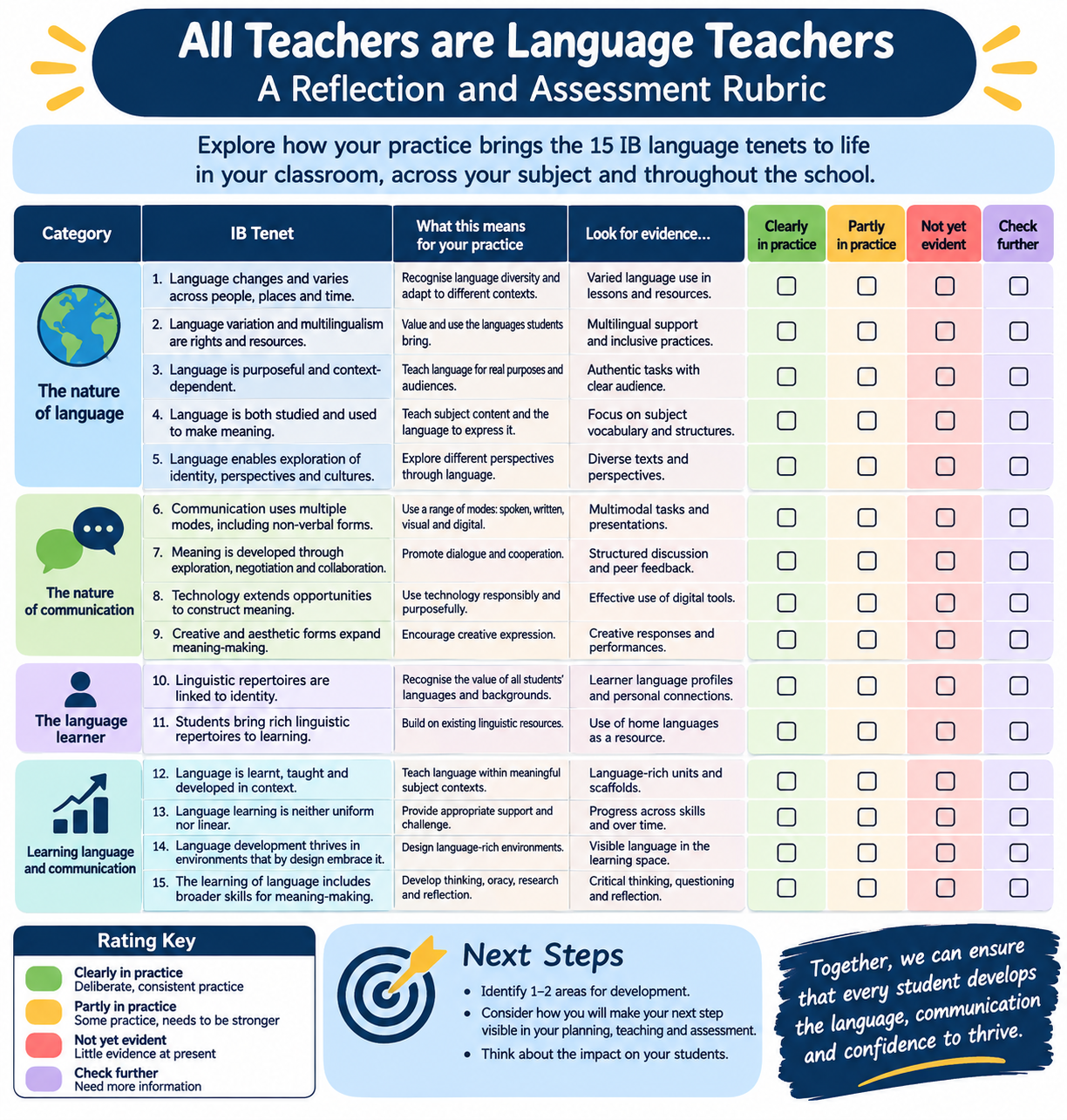
The IB’s commitment to the idea that every teacher is a language teacher is reflected in fifteen IB language tenets (2023), organised into four categories. They set out shared beliefs about the nature of language, communication, the language learner, and language learning. They emphasise the value of multilingualism, the importance of learners’ linguistic repertoires and the many ways in which meaning is created and communicated.
The tenets provide a framework for translating these beliefs into classroom practice, helping teachers across all IB programmes make language development an integral part of teaching and learning.
The document IB language tenets can be found in the Programme Resource Centre.
i have created the following rubric which all teachers can use as a quick self-reflective activity.
The following is a more detailed rubric, but also contains a suggest mini workshop.