What are we trying to change?
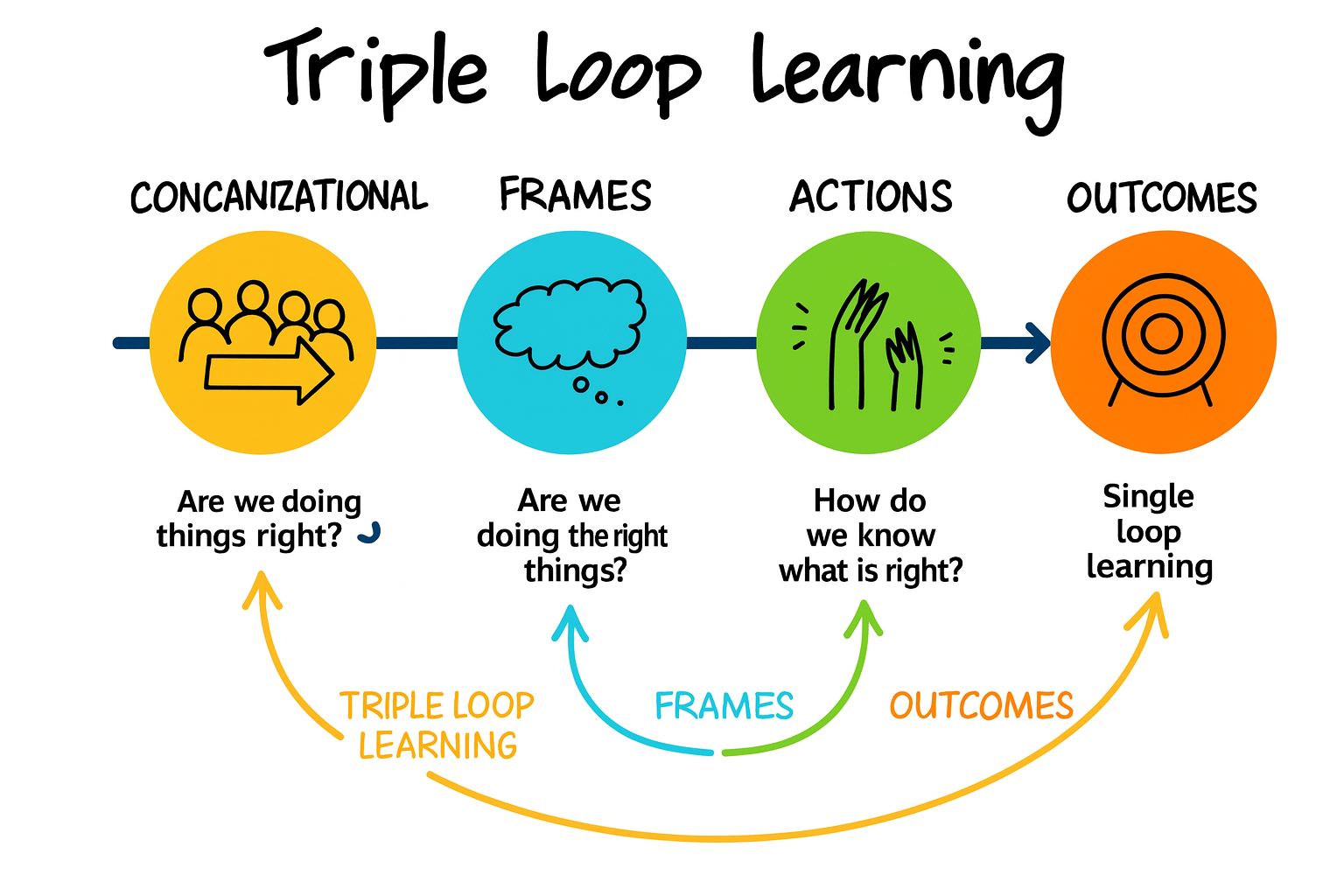 What is the loop model of change theory?
When schools talk about “bringing about change,” the conversation often jumps straight to actions—new policies, new tools, new strategies. But before leaders make any move, it’s worth pausing to ask a deeper question: What kind of change are we actually aiming for? Not all change is the same.
Some shifts are minor adjustments, some require rethinking the way the system works, and others call for re-examining the very purpose and values that shape the system. The single, double, and triple loop learning model offers a helpful lens for understanding these different layers.
- Single loop learning improves what already exists.
- Double loop learning examines why systems operate as they do.
- Triple loop learning explores the core purpose and values that justify the system in the first place.
Once we understand which loop we’re working in, our approach to change becomes clearer—and more likely to succeed.
Focus: Actions, implementation, operations, day-to-day practices, and operational assumptions.
Purpose: Course correction; solving immediate problems; improving execution.
- Are our planned activities being carried out as intended this week/term?
- Where are we seeing breakdowns in routines, systems, or delivery—and what small adjustments would correct them?
- What assumptions are we making about time, resources, or logistics that might need updating?
- What data or evidence from classrooms or student life suggests we need to tweak our approach?
- What obstacles are teachers or students experiencing right now, and how can we remove them quickly?
- What have we learned from recent failures or mistakes, and what can we adjust immediately?
- Are we supporting each other effectively in day-to-day practice? If not, what needs to shift?
Focus: Causal assumptions, patterns, strategy and the theories behind our actions.
Purpose: Checking whether the approach, not just the execution, is still appropriate.
- What patterns or trends are emerging in student learning, well being, or engagement across terms or years?
- Why is our approach working well in some contexts (subjects, year levels, classrooms) but not others?
- Are our underlying assumptions about how learning happens still valid?
- Are we interacting with students, families, and communities in ways that genuinely support change?
- What beliefs about teaching or behaviour underpin our current strategies—and do these beliefs still hold?
- Do our current policies or processes unintentionally reinforce barriers or inequities?
- If we weren’t already doing things this way, would we choose this approach today? Why or why not?
Focus: Identity, purpose, values, organisational worldview, and paradigmatic assumptions.
Purpose: Examining the WHY and WHO of the school—who we are and what we believe.
- Why do we do what we do? What values are truly driving our school’s work?
- Do our current priorities reflect our deepest purpose—or have we drifted?
- Which long-held beliefs about education or schooling might be limiting new possibilities?
- What assumptions about students, families, or learning are so “normal” that we rarely question them? Should we?
- Are we willing to change our identity or values when evidence suggests we should? Why or why not?
- Do our partnerships, policies, and resource allocations align with our stated mission?
References
- Tamarack Institute. TOOL | Single, Double and Triple Loop Learning.
- Aston, T. Medium, Assumptions and triple loop learning. Dec 29, 2020.
- Simon Fraser University. (n.d.). Triple Loop Learning. Complex Systems Frameworks Collection.