How to write a good PDP
What makes a PDP really work?
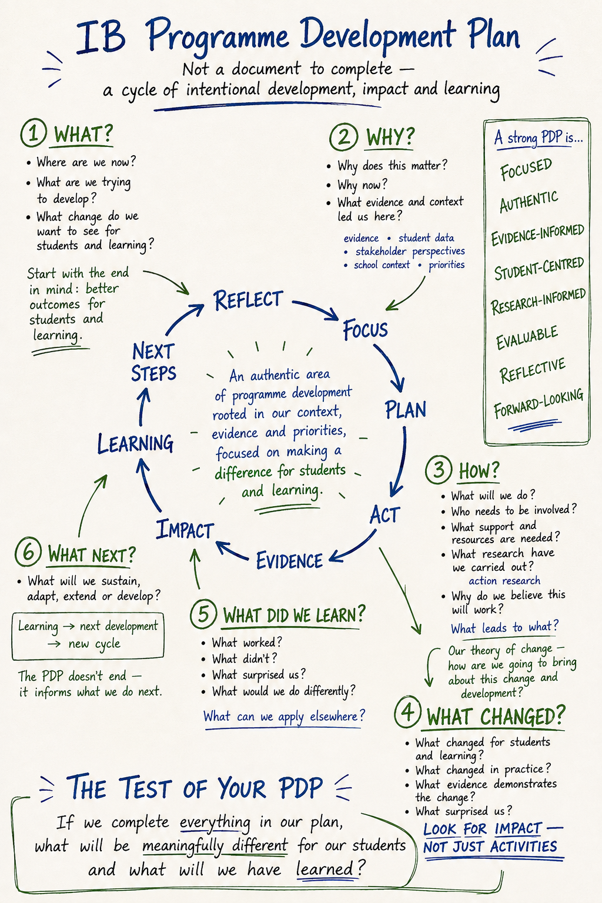
I am often asked to review a school’s Programme Development Plan (PDP) before its evaluation visit. Over the years, I have read and discussed many PDPs, taken part in evaluation visits and trained programme and evaluation leaders. Along the way, I have seen some PDPs that tell a really compelling story of development and learning, while others struggle to get beyond a description of what the school has done.
The ideas on this page bring together some of the things I have learned from those experiences. They are top tips, not a formula. I have also included examples to illustrate some of the ideas and help you think about your own PDP. Above all, a good PDP should tell an honest story about something that matters to your school: why you chose it, what you tried, what difference it made, what you learned and what you will do next.

Top tips for writing a Programme Development Plan
Here I have collected together some top tips from schools across the IB World. They are offered as suggestions for you to consider as you develop your own Programme Development Plan.
1. Start with student impact. Be clear about what you are trying to change or improve for students, why this matters and what you hope students will experience, understand, know or be able to do differently as a result. Then ask: What evidence would convince us that this change has actually occurred?
2. Choose a focused and authentic area. Your PDP does not need to represent everything the school has been working on. Choose a manageable area that matters in your context and provides a genuine opportunity to demonstrate development, impact and learning.
3. Distinguish development activity from impact. A common weakness is to describe what teachers or the school will do rather than the difference this will make for students. For example:
Activity: Develop a consistent approach to TOK across the curriculum.
Impact: Develop students' ability to question assumptions, evaluate evidence and consider different perspectives through authentic integration of TOK across the curriculum.
A useful formula is: development activity → change in practice → change in student experience or learning → evidence of impact.
4. Create a common understanding. Before beginning, make sure those involved have a shared understanding of the key concepts within your development focus. If, for example, your focus is differentiation, what does your school mean by differentiation and what would this look like in practice?
5. Establish a baseline. If you want to demonstrate change, establish what the situation was before the development began. This might include student work, student voice, surveys, assessment information, observations, planning, feedback or evidence of classroom practice. Then ask: What would we expect to see differently as a result of the development?
A particularly powerful approach is: Before → Development → After → Analysis. Don't simply show two pieces of student work. Explain what you were looking for, what was evident initially, what changed, what did not change and what you think explains the difference.
6. Research before and during the development. Draw on the experience of other IB schools, professional learning, research, workshops, micro-credentials and professional networks. Consider what others have already learned before designing your own approach. Most importantly, show how the research influenced your thinking or changed what you did rather than simply listing what you read, attended or visited.
7. Make your theory of change explicit. Explain the logic connecting your actions to the intended impact. For example: professional learning leads to a shared understanding; this changes teaching and planning; students then experience more consistent opportunities; and this contributes to changes in student learning or experience. Ask: Why should we expect what we are doing to produce the changes we want for students?
8. Be specific without becoming too narrow. Your intended impact should be clear enough to evaluate, while allowing room for professional learning, unexpected findings and changes in direction. A good PDP is a journey of inquiry, not a predetermined route to a particular outcome.
9. Set clear milestones. Establish realistic dates for key stages of the development, including opportunities to review progress, examine evidence and share learning. Even longer-term areas of development benefit from a defined period of focused action and review.
10. Use a range of evidence. Combine quantitative evidence with student voice, engagement, work samples, observations, classroom practice and other qualitative evidence. Important changes in student experience or learning may not immediately appear in assessment data.
11. Keep asking about student learning and experience. Whatever your development focus, continually return to the question: How is this improving student learning or experience? The answer may be demonstrated quantitatively, qualitatively or through a combination of both.
12. Look beyond success. A successful PDP does not have to be a success story. Some of the most valuable learning comes from discovering that something did not work as expected. Ask: What worked? What worked less well? What surprised us? Which assumptions proved to be wrong? Were there differences between subjects, year groups or groups of students? What did we change along the way? What would we do differently next time? Mixed or unexpected findings can strengthen a PDP because they demonstrate genuine professional inquiry.
13. Make the learning journey visible. Don't simply report the final outcome. Show the progression: Why this? What did we discover? What did we try? What changed? What did the evidence show? What did we adapt? What did we learn? What happens next?
This helps demonstrate that the PDP is a process of learning and improvement rather than simply a project with an end date.
14. Don't just collect evidence—analyse it. Evidence becomes valuable when you explain what it means. For example:
Evidence: 78% of students reported greater confidence in evaluating different perspectives.
Analysis: Student voice, supported by comparative student work, suggests that students became more confident and more able to evaluate competing perspectives. However, the evidence was stronger in subjects where students had repeated opportunities to practise this thinking. This led the school to reconsider its original assumption that occasional TOK activities would be sufficient.
The important step is the connection between evidence → interpretation → learning.
15. Connect evidence to next steps. Show how what you discovered has influenced subsequent decisions, adaptations or priorities. The PDP should contribute to the school's ongoing learning rather than simply end when the PDP is completed.
16. Choose an authentic example. Don't construct your PDP backwards from what you think an evaluation team wants to see. Choose a genuine piece of programme development that matters in your context, and use the evidence to tell an honest story about its impact, challenges and learning.
Ultimately
A PDP is not a showcase of success. It is an opportunity to demonstrate how your school identifies an area for development, takes informed action, examines the impact, learns from the evidence, adapts its practice and identifies what comes next.
The strongest PDPs therefore tell a story of development and learning, not simply a story of what the school did.
The IB provide an online 'motif builder' to support your design of the programme development plan. Click HERE.
Why PDP must focus on impact for students
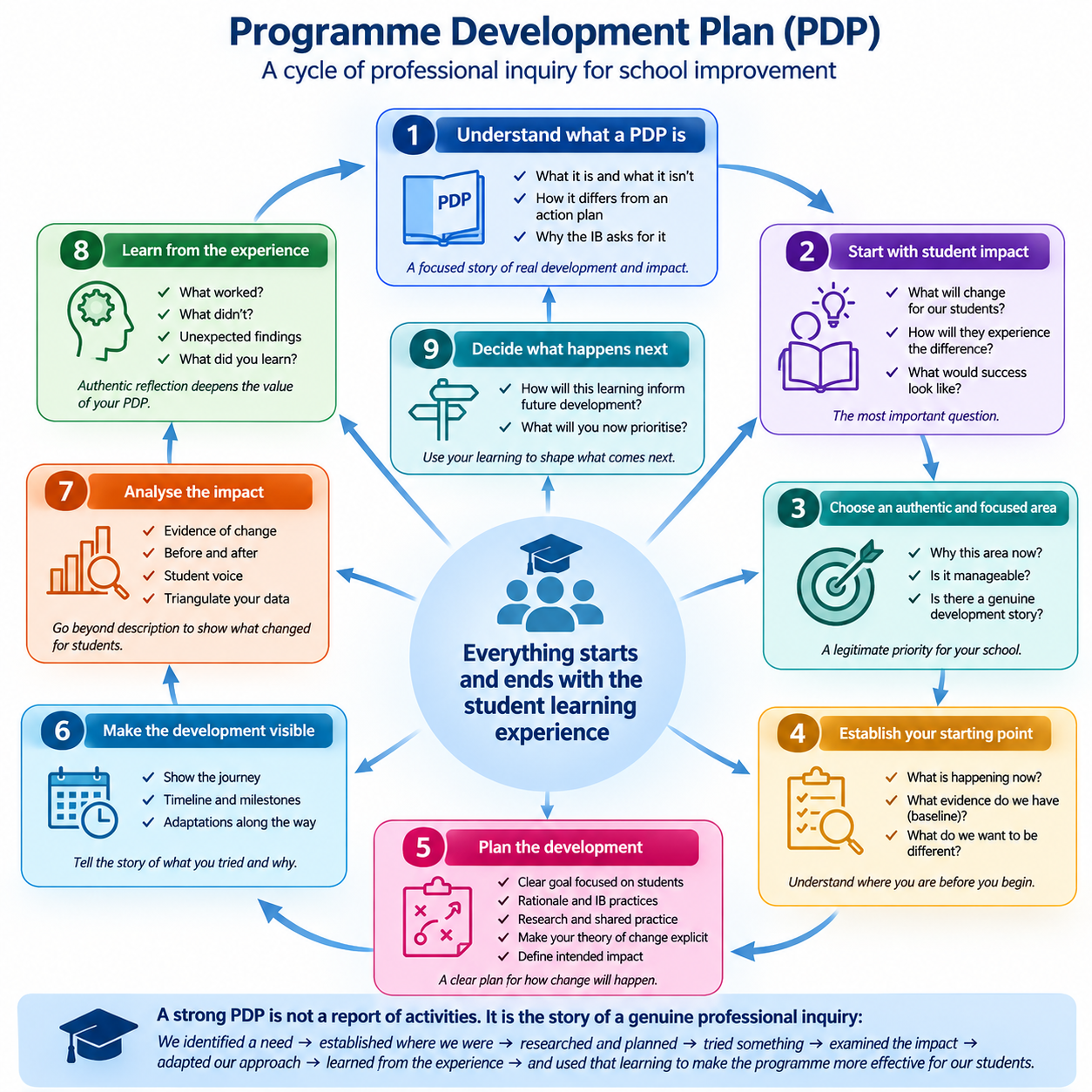
A strong Programme Development Plan (PDP) should begin with a simple question: what difference do we want this development to make for students? It is easy to document activities, resources, training and implementation, but these demonstrate what the school has done rather than what students have gained. Impact should therefore be considered from the outset, with the intended change clearly defined.
A useful PDP process moves through:
- Goal – what student change are we seeking?
- Action – what will we do?
- Experience – what will students experience differently?
- Impact – what will change for students?
- Evidence – how will we know?
- Adaptation – what will we change in response?
Evidence should be planned alongside the development, rather than collected retrospectively. Milestones help schools check whether they are on track and provide opportunities to adapt:
- Use quantitative and qualitative evidence.
- Include student voice and student work where appropriate.
- Draw on existing data as well as collecting new evidence.
- Identify interim milestones that show progress towards the intended impact.
- Use what the evidence reveals to refine or change the approach.
The aim is not to prove that everything worked, but to demonstrate that the school is learning from evidence and using it to improve students’ learning and experience.
Examples of PDPs
Here are some subjects which schools have chosen. I am selecting the subject and showing how this will have an impact on student learning.
Subject: Differentiation
Goal: To design and implement a differentiated teaching and learning framework that will accommodate diverse learning styles, abilities, and interests of students across the 5 years of the MYP, establishing professional development for our teachers so they can create inclusive and differentiated learning environments.
Impact: Designing and implementing a differentiated teaching and learning framework will make a significant difference for our students and their families, as well as our teachers.
- A more tailored teaching to the students' needs will most likely increase engagement.
- Students will receive instruction that cater their individual learning style and preferences, fostering a more inclusive and supportive environment.
- Students will feel supported and challenged at an appropriate level, this will promote confidence and motivation. This positive experience will lead to a nice and conducive learning environment, a happier place for both students and teachers.
- Teachers will be provided with knowledge, resources and strategies to be able to provide students with additional support or challenges when needed.
- By acknowledging and accommodating diverse needs, the school will ensure that every student accesses an education that suits them.
Subject: Horizontal and vertical alignment of curriculum
Goal: Design a fully aligned curriculum both horizontally and vertically using State Standards.
Impact: Students in the MYP will have clear learning standards that go alongside their assessment criteria. This provides students with a way to know what they should know and how they will show they know it.
Subject: Assessment
Goal: To rethink our current assessment plan in order to make sure that our assessments are well distributed across the school year. This is to ensure they are effective in helping us, students and families understand the students’ progress and needs for support, while taking care of their wellbeing and avoiding periods of excessive testing.
Impact: Rethinking and planning the assessment calendar better will help students have a better balance between school life and personal life, allowing them for better planning and structure as well as for better preparation for their assessments..
- Teachers will be able to rethink their assessments and make sure they are extremely meaningful. It will also alleviate some of their marking time.
- Students will be able to better focus on each assessment, and to have a better study plan.
- Both students and teachers will be able to prioritize / balance their wellbeing, while still complying with the IB demands and ensuring a fair and effective evaluation of the learning.