Managing conflict in a team
 A practical guide for Heads of Department and Coordinators
Disagreement is inevitable. Avoiding difficult conversations rarely makes things better. Whether you need to challenge a colleague, address unhelpful behaviour, give difficult feedback or raise a concern with another leader, knowing how to handle conflict constructively is essential to leading and working effectively in a team.
The challenge is not to avoid disagreement, but to turn it into helpful conversation that helps people and teams move forward.
Why disagreement matters
A team in which everyone agrees is not necessarily a team that works well. When people feel unable to challenge an idea, question a decision or raise a concern, problems go unaddressed and opportunities to improve are missed.
As a Head of Department or Coordinator, your role is not to eliminate disagreement but to make it constructive. Colleagues should feel able to:
- Express different opinions openly.
- Question decisions and explain their concerns.
- Challenge established practice.
- Give and receive honest feedback.
- Disagree about an issue without making it personal.
- Commit to a shared decision, even when it was not their preferred option.
The key distinction is between harmony and effectiveness. A team that avoids difficult conversations may appear harmonious, but that does not mean it is making the best decisions or addressing the issues that matter.
Ask yourself:
Do colleagues feel able to tell me what they really think, or have I unintentionally created a team in which people tell me what they think I want to hear?
Recognising when something needs to be addressed
Conflict rarely starts with a major confrontation. More often, it develops gradually through misunderstandings, frustration, competing priorities or behaviours that go unchallenged.
As a Head of Department or Coordinator, look out for early signs:
- Colleagues withdraw from discussions or become noticeably quieter.
- The same disagreements keep resurfacing.
- People agree in meetings but complain afterwards.
- Communication becomes defensive or strained.
- Colleagues talk about one another rather than to one another.
- Responsibilities are repeatedly neglected or decisions quietly ignored.
These signs do not necessarily indicate serious conflict, but they are reasons to pay attention and find out what is happening.
Consider two situations you might encounter:
Missed deadlines: A colleague repeatedly fails to meet agreed deadlines, creating extra work for others. Rather than completing the work yourself to avoid confrontation, discuss what is happening, clarify expectations and agree what needs to change.
Unhelpful behaviour: A team member regularly criticises decisions after meetings or makes dismissive comments about colleagues. Rather than ignoring the behaviour, explore their concerns and address the impact their actions are having on the team.
Top tip: Address issues while they are still manageable. Left unresolved, small concerns can grow into frustration, damaged relationships and wider team tensions.
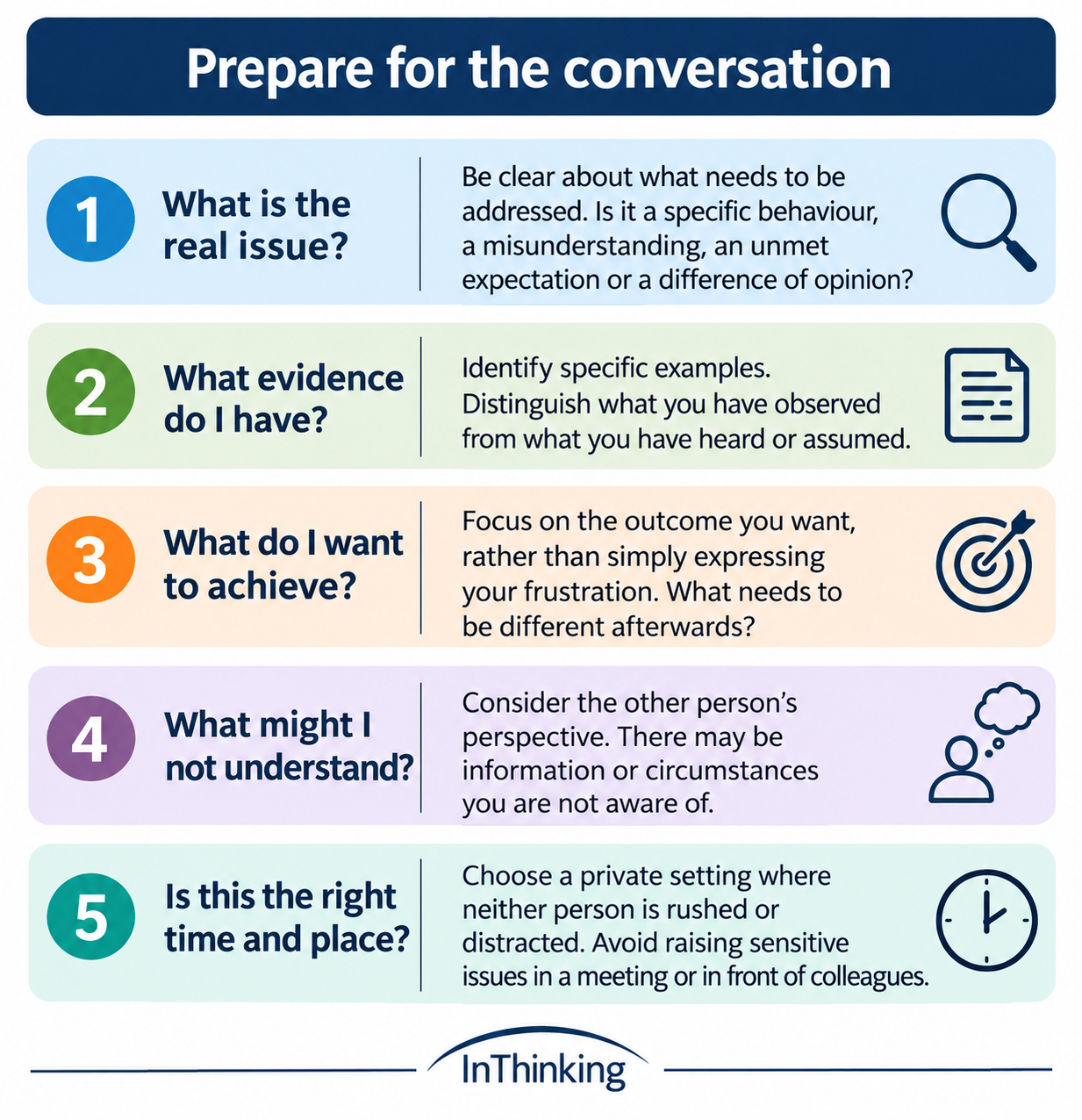
Before having a difficult conversation
One of the biggest mistakes people make is entering a difficult conversation without preparing. They know they are unhappy about something, but they have not clearly identified what needs to change or what they hope to achieve.
Before approaching a colleague, take a few minutes to think through the following. Be clear about the conversation you need to have You do not need to rehearse every sentence, but it helps to have a clear opening.
For example:
- “I'd like us to talk about something that I think is affecting the team.”
- “There is an issue I would like to understand better. Could we find some time to discuss it?”
- “I wanted to talk to you about what happened in yesterday's meeting.”
- “I think we have different views about how we should approach this. I'd like us to explore that together.”
Being direct is usually kinder than allowing someone to guess what the conversation is about.
Listen with curiosity rather than interrupting, defending or persuading. Allow silence and avoid making assumptions.
Do: Ask open questions, acknowledge concerns, summarise and check understanding.
Avoid: Interrupting, making assumptions, dismissing perspectives or becoming defensive.
Remember: listening does not mean agreeing; it means understanding the other person's perspective while maintaining professional expectations.
Turn agreement into action
Resolving conflict requires follow-through. Check that agreements are implemented and working relationships improve.
As a team leader:
- Check agreed actions are completed.
- Recognise improvements.
- Address continuing concerns promptly.
- Clarify expectations if necessary.
As a team member:
- Honour agreed actions.
- Change behaviours where needed.
- Raise continuing concerns directly.
- Allow relationships to move forward.
Remember: The aim is not necessarily agreement, but a professional working relationship and a constructive way forward.
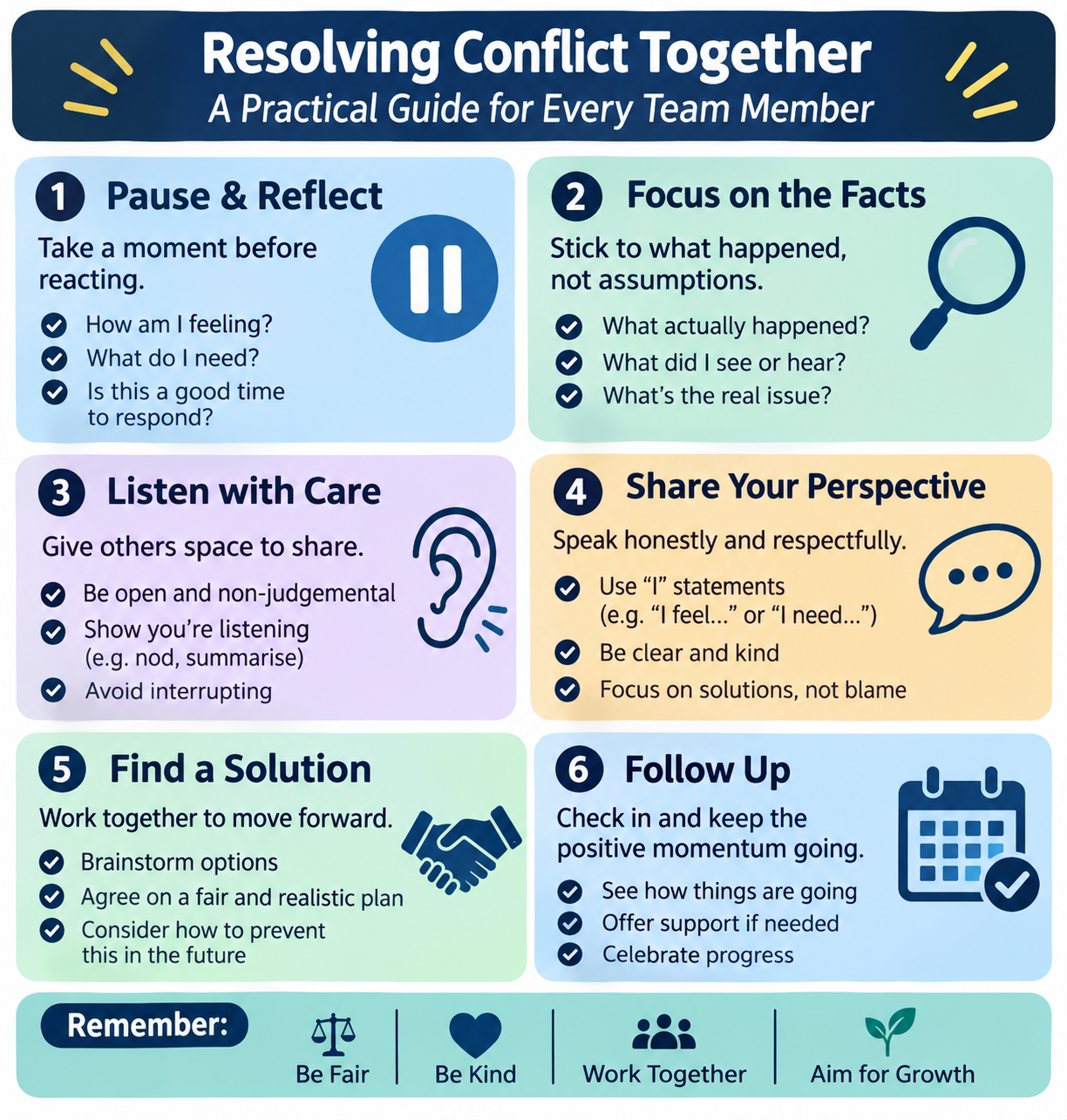
Resources
Managing team conflict - top tips, Civil Service. (n.d.)
Youth Employment UK. (2018, January 22). How to manage conflict in a team – Do’s and don’ts