PDP from a learners' perspective
As a Chair of Evaluation visits, one of the challenges I see many schools having is writing the programme development plan (PDP) from the perspective of the teacher, whereas, in fact, the focus of a PDP should be on the impact it will have on the learner.
A quick trick you can use is to use AI to refocus your PDP. Here is how I did it for a school that asked me to review their programme development plan.
Primary Years Programme Example
This is a summary of what the school provided in their propgramme development plan (for ease I have reduced it to one slide).
Bridging the gap between PYP and MYP
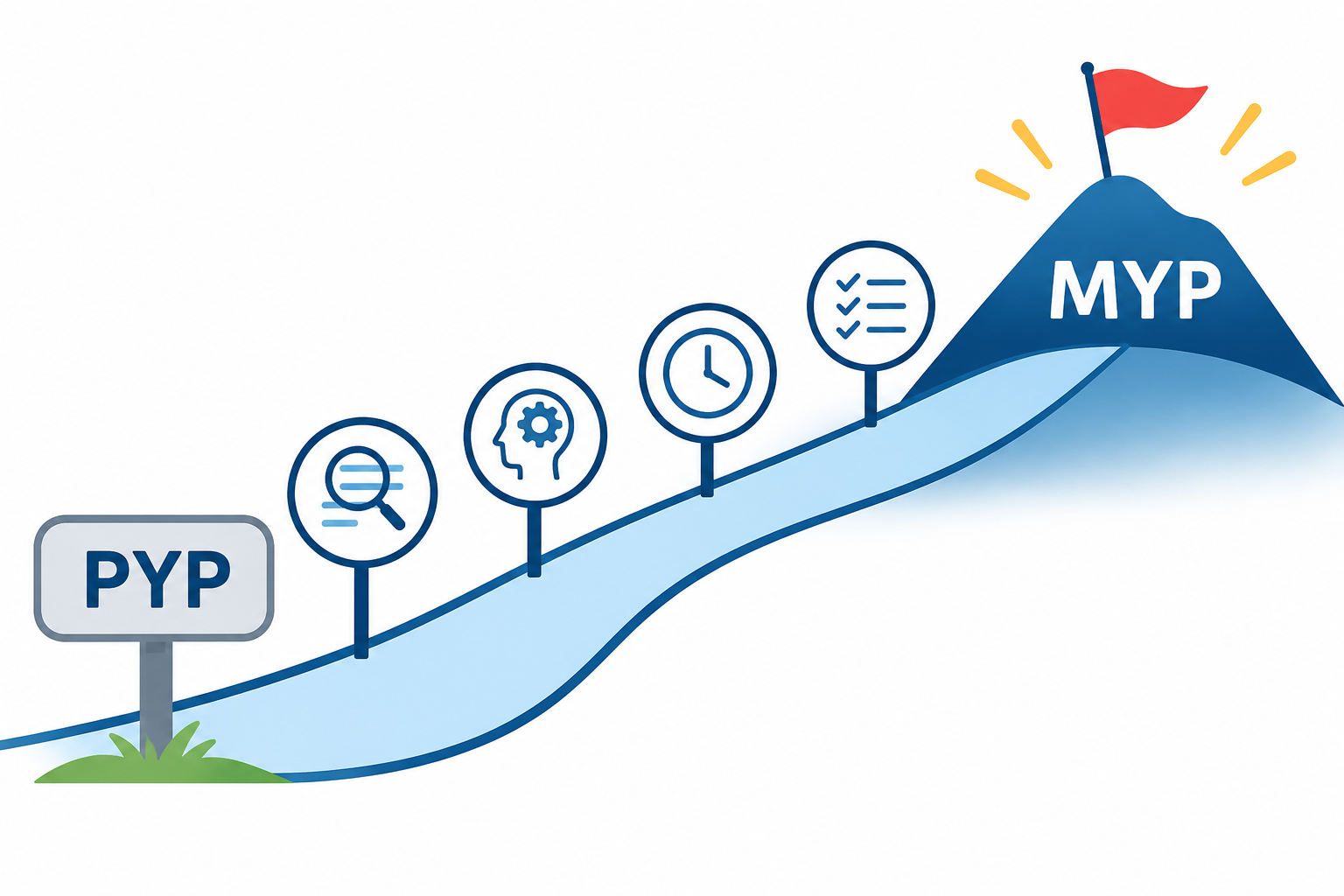 Goal: Improve Grade 5 students’ readiness for the transition to MYP 1, developing greater confidence, independence, time management, critical analysis and the ability to respond effectively to assessment criteria.
Rationale: Baseline assessments, Edmentum data and teacher observations identified gaps in English, mathematics and science, particularly text analysis, reading comprehension, written expression, mathematical reasoning and scientific explanation. Students also need further development in managing timed tasks, analysing questions and organising their learning independently.
Approach
- Align PYP and MYP assessment criteria and expectations through teacher collaboration.
- Explicitly teach ATL self-management and analysis skills.
- Provide regular opportunities for scaffolded, timed and criterion-related assessment.
- Use feedback, rubrics and self-assessment to develop student independence.
- Provide targeted support based on identified learning needs.
Intended impact on students
Students will demonstrate:
- Greater confidence when approaching formal assessments.
- Improved time management and organisation.
- Greater independence in analysing questions and instructions.
- More effective responses to assessment criteria.
- Improved achievement in English, mathematics and science.
- Greater confidence and readiness for MYP 1.
Evidence of impact
Edmentum and assessment data; comparative student work; timed-task observations; rubrics and self-assessments; student surveys and reflections; MYP 1 teacher and student feedback.
What has been learned / next steps
Students have shown improvement in confidence, engagement, time management and task execution. However, independent analysis of complex prompts and consistent use of self-assessment criteria remain areas for development.
The school will strengthen assessment literacy, progression in ATL skills and PYP–MYP curriculum alignment, extending effective strategies across other grade levels.
I then used this prompt for AI: “This is the programme development plan. Imagine students were writing this - afterall all PDPs should aim to have impact on learners. In as short space as possible what would it look like?”
This is what ChatGPT produced:
Our learning journey: Getting ready for the MYP
Our goal: We want to move from PYP to MYP feeling confident, independent and ready for new learning challenges.
Why does this matter?
We have found that we sometimes need more practice in understanding complex questions, analysing information, explaining our thinking and managing our learning.
What are we working on?
We are learning to:
- Understand questions and instructions before answering.
- Analyse texts, information and evidence.
- Explain our thinking in English, mathematics and science.
- Manage our time, organise our work and meet deadlines.
- Understand assessment criteria and use them to improve our work.
- Reflect on our progress and take greater responsibility for our learning.
How will we know we are improving?
We will look at our work, assessment results, feedback and reflections to see how much we have improved. We will also tell our teachers how confident and prepared we feel.
What difference should this make?
We will become more confident, independent and capable learners, ready to take on the challenges of MYP Year 1.
Diploma Programme Example
This is a summary of what the school provided in their propgramme development plan (for ease I have reduced it to one slide).
Programme development plan: Redesigning TOK
Goal: Develop students’ thinking skills through TOK and enable them to transfer these skills across their Diploma subjects.
Why?
- Students were unclear about TOK’s purpose and value.
- Teachers wanted greater clarity and consistency.
- Students did not always recognise TOK in their subject learning.
- The course needed a stronger focus on transferable thinking skills.
Intended impact on students. Students will be able to:
- Recognise the thinking skills a task requires.
- Apply TOK concepts to knowledge claims in their subjects.
- Evaluate competing claims and sources using evidence.
- Reflect more accurately on their own thinking.
- Recognise and explain the value of TOK in their wider learning.
How will we achieve this?
- Teach one named thinking skill through a real case.
- Model, practise and gradually develop independent application.
- Use discussion, peer challenge, the TOK Log, exhibitions and essays.
- Build a shared understanding of TOK across subject teaching.
How will we know?
Student work, reflections, exhibitions, essays, focus groups and teacher accounts will show whether students can think more critically, transfer their skills and recognise the value of TOK.
I then used this prompt for AI: “This is the programme development plan. Imagine students were writing this - afterall all PDPs should aim to have impact on learners. In as short space as possible what would it look like?”
This is what ChatGPT produced:
A students’ perspective: Our learning development plan
We want to become better thinkers – in TOK and across all our subjects
We want to be able to:
- Think critically: evaluate different claims and decide which evidence and sources we can trust.
- Make connections: apply what we learn in TOK to questions and ideas in our other subjects.
- Understand our thinking: recognise the thinking skills we are using and how we can improve them.
- Think independently: apply these skills to unfamiliar situations without relying on teacher support.
- Learn from others: challenge our thinking through discussion, feedback and different perspectives.
How will we know we are improving?
We will be able to demonstrate these skills in our work, explain how our thinking has developed, and recognise how TOK helps us become better learners across the Diploma.
The important shift is that this describes what students will be able to do differently as a result of the PDP, rather than what teachers or the school will do. The activities, professional learning and changes to the curriculum are the means; improved student learning is the end.