What's an IB education?
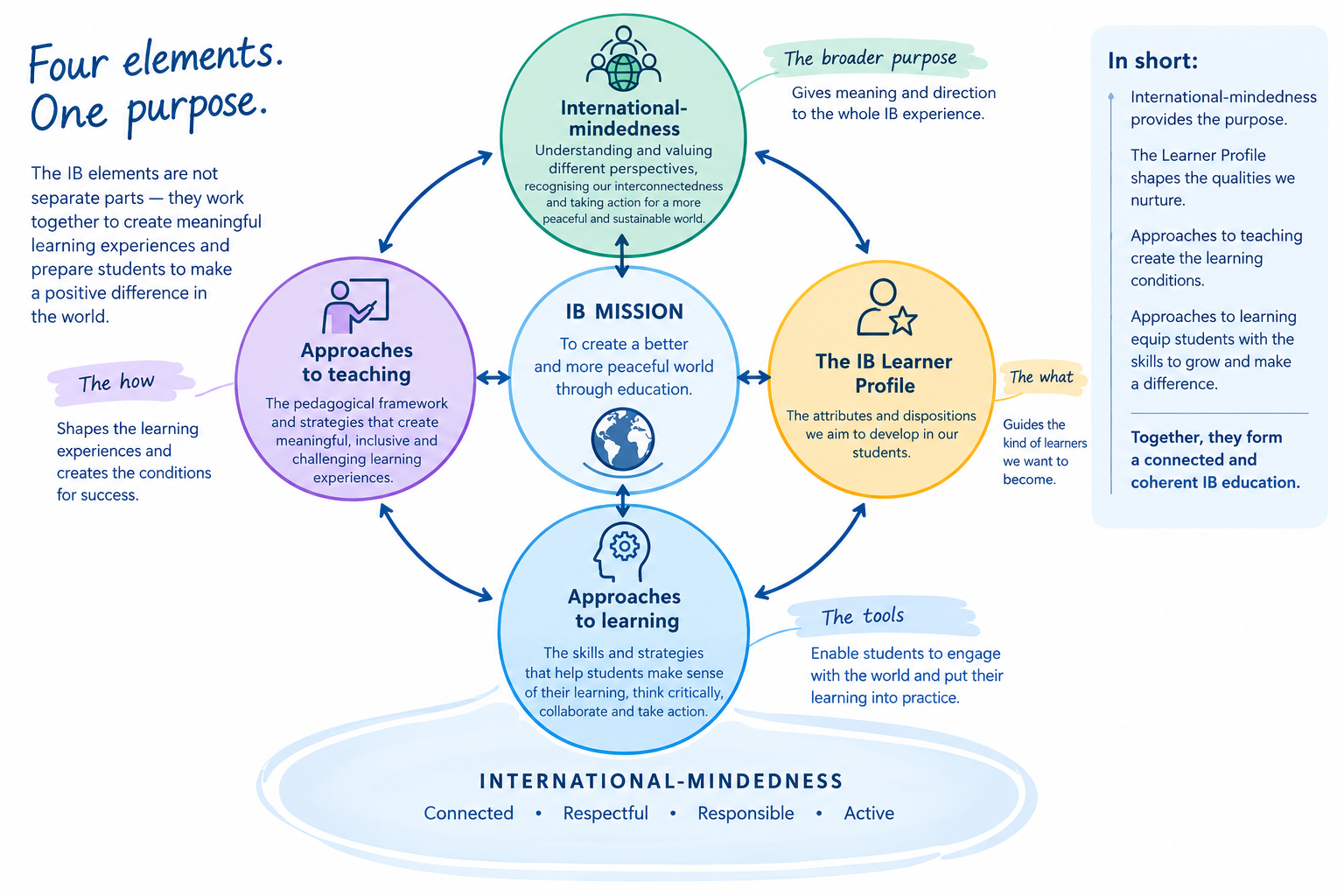
This month, I have been part of an IB study group exploring the key elements of an IB education. It has been a helpful opportunity to return to the basics and reflect on what lies at the heart of the IB. It also encouraged me to write this article from the perspective of parents and teachers who are new to the IB, and who may be wondering what makes an IB education distinctive.
It is something schools could adapt and share in a parent newsletter to help explain what an IB education means in practice.
Start with the end in mind
The starting point is the IB mission: to create a better and more peaceful world through education.
This is more than a statement to display on a school wall. It expresses the purpose behind an IB education. We want young people to leave school not only with knowledge and qualifications, but also with the skills, attitudes and motivation to make a positive difference in the world.
So, an important question for any IB school is: How do we help students become the kind of people who can make this happen?
Four key elements help us answer this question.
International-mindedness: understanding our world
International-mindedness is central to the IB. It means developing an understanding of our own perspectives and those of others, appreciating different points of view, recognising our interconnectedness and taking responsibility for the world we share.
This goes beyond celebrating different nationalities, learning about other countries or holding international days. It is about helping young people become curious about the world, question their assumptions, listen to others and recognise that their actions can have an impact beyond themselves.
Coordinators can help teachers ask:
- Whose perspectives are represented, and whose are missing?
- How do students challenge their own assumptions?
- Where do they connect local experiences with global issues?
- What evidence shows that students are developing greater intercultural understanding?
International-mindedness should be visible in everyday learning, not confined to particular events or curriculum topics.
The IB Learner Profile: the people we hope to develop
The IB Learner Profile describes ten attributes that we aim to nurture in students: inquirers, knowledgeable, thinkers, communicators, principled, open-minded, caring, risk-takers, balanced and reflective.
These are not simply qualities for students to memorise. They should influence how young people approach their learning, relationships and decisions.
For example, being open-minded means being willing to consider a perspective different from our own. Being principled means acting with integrity, even when doing so is difficult. Being reflective means thinking about what we have learned, what we could do differently and how we might improve.
The aim is to develop these attributes over time, through everyday experiences at school and beyond.
The Learner Profile can become a set of familiar labels rather than a meaningful influence on behaviour and decision-making.
What does being open-minded look like when we disagree? What does being principled mean when nobody is checking? How do students demonstrate that they are becoming more reflective?
Approaches to teaching: how teachers create opportunities for learning
An IB education is not defined only by what students learn, but also by how they learn it.
Teachers design learning experiences that encourage students to ask questions, explore ideas, make connections and think for themselves. They may introduce a topic, provide guidance and structure, and then gradually give students greater responsibility for their learning.
Consider inquiry. If we want students to become inquirers, we need to give them opportunities to investigate questions, explore possible answers and develop their own understanding. Simply telling students to be curious is not enough; the way we teach must encourage curiosity.
This does not mean that teachers stop explaining, demonstrating or providing direct instruction. It means choosing teaching approaches that help students understand, apply and extend what they learn.
Approaches to learning: the skills students develop
To become confident, independent learners, students need more than subject knowledge. They also need skills and strategies that help them learn effectively.
The IB approaches to learning focus on five broad areas: thinking, communication, social, research and self-management skills.
Students learn how to evaluate information, express ideas clearly, work with others, manage their time and reflect on their progress. These skills help them become more independent and apply their learning in different situations.
For example, a research task is not just an opportunity to learn about a subject. It can also help students develop their ability to find reliable information, evaluate evidence, acknowledge sources and communicate their findings.
These skills become increasingly important as students take greater ownership of their learning.
Coordinators can encourage teachers to:
- Name the skill students are developing.
- Model what effective use of the skill looks like.
- Practise it explicitly with students.
- Build progression across year levels and subjects.
- Encourage reflection on how the skill can be transferred to new contexts.
Not every lesson needs to address every ATL category. A focused approach can make learning more explicit and meaningful.
How do these elements fit together?
The four elements are not separate parts of an IB education. They work together to shape the experiences students have every day.
Imagine students investigating a local environmental issue. They develop research and thinking skills as they gather and evaluate evidence. Their teachers use inquiry-based approaches to help them explore the issue and consider possible solutions. The Learner Profile encourages them to be knowledgeable, open-minded, principled and caring. Their growing international-mindedness helps them recognise how a local issue might connect with wider global challenges and responsibilities.
The learning becomes more than acquiring information about the environment. Students have opportunities to develop skills, demonstrate attributes and consider how they might use their understanding to make a difference.