1. Impact of the system of slavery on the USA

This page focuses on the key issue of slavery. Slavery was fundamental in dividing America and causing conflicts between North and South which ultimately led to the Civil War.
The four points of specified content for this Inquiry Topic are:
- The economic impacts of the cotton economy
- Conditions of enslavement
- Adaption and resistance
- Political impacts including the abolitionist debate
Guiding questions: (Click on the question below to go to that section of the page)
Argument: Slavery was a key cause of the civil war
Key concept - Cause and consequence: What were the consequences of the the cotton economy?

"The First Cotton Gin", an engraving from Harper's Magazine, 1869
Slavery was the basis of the economic system in the Southern states of the US. The Southern economy was largely agricultural and based on the cash crops of cotton, tobacco and sugar.
The invention of the cotton gin in 1793 led to a massive expansion in cotton plantations and they became increasingly profitable with a seemingly insatiable market for cotton especially in Britain. The South started to talk about ‘King Cotton’ which saw the Southern economy continue to thrive even when the North’s economy faltered (e.g. in 1857).
The cotton economy led to the dominance in the South of the elite planter class. The Southern economy was also based on exporting cotton meaning that the South was opposed to the placing of tariffs on any foreign goods, especially British ones, fearing that other countries might place tariffs on cotton.
Watch the following two videos and answer these questions:
- How did the cotton gin improve the profitability of growing cotton?
- What impact did it have on slavery in the South?
- What percentage of the world’s cotton was produced to the Southern states?
- What did the South believe that British reliance on their cotton mean?
Using the information from the videos above, as well as the historian view below, identify the key consequences of the cotton gin on slavery in the US.
Extract from an article by Tim Lockley, professor of history at the University of Warwick
The consequences of the invention of the cotton gin were extensive. It gave enslavers incentives to defend the enslavement of black people, and to expand the geographic range of the system. Without a viable cash crop, slavery might have remained limited to coastal South Carolina and Louisiana. In Virginia, the soil exhaustion caused by intensive tobacco farming led to a gradual shift into cereal crops, which needed fewer enslaved people. Demand from the lower South led to an internal trade in enslaved people from the upper to the lower South.
But without that demand what might have happened? Would planters have retained their enslaved workforce that cost money to feed, clothe and house when the profits didn't justify it? Perhaps large numbers would simply have been freed. It is impossible to know for sure, but the invention of the cotton gin certainly made slavery viable and sustainable up until the American Civil War
Get into pairs or small groups. Each pair/group should research further one of the following topics and prepare a brief presentation for the rest of the class.
Make sure that you include images and statistics in your presentation.
- The growth of cotton production 1793-1860
- Economic comparison of the Northern and Southern states in the first half of the nineteenth century.
- Fluctuations in slave population, ownership and prices.
- Lifestyle of the planter class
- Southern claims that their economic system was superior to the North’s
In the first half of the nineteenth century the South became increasingly focused on cotton production, remaining agricultural and based on slave labour. The North at the same time underwent increasing industrialisation and urbanisation.
Economic differences
The North had 85 per cent of the industries of the United States, It was dominated by manufacturing and trading industries. The industries of New England and New York were rapidly expanding in the early 19th Century. Thus they needed all the labour they could get. This meant they were opposed to the settlement of the new Western lands as this drew off potential workers from the factories. Shortage of workers meant having to pay higher wages. However almost all new immigrants (5 million, 1830-1860) settled in the North not the South.
In 1860 40% of the Northern population still worked in agriculture. In the South, by contrast, 80% of the population worked in agriculture. Agriculture in the North focused on food crops rather than cash crops.
As you read above, 'King Cotton' ruled in the south, together with tobacco. Cotton was grown on the large plantations in the warm, humid lands of the south-east, such as in the states of South Carolina and Georgia. The plantation owners were all in favour of expanding westwards, to enable new plantations to be developed on the fertile soils of the Mississippi valley. The labour problem did not bother them, since they had their own slaves. The issue of high wages was also not a problem.
The issue of tariffs
The manufacturers of the North wanted the Federal Government to set high tariffs on imported manufactured goods, in order to 'protect' their industries and prevent cheaper foreign imports under-cutting their prices. The plantation owners of the South, however, wanted free trade. High tariffs on imports would only encourage foreign countries to put high tariffs on American exports - and the cotton growers thrived on exports.
High tariffs also put prices up at home, since foreign goods were dearer. The southerners wanted to keep prices as low as possible. The plantation slave-owner had no wages to pay but had to clothe and house his slaves. The northern manufacturers, on the other hand, wanted to keep prices high.
Social differences
The North was free and the South was not. The slave trade had been abolished in 1807 but population growth caused numbers to grow rapidly. By the time of the Civil War, almost all of the slaves had been born into captivity. In 1807 there were just over a million slaves. By 1860 there were four million.
Political differences
The southern states wanted freedom from interference by the Federal government whereas the northern states wanted stronger central government.
Southerners were always fearful that the free-soil states of the north - where slavery was illegal - would eventually out vote the slave-owning sates of the South. When that happened, they would be able to amend the constitution and abolish slavery. They also resented other ways by which the northern states tried to keep their interests paramount
They were determined to make sure that as many slave states as free states joined the Union so that they could not be outvoted in the Senate.
More on all of these issues on the next page!
Based on your research and presentations above, discuss in pairs the following questions:
- How might the economic system in the South impact on society?
- The North and South both argued that their economic system was superior. How can this be the case?
- The South was highly reliant on luxury and industrial goods imported from the North and abroad; why was this significant?

This photos of a whipped slave named Gordon was taken at Baton Rouge, Louisiana, 1863.
The image was mass-produced and used as abolitionist propaganda
In thinking of America, I sometimes find myself admiring her bright blue sky- her grand old woods- her fertile fields- her beautiful rivers- her mighty lakes and star-crowned mountains. But my rapture is soon checked when I remember that all is cursed with the internal spirit of slave-holding and wrong; When I remember that with the waters of her noblest rivers, the tears my brethren are borne to the ocean, disregarded and forgotten; That her most fertile fields drink daily of the warm blood of my outraged sisters, I am filled with unutterable loathing.
Frederick Douglas, a freed slave writing to William Lloyd Garrison in 1846
The conditions of enslavement were for most slaves horrendous. They were considered ‘property’ rather than as fellow humans by their owners. Slaves would work long days (sun rise to sunset in the fields) 6 days a week. They generally lived in very basic and overcrowded wooden huts and were provided a meagre diet based on corn and pork. Floggings took place of slaves (see photo above) notably for not working fast enough. There were other physical and psychological horrors including the forcible breaking up of marriages and families when slaves were sold; many female slaves were sexually exploited and numerous slaves were branded or otherwise mutilated. It was illegal in most southern states to teach slaves to read or give them any other form of education.
In the mid-nineteenth century there was increasing defense of slavery in the South. It was argued that owners acted in a paternalistic way towards their slaves and that it was in the owners best interest to have happy and healthy slaves.
Defenders of slavery suggested that working hours and living conditions of slaves in the south were better than factory workers in the North. Particular emphasis was placed on the fact that slave owners ‘cared’ for children and the elderly whilst Northern industrialists did nothing for the families of their workers.
Statistics on slave life expectancy (roughly equal to those of poor whites), low levels of slave suicide, low numbers of fugitive slaves and low number of slave revolts were all used to suggest slaves were not mistreated.
Such arguments were clearly unconvincing with other explanations for these statistics. How well or badly slaves were treated did however vary from owner to owner and also depended on what work they did. The majority of slaves worked in the fields but some worked as household servants, some worked in industry and trades.
Slavery was a system designed to ensure a complete imbalance power between owner and slave. This imbalance was then further exaggerated by the complicity of wider white society in the South and to a degree in the North. Despite this imbalance slaves did resist. All resistance came with risks and potentially horrendous consequences.
Day to day resistance included.
- Deliberately carrying out work poorly or slowly
- Pretending to be ill
- Damaging/ destroying equipment
- Stealing food/ valuables
More extreme resistance included:
- Openly defying orders
- Arson
- Escape
- Armed rebellion
Probably the most famous example of a slave escaping is Harriet Tubman. Not only did she escape slavery herself but played a major role in the Underground Railroad helping many other slaves escape to the North and Canada taking great personal risk.
The Underground Railroad consisted of 'stations' (anti-slavery homes) through which many 'passengers' (runaway slaves) were taken secretly by 'conductors' (usually white and black abolitionists) from slave states to the free-soil safety of Canada. (see below)
During 19 expeditions into the south, Harriet Tubman rescued more than 300 slaves, including her aged parents, and earned the title 'Moses'.
Work in pairs to produce a presentation on the significance of Harriet Tubman and the Underground Railroad
Use the following sites to help you:
When Haiti’s slaves won their freedom in the 1790s, with the massacring of most of the white population, fear spread amongst the white population of the Southern states. Slavery was seen as not only an economic system but also a method of social control; this encouraged non-slave owing whites to support the ‘peculiar institution’. The invention of the cotton-gin and consequent increase in the demand for slaves lead to the South becoming increasingly defensive over slavery and increasingly worried about anything that threatened its continuation. In states such as Mississippi and South Carolina, where the slave population grew until it matched and even exceeded the white population, there was particular paranoia over potential armed uprisings.
The biggest rebellion however took place in Virginia in the form of the Nat Turner revolt.
Almost 30 years later there was another attempt to raise a major slave revolt took place in Virginia in the form of John Brown’s Raid (Harpers Ferry)
Key concept - similarity and difference: What similarities and differences existed between the Nat Turner revolt and the John Brown Raid?
Watch the following videos and answer these questions:
- What similarities and differences are there between Nat Turner’s revolt and John Brown’s raid?
- Which of the two had the greatest impact? Explain your answer
- Why do you think there were not more large scale slave revolts?
- Can any conclusions about slavery be drawn based on the limited number of large scale revolts?
Slaves found other ways to survive the horrors and degradations of their situation.
- They married, had children and worked hard to keep their families together.
- They shared stories to keep their cultures alive and passed down skills in medicines and herbs, in fishing and hunting so that they could improve their lives in small ways.
- Religion was also important for providing inspiration and comfort and meetings were held in secret. Some slaves practiced African relgions – others practiced Christianity and often incorporated aspects of traditional African religions into Christianity.
- African musical traditions were preserved and adapted, leading to the creation of Black spirituals
- Other slaves secretly learned to read and write.
Concept - cause and consequence: What were the causes and consequences of the abolitionist movement?
Watch this clip from 12 years a Slave where Epps (a slave owner, played by Michael Fassbender) and Bass (whose action led to Solomon’s release, played by Brad Pitt) are debating slavery (or read pages 178-182 from Chapter XIX).
- What are the arguments that are made for and against slavery?
Note that if this link doesn't work for you, an alternative can be found here
Abolitionists were people who worked hard for the ending of the slave trade and for the abolition of slavery in all parts of America. They were also concerned for the welfare of freed slaves.
Abolitionism existed in the Northern states of the USA in the early nineteenth century and even had small pockets of support in some areas in the South. It is worth noting however that it was not a widely popular idea even in the North. Abolitionists were often viewed as extremists and trouble makers. Many in the North disliked slavery but were worried about the expansion of slavery rather than removing it where it already existed. Strongly racist attitudes existed in both the North and the South.
Quakers were an important group of abolitionists. They converted many people to their beliefs and by 1820, there was strong support for the abolition of slavery.
The American Colonization Society, founded in 1816, had followers in the North and in the South. This society was also interested int eh resettlement of slaves in Africa.
An important abolitionist was Theodore Dright Weld. He was completely against the 'sin' of slavery but he was a 'gradualist'. This meant that he wanted the ending of slavery to happen gradually. He believed that it would cause too many social and economic problems to release all the slaves at once. Some of teh gradualists suggested that plantation owners could receive compensation for losing slaves.
Another abolitionist leader was William Lloyd Garrison. He was far more militant in his views and actions. He wanted to stop slavery everywhere at once. He would not eat cane sugar or wear cotton cloth - as both were produced by slaves. He did not believe in 'gradualism' or in giving compensation ot the slave owners.
The moderate abolitionists tried to work through the Union. Local anti-slavery societies sent petitions to their congress men and in 1836, they gave 20,000 petitions to congress. The Southerners made the House pass the 'gag resolution' which prevented discussion of these petitions. This went against freedom of speech and caused many arguments until it was ended in 1844.
Weld also wrote many important tracts such as 'American Slavery as it is'.
Garrison and his followers had many slogans such as 'no Union with Slaveholders'. He refused to vote and he printed a weekly newspaper called 'The Liberator'.
Abolitionism existed in the Northern states of the USA in the early nineteenth century and even had small pockets of support in some areas in the South. It is worth noting however that it was not a widely popular idea even in the North. Abolitionists were often viewed as extremists and trouble makers. Many in the North disliked slavery but were worried about the expansion of slavery rather than removing it where it already existed. Strongly racist attitudes existed in both the North and the South.
Abolitionists attacked slavery using arguments based on morality, the law, religious teaching and economic theory.
Moral
Slavery was in all forms immoral, fundamentally denying people their basic human rights and treating them as property. Today it seems ridiculous that these arguments could be countered, but at the time the defenders suggested that abolitionism was a greater moral problem. They argued that abolitionism would lead to great bloodshed and chaos in the South. They also argued that removing the ‘discipline’ and ‘paternalism’ of slavery would be to the detriment of the slaves who would be unable to look after themselves and become destitute. Some slave owners went further and argued that slavery was not the ‘necessary evil’ that many in the South had seen it but instead a ‘moral good’. They claimed that slaves were better treated and had better lives than factory workers in the North. Abolitionist, who fundamentally saw slavery as a moral evil, vigorously attacked all of these arguments. Abolitionist themselves were however divided between those who wanted immediate and those who wanted gradual emancipation.
Legal
The legal arguments were centered around whether slavery was allowed under the Constitution (with particular reference to the Declaration of Independence and the Bill of Rights). The defenders of slavery pointed to slavery being mentioned in the Constitution and that many of the Founding Fathers were slave owners themselves. The issue of slavery was also tightly connected to ‘states' rights’ with the argument that only the states could decide if they wanted/ didn’t want slavery within their states.
Religious:
Slavery was counter to the teachings in the Bible on how people should be treated and their position in the eyes of God. These arguments increased with the advent of the Second Great Awakening, which was driven by Evangelical religious fever. Religion and religious groups were key underpinning foundations of the abolitionist movement. Defenders of slavery, however, also used religious arguments pointing to the existence of slavery in the Bible and that it was not forbidden by Jesus or elsewhere in the Bible. Slave owners also pointed out that they introduced Christianity to the slaves who would otherwise have been ignorant of it.
Economic
Abolitionists pointed to the relative lack of industrialization, urbanization and technological advancement in the South to argue that slavery was holding back Southern economic development. Abolitionists argued that the fundamental absence of positive motivation or opportunity for self improvement meant that slaves would always be less productive than freemen. Defenders of slavery focused on the success of ‘King Cotton’ and claimed that it was not a case of the South failing to industrialize but simply a case of it not wanting to.
Print out or copy the table below which contains arguments used by slave owners in the nineteenth century to justify slavery. Produce counter arguments to defeat their arguments.
 Grid: Arguments for and against slavery
Divide the class up so that you have enough individuals/pairs/groups to cover the following abolitionists:
- William Lloyd Garrison
- Wendell Phillips
- Lydia Maria Child
- Samuel May
- Lucretia Mott
- Sojourner Truth
- Lewis Tappan
- William Seward
- Frederick Douglass
- Gerrit Smith
Follow the tasks on the attached PowerPoint to research the main abolitionists. You will find this website useful but try to find other sources as well.
The Underground Railroad and The Fugitive Slave Law
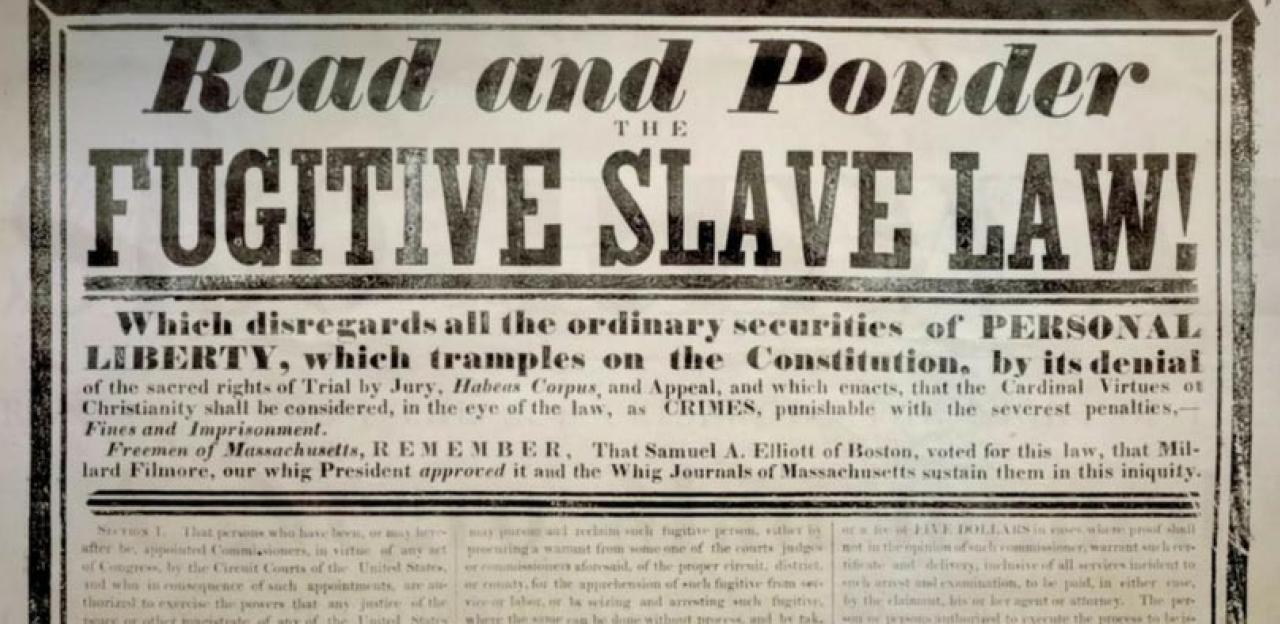
By 1850 Southerners were demanding a new and stronger fugitive slave law. The old one, passed by Congress 1793, had proved inadequate to cope with runaways, especially since unfriendly state authorities failed to provide needed cooperation.
Estimates indicate that the south in 1850 was losing perhaps 1,000 runaways a year, out of its total of some 4 million slaves. In fact, the owners probably freed more blacks voluntarily than every escaped. But the issue of runaways being helped by abolitionists was unacceptable to the slave owners. They argued that the Constitution and laws of Congress protected slavery.
1. Read the following article (click on the eye) on the growth of abolitionism in the North and complete the table below.
2. Which of the following posed a bigger problem for abolitionists?
- Internal disagreement
- External opposition
The growth of abolitionist sentiment in the North
In the 1830s, American abolitionists, led by Evangelical Protestants, gained momentum in their battle to end slavery. Abolitionists believed that slavery was a national sin, and that it was the moral obligation of every American to help eradicate it from the American landscape by gradually freeing the slaves and returning them to Africa. Not all Americans agreed. Views on slavery varied state by state, and among family members and neighbours. Many Americans—Northerners and Southerners alike—did not support abolitionist goals, believing that anti-slavery activism created economic instability and threatened the racial social order.
But by the mid-nineteenth century, the ideological contradictions between a national defences of slavery on American soil on the one hand, and the universal freedoms espoused in the Declaration of Independence on the other hand, had created a deep moral schism in the national culture. During the thirty years leading up to the Civil War, anti-slavery organizations proliferated, and became increasingly effective in their methods of resistance. As the century progressed, branches of the abolitionist movement became more radical, calling for the immediate end of slavery. Public opinion varied widely, and different branches of the movement disagreed on how to achieve their aims. But abolitionists found enough strength in their commonalities—a belief in individual liberty and a strong Protestant Evangelical faith—to move their agenda forward.
Whilst Abolitionists agreed that slavery needed to be ended they did not agree on which strategy to pursue to achieve their ultimate aim. The English Historian, Howard Temperley wrote that it was easier for the abolitionists to agree about the ends than about the means, which could often seem vague, contradictory and impractical. It was because slavery was embedded in the fabric of the Constitution and of the Union that William Lloyd Garrison, one of the more extreme abolitionists, advocated the pursuit of a higher law above and beyond the Constitution, and disunion.
By the 1830s a militant South had become totally opposed to emancipation (the state of Georgia, for example offered a $500 reward for the abduction of Garrison) while the North, with the exception of about 1% of the population (who were black), remained indifferent or Negrophobe. In fact the Historian Tocqueville argued that racial prejudice was stronger in the North than in the South, and although only 1% of the North’s population were African American, they were discriminated against, disenfranchised and segregated. In 1813 Illinois territory passed a law which ordered every incoming free African American to leave the territory under penalty of 30 lashes repeated every 15 days until he or she left. In its original constitution, Oregon, which joined the Union as a free state in 1859, forbade African American immigrants from entering it.
The Whites living in both the North and South feared what would happen once African Americans were emancipated; many believed a race war would break out. In 1817 the American Colonisation Society was established as a solution to this problem and famous supporters such as Thomas Jefferson, Henry Clay and Abraham Lincoln believed in its aim to transport African Americans back to Africa. But increasingly this policy was rejected as a moral evasion and various strategies of gradual and compensated emancipation were considered until the more radical wing of abolitionists adopted immediate freedom as their central doctrine. The emancipation of British West Indian slaves in 1833 and the intransigence of Southern slave owners contributed to this change of heart. However, it was a central insistence upon the evil of slavery and a refusal to compromise with it, or accommodate to it, which held Garrison and his followers together.
On the 1 January 1831 Garrison issued the first publication of his newspaper, The Liberator, and publicly criticised the doctrine of gradualism. Garrison co-published weekly issues of The Liberator from Boston continuously for 35 years, from January 1, 1831, to the final issue of December 29, 1865. Although its circulation was only about 3,000, and three-quarters of subscribers were African Americans in 1834, the newspaper earned nationwide notoriety for its uncompromising advocacy of "immediate and complete emancipation of all slaves”. Garrison set the tone for the paper in his famous open letter "To the Public" in the first issue. The Liberator faced harsh resistance from several state legislatures and local groups: for example, North Carolina indicted Garrison for felonious acts, and the Vigilance Association of Columbia, South Carolina, offered a reward of $1,500 ($25,957.20 in 2005 dollars) to those who identified distributors of the paper.
Many abolitionists did not support Garrison’s views, which also included anticlericalism, feminism and pacifism. The abolitionist movement was made up of a large spectrum ranging from Garrison’s immediate emancipation at one end, to those who advocated political means and co-operation within the existing party system on the other. A belief in gradual reform, exerting pressure through party voting, led first to the establishment of the Liberty Party (1844) then of the Free Soil Party (1848), which ran Martin Van Buren and Charles Francis Adams as presidential candidates. The creation of the Republican Party, in the aftermath of the Kansas-Nebraska Act of 1854 finally led to the candidacy and election of Abraham Lincoln as President in 1860 on a platform committed to the non-extension of slavery. It was the fundamental division over whether abolitionists should dabble in partisan politics which led to the major split in their ranks in 1840 with the anti-Garrisonians forming the American and Foreign Anti-Slavery Society. But it would be wrong to see the Garrisonian wing of the movement bearing the torch of emancipation alone. The history of the abolitionist movement was a history of sectarian splintering with many whose awareness of the evil of slavery was heightened by the rhetoric of its leaders swelling the ranks of political reformism, voting for the Free Soil Party, engaging in postal campaigns, rallies, assisting the Underground Railroad, helping runaways to escape, ignoring the 1850 fugitive slave law and fighting the gag rule in Congress. All of these were practical activities to help blacks gain freedom, rather than Garrisons’ impractical ideological idealism
| Evidence to suggest that the abolitionist movement progressed in this period (1830-1860) | Problems faced by the abolitionists this period |
What can we learn from this source about William Lloyd Garrison's view regarding abolition of slavery?
Assenting to the "self-evident truth" maintained in the American Declaration of Independence, "that all men are created equal, and endowed by their Creator with certain inalienable rights -- among which are life, liberty and the pursuit of happiness," I shall strenuously contend for the immediate enfranchisement of our slave population. In Park-street Church, on the Fourth of July, 1829, in an address on slavery, I unreflectingly assented to the popular but pernicious doctrine of gradual abolition. I seize this opportunity to make a full and unequivocal recantation, and thus publicly to ask pardon of my God, of my country, and of my brethren the poor slaves, for having uttered a sentiment so full of timidity, injustice and absurdity. A similar recantation, from my pen, was published in the Genius of Universal Emancipation at Baltimore, in September, 1829. My conscience in now satisfied.
Below are several contemporary sources on the issue of slavery.
Read these sources and, in pairs, discuss:
a. What you can learn from these sources about slavery as a source of tension the US
b. How the context of each source affects its value for a historian investigating slavery. (You can also print them off on the attached PDF to annotate as you read)
Source A
From an anti-slavery novel, ‘Uncle Tom’s Cabin’ by Harriet Beecher Stowe, 1852. This extract contains the words of a character from the novel, Mary, the wife of Senator John Bird.
‘You ought to be ashamed, John! Poor, homeless, houseless creatures! The Fugitive
Slave Law is a shameful, wicked, abominable law, and I’ll break it, for one, the first time I get a chance; and I hope I shall have a chance, I do! Things have got to a pretty pass, if a woman can’t give a warm supper and a bed to poor, starving creatures, just because they are slaves, and have been abused and oppressed all their lives, poor things! I know little about politics, but I can read my Bible; and there I see that I must feed the hungry, clothe the naked, and comfort the desolate; and that Bible I mean to follow.’
Source B
From the author’s introduction to her novel, ‘The Planter’s Northern Bride’ by Caroline Lee Hentz (1854), in which the author explains her views. This book was a Southern response to ‘Uncle Tom’s Cabin’.
It is our honest belief that the Negroes of the South are the happiest labouring class on the face of the globe; despite all that can truly be said of their trials and sufferings. The fugitives who flee to the Northern States are no proof against the truth of this statement. They have, most of them, been affected by the influence of others — tempted by promises which are seldom fulfilled. The seeds of discontent and rebellion have taken groves of the South.
Source C
From a speech by James Henry Hammond, Senator for South Carolina, to the US Senate, 4 March 1858.
The South has sustained the North in great measure. You (the North) fetch and carry forus. One hundred and fifty million dollars of our money passes annually through yourhands. It assists to keep your machinery together and in motion. Suppose we were to discharge you; suppose we were to take our business out of your hands; we should consign you to anarchy and poverty. You complain of the rule of the South; that has been 5 the force that has preserved you in your affluence. We have kept the Government conservative to the great purposes of the Constitution. We have placed it, and kept it, upon the Constitution; and that has been the cause of your peace and prosperity.
Source D
From ‘The Cotton Kingdom: a traveller’s observations’ by Frederick Law Olmsted, published in 1861. Olmsted was a Northern journalist who carried out research in the Southern states in the 1850s.
Let a man be absent from the North for twenty years, and he is struck, on his return, by the ‘improvements’ which we have made: better buildings, churches, schoolhouses, mills, railroads and much more. It is not difficult to see where the profits of our manufacturers and merchants are. But where will the returning traveler see the accumulated cotton
profits of twenty years in the South? Ask the cotton-planter for them, and he will point not 5 to libraries, churches, schoolhouses, mills, railroads or anything else; he will point to the increased number of slaves he owns and almost nothing else. The total increase in wealth of the southern population during the last twenty years shows for almost nothing.

Concept - perspectives: Should African Americans receive compensation for slavery?
Should African Americans receive compensation for slavery? Student should research the current arguments about this in the news and set up a debate. The website Issues and Controversies in American History is an excellent starting point - but you need a subscription to access all the materials:
Issues & Controversies in American History: This Month in History, February 2020—Slave Reparations | Infobase (www.infobase.com)
Since the United States abolished slavery in 1865, former slaves and their descendants have raised the issue of whether they should receive compensation and redress in some form for slaves’ unpaid labor and suffering. While some place emphasis on financial reparation, others have focused on land ownership or simply called for an apology. Although the issue languished in the years after Reconstruction, it gained renewed attention in the 1990s and early 2000s. Supporters of reparations see them as repayment of a debt, whether moral, financial, or psychological. Since slaves worked without pay for more than two centuries, they argue, those who profited from their labor should compensate their descendants in some way. Reparations, they contend, will also promote racial reconciliation. Opponents of reparations see them as impractical. Determining who would pay reparations, who would receive them, and how much they would get, they argue, is too controversial to solve fairly. Putting a price tag on suffering under slavery, they contend, is also disrespectful to those who underwent it.
Watch the following summary video on Slavery and then complete the tasks below:
Based on the video and the rest of this section produce:
- A summary diagram highlighting the key points you have learnt
- A series of revision cards to help you go back over the section later
- An online quiz using kahoot or similar to test your classmates on this section
Tags: slavery