Example 2: The Russian Federation (1985-1999)
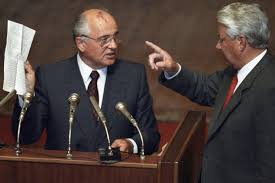
The period between 1985 and 1999 was an era of critical transformation in Eastern Europe as the Soviet Union collapsed and was replaced by the Russian Federation.
This transition was driven by systemic economic issues, the failure of Gorbachev’s reforms (perestroika and glasnost), and mounting nationalist and democratic pressures across the Soviet bloc. Politically, the change involved the dismantling of the Communist Party’s monopoly on power, the dissolution of the USSR in 1991, and the creation of a new regime under Boris Yeltsin, culminating in the 1993 Russian Constitution. Economically, Russia underwent a rapid and destabilizing shift from a centrally planned system to a liberalized market economy, with mass privatization, deregulation, and hyperinflation.
Please note that the Full Source Paper is on the setting Default-OFF: this means it can only be accessed by students when switched on by you. (To switch pages on or off for a group you need to go to the Page manager for the relevant group.)