At a glance

This page gives an overview of the key changes in the course that you need to be aware of. These are discussed in more detail on the specific pages for each of the sections of the DP History exam.
What are the key changes to the new curriculum?
Focus
Many elements of the course in terms of skills remain the same. Students need to have a firm grasp of content, to be able to evaluate sources, understand historical concepts, construct arguments, understand different perspectives.
However, the new syllabus is structured slightly differently in order to put emphasis on students engaging directly with the content:
Historical Inquiry
Historical Inquiry is at the centre of the new curriculum. For each section of the course the content is focused around an inquiry question.
Contexts
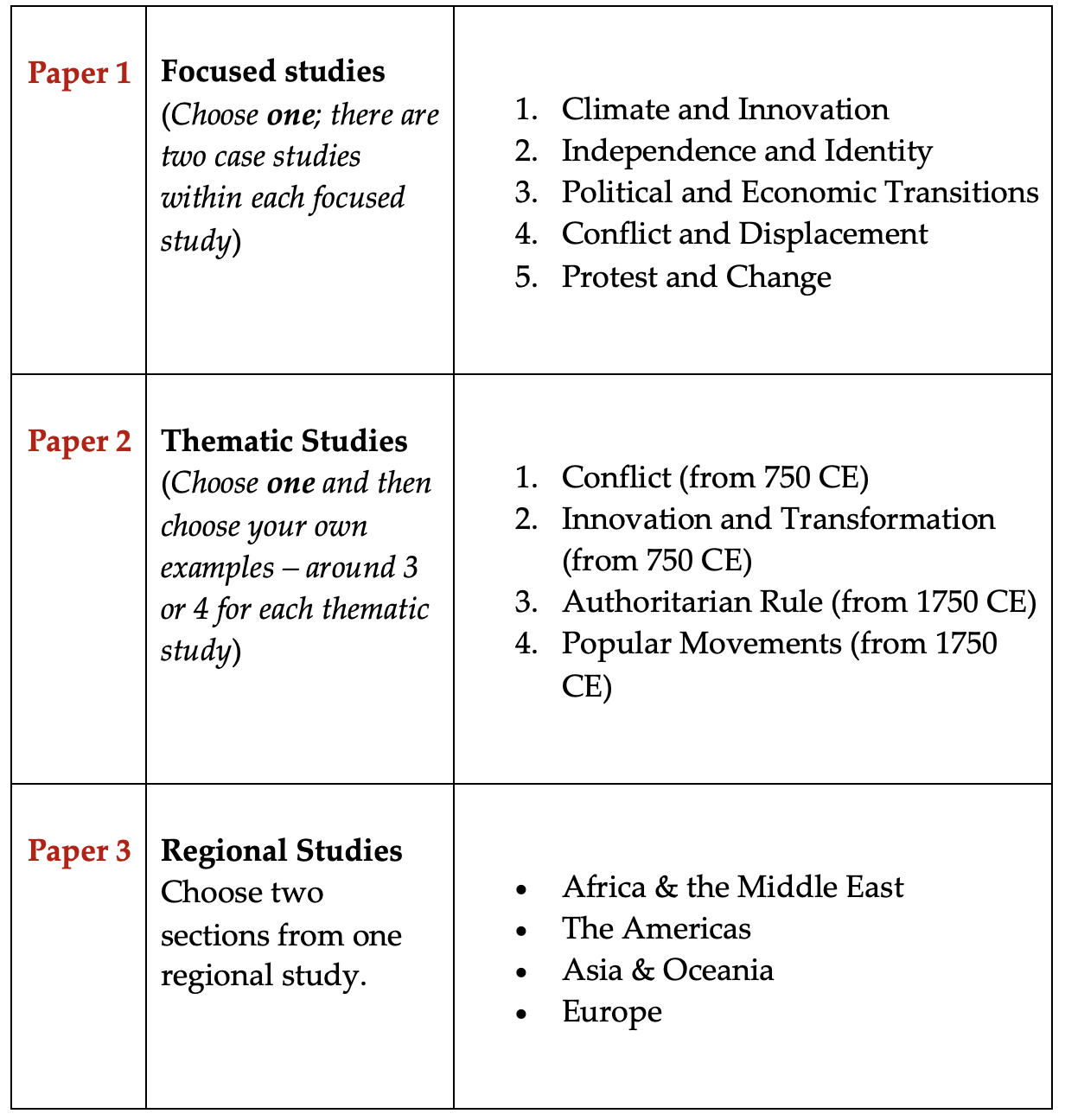
Each paper focuses on a different ‘inquiry context’ to help scaffold and direct the content:
Paper 1 is the focused study
Paper 2 is the thematic study
Paper 3 is the regional study
The IA is the historical investigation
Concepts
Historical concepts provide focus and direction for the historical inquiry.
The 4 concepts are: cause and consequence, continuity and change, perspectives and significance
They feature in all areas of teaching and assessment and are discussed more fully on the next page.
Content
The content demands of the DP History course have been reduced to lessen student workload and allow more time for teachers to use inquiry-led teaching and to develop student understanding of concepts.
- For Paper Two, students now only need to study ONE ‘Thematic Study’ (not two 'World History Topics' as in the current curriculum)
- For Paper Three, students now only need to study TWO sections in the ‘Regional Study’ (rather than three).
Structure of the three examination papers
There are 5 options (known as Focused Studies) to choose from for Paper 1, and each option contains two examples from different regions.
Students still have to analyse sources; however questions are now based around overarching ‘inquiry questions’ for each ‘focused study’.
There are now only 3 questions on Paper 1.
These questions require students
- to show their understanding of the content in the sources in relation to the inquiry question
- to discuss how the context of each source impacts how it can be used by historians
- to understand and discuss the different perspectives that are revealed in the sources
For more detail on the new structure for Paper 1 and how it impacts teaching, go to this page: 3. Teaching Paper 1
Paper 2 has been completely re designed.
Students are taught ONE Thematic Study out of a possible five.
In the exam, there are now TWO sections.
In Section A, students have to answer a short-response question on one of the 4 specified concepts mentioned above using one example from their Thematic Study.
In Section B, students answer two questions.
One is a short-answer response in which students focus on one example only from their Thematic Study. The other is an essay-response question requiring students to make connections from different examples that they have covered in their Thematic Study.
For more detail on the structure of Paper 2, go to this page: 4. Teaching Paper 2
As mentioned above, the key change here is that students only have to answer two essay questions, not three. Thus, students will study only two ‘sections’ (confusingly also called ‘regional studies’) and write one essay question from each different section.
In all questions, students have to evaluate an argument presented in the question, explore diverse perspectives and reach a reasoned judgement.
For more detail on Paper 3, go to this page: 5. Teaching Paper 3
Overview
Weighting and timing of papers
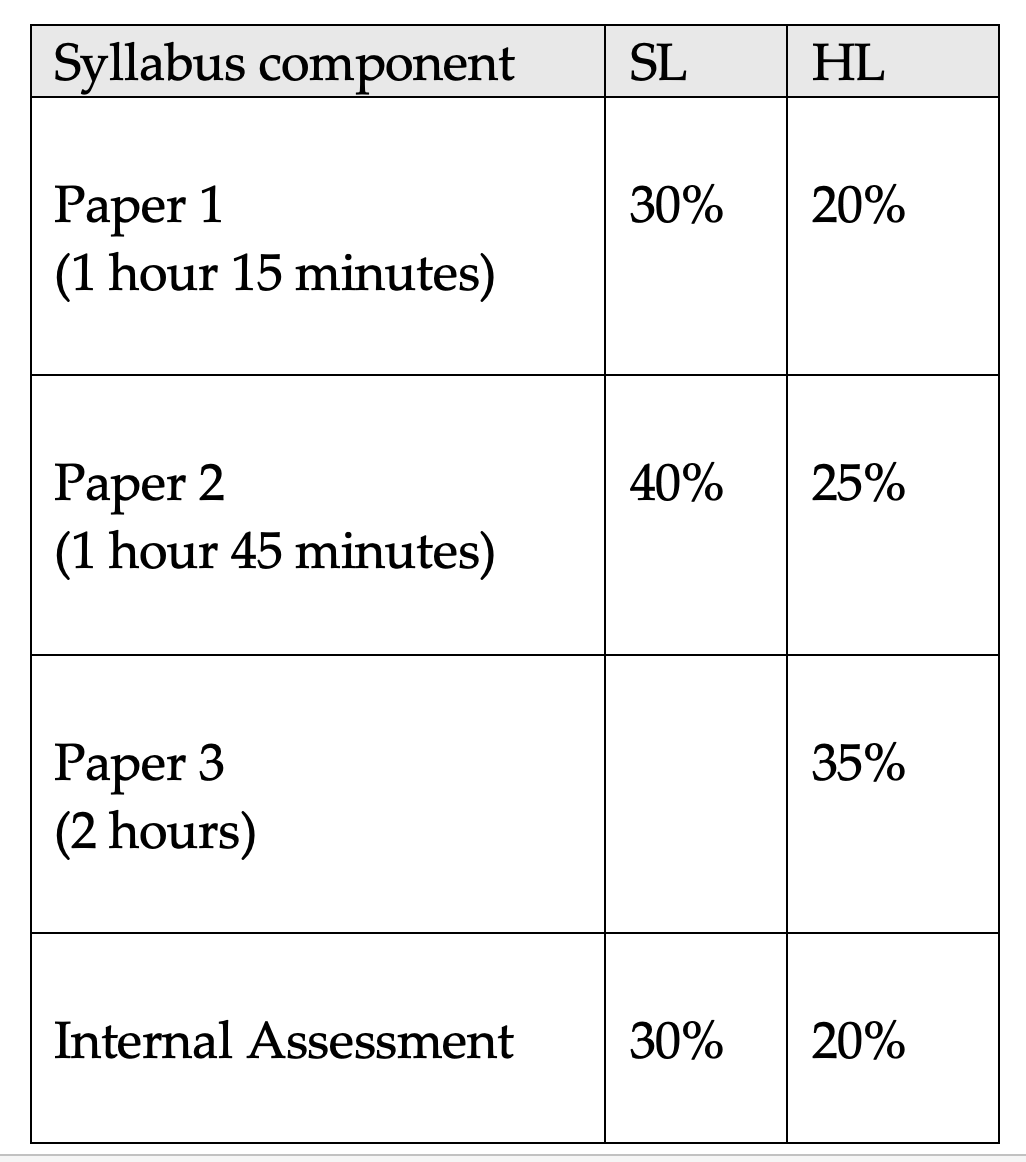
The percentage weighting and length of each paper in the new curriculum is shown below.
The Internal Assessment
The changes to each paper are all discussed in more detail on the following pages!