June Blog: 2028 Curriculum Think In, Anniversaries and Site update
See below for
- Site update
- How to sign up for the first 2028 Curriculum History Think In with Jo and Keely
- June anniversaries
Site update: Curriculum 2028
In the last month, we have added the following to the Curriculum 2028 section of the site:
Paper 3: Americas, 11: Social movements in the Americas (1945–2020) (First section)
Paper 2: Conflict since 750: Algeria
We will continue to add more examples throughout July to help you with your preparation for the first teaching of this curriculum from August.
And then we will continue to add examples throughout 2026 and 2027 - and beyond!
Sign up for our Think In!
11th August 14:00 CEST
In this 3 hour virtual Think In, we will address the key changes to the 2028 course.
. Topics covered include:
- Understanding the new syllabus - content, concepts and contexts, plus the new assessment models for all 3 papers
- Advice and preparation for planning and delivering the new course
- Resources to support teachers.
- Addressing questions and concerns.
To book a place at the Think In go to https://inthinking.net/ and click on Think Ins
Hope to see you there!
New Extended Essay
Your current students will now be writing their Extended Essays following the new criteria for the 2027 examination.
Just a reminder that we have a section on the site explaining the new criteria.
And we have also just added an exemplar essay following the criteria - with RPF and marking comments.
2027 Extended Essay exemplar
To what extent was British pressure responsible for the abolition of slavery in Brazil between 1826 and the Golden Law of 1888?
History in the news: Anniversaries
This month sees some interesting historical anniversaries which are relevant to IBDP History students:
80th Anniversary of the International Military Tribunal in Tokyo
At the International Military Tribunal in Tokyo in 1946, judges from 11 countries gathered to try, under international law, the war crimes committed by Japanese militarists during the Second World War. Twenty-eight Japanese military and political leaders were charged with fifty-five separate counts encompassing the waging of aggressive war, murder and conventional war crimes committed against prisoners-of-war, civilian internees and the inhabitants of occupied territories.
The Trials were important for putting concepts such as crimes against peace, war crimes, and crimes against humanity into the realm of international law. It helped to establish the post-war ‘rules-based world order’ in which standards were established for behaviour of leaders who could now be accountable internationally for their actions.
This is a timely anniversary given that the global ‘rules-based order’ is currently under intense pressure.
The following article from the National World War Two Museum in New Orleans gives the context and details of both the Nuremberg and Tokyo tribunals; it also highlights controversies that have developed regarding the Tokyo tribunal:
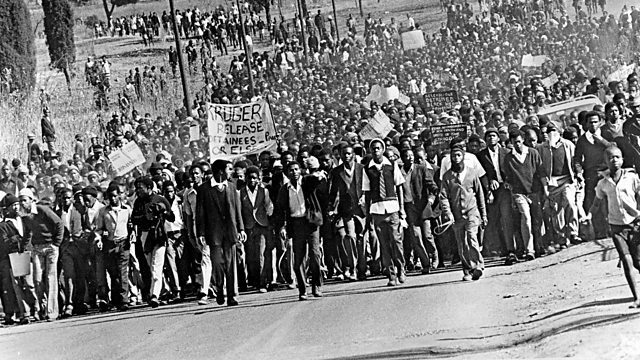
50th Anniversary of the Soweto Uprising
Students studying Rights and Protest for Paper 1 and/or South Africa for Paper 3, Africa region and the Middle East, will be interested in the debates around the 50th Anniversary of the Soweto Uprising.
This event was a decisive turning point in the fight against apartheid in South Africa; on 16 June 1976, students took to the streets of Soweto to protest against the imposition of Afrikaans as the language of instruction in Black schools. What followed was a massacre, with 176 dead after the police opening fired, and a death toll that came closer to 700 as the protests spread across the country. However, it was also a turning point due to the intense international pressure on the apartheid regime that it generated.
The anniversary is a time for remembering this tragic event and its impact on apartheid; however it has also sparked debate in South African about the degree of progress that South Africa has achieved since Black South Africans finally achieved equality in 1990.
As the following article notes:
The 50th anniversary of the Soweto Uprising is worthy of remembrance to appreciate that true progress generally requires struggle on the part of the people. Yet, it also reveals how far South Africa still must travel to become truly egalitarian. Despite more than thirty years of freedom, most Black South Africans remain deeply poor while the average white South Africans remain far more likely to own land and a house, and far more likely to have a high school or university education.'