August Blog: The Helsinki Accords 50 years on
Anniversaries
50th Anniversary of the Helsinki Final Act
‘[The OSCE’s] vision of a peaceful, cooperative Europe whose governments respect the international rule of law and protect human rights has not survived the test of time. But, in the spirit of the original Helsinki accord, it surely remains a prize worth striving to achieve.”
The Irish Times, 31 July 2025
On August 1, 1975, the Helsinki Final Act (also known as the Helsinki Accords) was signed by 35 countries. The Helsinki Final Act was the outcome of the Conference on Security and Cooperation in Europe (CSCE), which began in Geneva in 1973 and it was a landmark agreement primarily aimed at easing Cold War tensions and fostering cooperation between the Soviet bloc and the West.
The 50th Anniversary has given rise to much discussion and, indeed praise, for this agreement:
The accord committed adversaries to a large number of wide-ranging pledges to enhance mutual security and to foster cooperation. Opposing political, military, economic, social, and ideological systems notwithstanding, the document also bound its signatories to a demanding catalogue of foundational norms, and its provisions for follow-up gave the accord a dynamic character, ensuring that progress could be monitored in the future and violations addressed for all to see. These impressive achievements make the Final Act a masterpiece of modern diplomacy and a textbook example of successful negotiations among enemies.
https://engelsbergideas.com/notebook/the-helsinki-final-act-a-masterpiece-of-modern-diplomacy/
The CSCE evolved into the Organization for Security and Co-operation in Europe (OSCE): it is the world's largest regional security organisation - the only one of which Ukraine, the US and Russia are members - and it continues to operate, now with 57 participating states. However, given Putin's invasion of Ukraine, the media analysis of the success of the Helsinki Accords on this anniversary has been accompanied with discussions of the threats to security and cooperation that Europe now faces, and the extent to which the principles that were established at Helsinki can be maintained, or even renewed.
The statement made by the OSCE following their 50th Anniversary meeting included the following:
Yet, on this anniversary, we must acknowledge a painful truth: these principles have been repeatedly challenged and violated over the past 50 years. Today, the Russian Federation’s ongoing war of aggression against Ukraine constitutes a grave and unprecedented violation of the very principles the Helsinki Final Act was intended to uphold. This unprovoked and unjustified war has inflicted immense human suffering and caused profound damage to the European security order. It is not only an attack on Ukraine, but an assault on the shared commitments of all OSCE participating States.
The following articles are all useful for discussing this anniversary with IBDP students - particularly those studying the Cold War:
The Office of the Historian gives a good overview of the background and details of the final agreement:
Milestones in the History of U.S. Foreign Relations - Office of the Historian (history.state.gov)
The Helsinki Final Act was an agreement signed by 35 nations that concluded the Conference on Security and Cooperation in Europe,...
This is a timeline of the events leading up to the Helsinki Accords from the Wilson Centre:
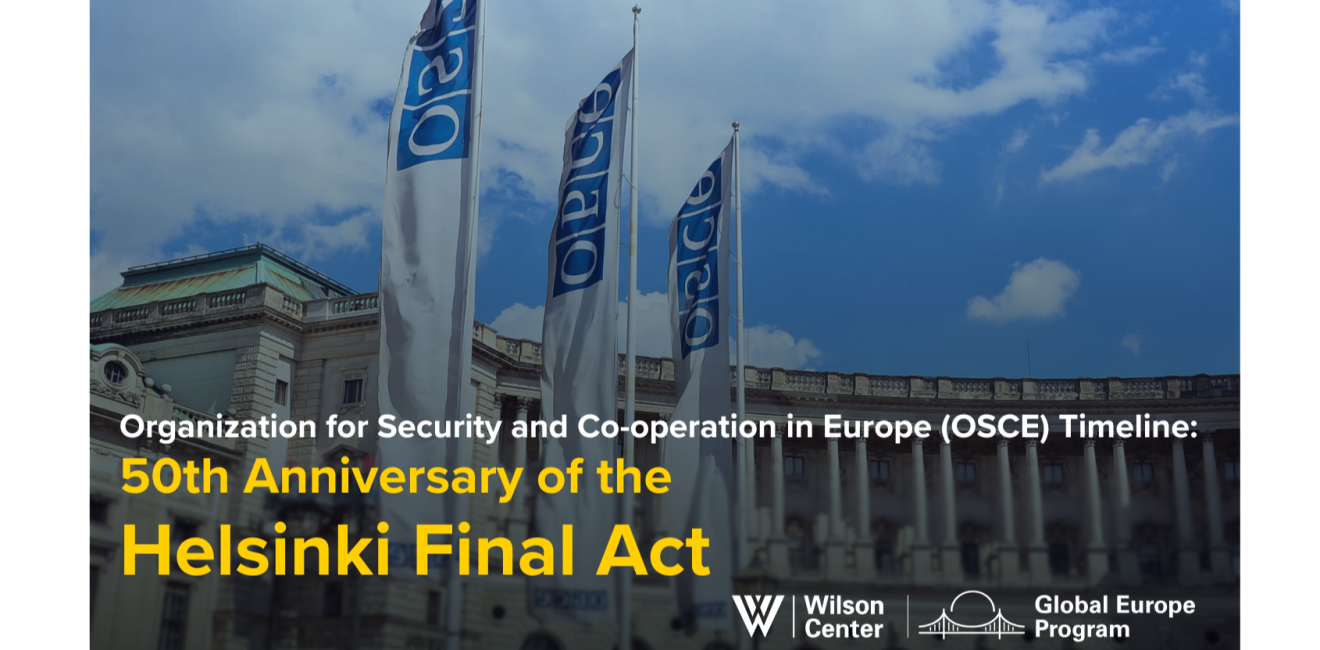
Organization for Security and Co-operation in Europe (OSCE) Timeline: 50th Anniversary of the Helsinki Final Act (Wilson Center)
On August 1, 1975, the Helsinki Final Act (also known as the Helsinki Accords) was signed by 35 countries. The Helsinki Final Act was the outcome of...
Another article from The Guardian newspaper discussing the Helsinki Accords in the context of Putins's actions in Europe;
The Helsinki accord was a masterpiece of European diplomacy. Fifty years on, we need its spirit more than ever | Kai Hebel and Richard Davy (the Guardian)
The OSCE hasn t stopped Putin s aggression, but it has the potential to help broker a peace in Ukraine when the time is right, say authors Kai...
80th Anniversary of the bombing of Hiroshima and Nagasaki
This significant anniversary has also given rise to new media resources for reviewing or covering the pivotal and devastating events of August 1945.
The BBC will broadcast the following programme on Monday 4th August: What happened at Hiroshima?. Again today's unstable global situation provides the context for the programme's narration and discussion:
The film’s reporter and narrator, award-winning BBC journalist Jordan Dunbar sets the story of Hiroshima against the backdrop of today’s febrile international situation as nuclear brinkmanship is moving front and centre. Jordan looks at what led to the events of August 1945, talks to some of the last survivors of the bombing of Hiroshima – and asks what we can learn to stop history from repeating itself.
The BBC also broadcast this documentary entitled Atomic People on Hiroshima last year. This documentary also combines archival footage with the voices of survivors.
Site update: New Extended Essay guidelines
We have just uploaded another high scoring Extended Essay which we hope both you and your students will find useful for the next examination session:
However, please note that the IB has released a new Extended Essay guide, for first teaching in 2025 and first examinations in 2027.
The new guide can be found on MyIB.
In addition, we have uploaded the following page to help you navigate the changes and to understand the key differences:
The new Extended Essay (2027)
The new Extended Essay (first teaching 2025, first exams 2027).
Curriculum Review Update
A reminder that the 3rd Curriculum Review can also be found on MyIB along with a Final Curriculum Review Report published in April this year.
To help you manage the transition to the new curriculum please note that we will have our site ready with new materials and guidance in good time to begin teaching in August 2026