If AI can answer the question, what is left for the TOK student to think about?
Quite a lot, actually.
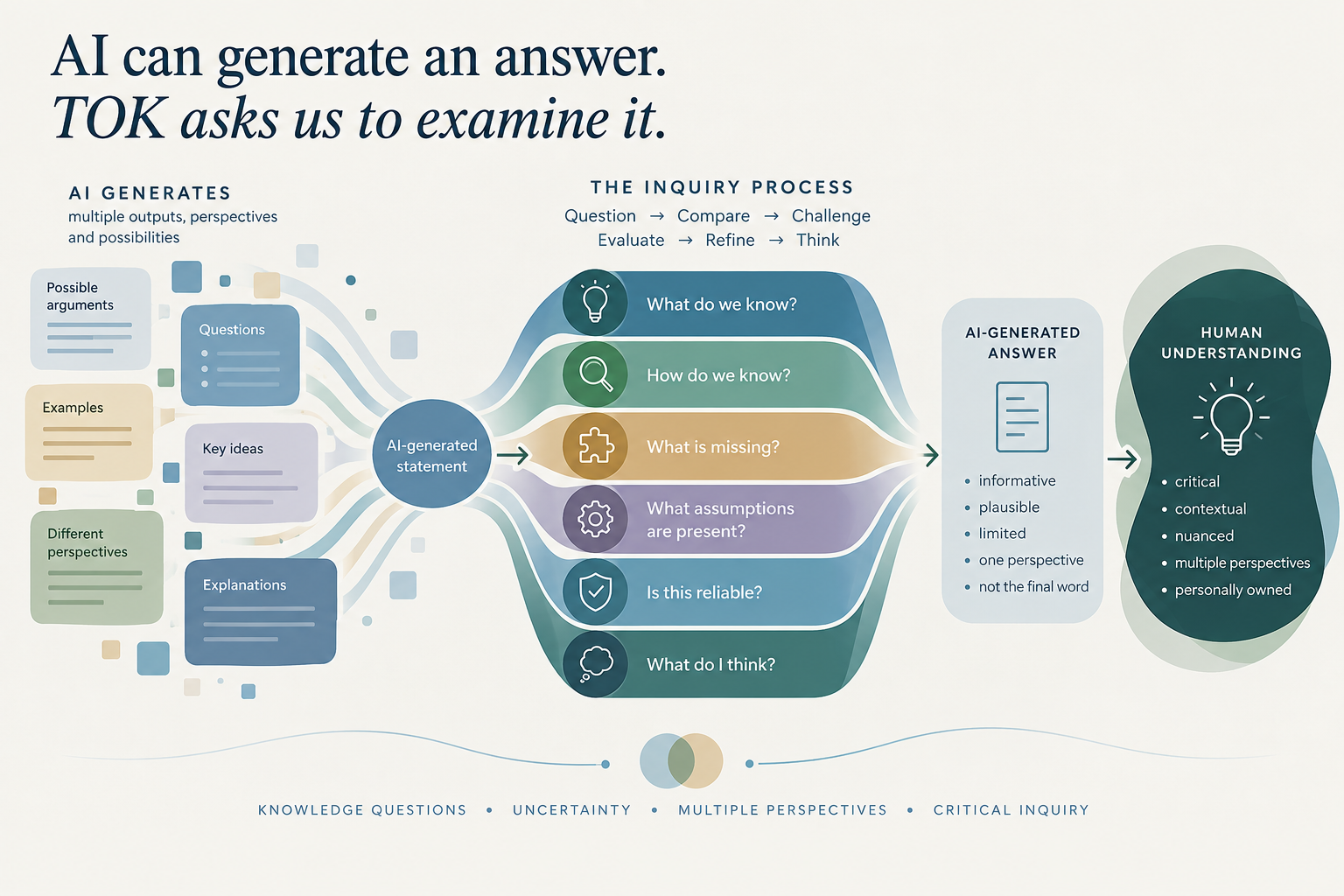
The more powerful generative AI becomes, the more important it is that students understand how knowledge is produced, challenged, interpreted and justified. The challenge for TOK teachers is therefore not simply deciding whether students should use AI. It is deciding how AI can be used to deepen thinking rather than replace it.
The IB has produced a new subject-specific publication, Using AI in the Learning and Teaching of DP Theory of Knowledge (International Baccalaureate Organization, 2026). The document explores how generative AI can be used thoughtfully throughout the two-year TOK learning journey, while recognising the particular risks it presents to critical thinking, intellectual honesty and the social nature of knowledge. Its central message is that AI should support, rather than replace, students’ own thinking. The publication encourages educators to use AI as a stimulus for inquiry, dialogue, comparison and reflection, while helping students understand the limitations, biases and uncertainties of AI-generated outputs. It also emphasises that AI itself can become an object of TOK inquiry and that effective use depends on a classroom culture in which students feel safe to think independently, question ideas and be open about their use of AI.
What does this mean for TOK teachers?
The publication identifies a number of important principles:
- Think first: students should develop their own ideas, writing and discussion before engaging with AI.
- Evaluate AI critically: AI outputs may be inaccurate, biased, incomplete, fabricated or overly confident. They should be questioned rather than simply accepted.
- Maintain intellectual ownership: AI should support students’ thinking, not replace their critical examination of knowledge questions.
- Use AI as a thinking partner: students can use AI to generate perspectives, examples, counterarguments and questions, while remaining responsible for evaluating and refining the responses.
- Make AI itself an object of TOK inquiry: students can investigate how AI produces outputs, how changing a prompt can change an answer, and how assumptions and training data can influence what AI produces.
- Protect dialogue and uncertainty: AI should not shortcut the social and collaborative process through which students explore ambiguity, challenge assumptions and encounter alternative perspectives.
- Embed AI within authentic TOK learning: AI can support work with real-world examples, conceptual understanding, claims, counterclaims and the evaluation of arguments and evidence.
- Keep assessment separate: the publication is about learning and teaching and does not provide policy or guidance for IB summative assessment.
(The document is found in the IB Programme Resource Centre).
One of the most useful ideas in the publication is establishing a “think first” norm: students develop their own ideas before asking AI for explanations, examples or arguments. AI can then become a tool for comparing, challenging and evaluating ideas, rather than simply retrieving information. For example, students might ask AI to generate possible knowledge questions or arguments for and against a claim, but then judge which are insightful, what has been overlooked and how the responses could be improved.
The IB also suggests that AI itself can become an object of TOK inquiry. What happens when a small change in a prompt produces a different answer? Why can AI sound confident when it is wrong? What assumptions and biases influence its outputs? What can human experience, perspective and conceptual understanding contribute that AI cannot? These questions take us back to the heart of TOK.
The publication therefore suggests that the most productive use of AI may not be to make learning easier or faster, but to make thinking more visible. AI can provide an argument to challenge, an example to test, a definition to interrogate or a perspective to question. Used in this way, it becomes part of the inquiry rather than a substitute for it. The bigger question for schools is not simply “Should students use AI?” but “How do we teach students when to use AI, how to question it and when to put it aside and think for themselves?” That is ultimately a question about the kind of learners and knowers we want our students to become.