EE Planning document
The Extended Essay - Planning Document

"The only reason for time is so that everything doesn’t happen at once.”
- Albert Einstein (1879 - 1955), recipient of the Nobel Prize in Physics (1922)
How to use this planning sheet
This planning sheet is designed to help you choose a suitable Extended Essay topic, develop a focused research question, and plan your Business Management investigation. It is based on the 5Cs model, also used for the IA.
You can use the planning sheet to organise your initial ideas and present your proposed topic and research question to your EE supervisor for discussion and feedback. It will also help you identify relevant business management theories and tools, consider possible sources of evidence, and establish a clear direction for your research.
Important guidance
Before proceeding with your Extended Essay, you should be able to demonstrate to your EE supervisor that:
- Your chosen area of study is appropriate for a Business Management investigation and allows you to explore a relevant business issue or decision.
- Your research question is sufficiently focused, analytical, and manageable within the 4000-word limit.
- Your secondary research is relevant, reliable, and accessible, with sufficient evidence available to investigate your research question effectively.
- Your chosen business management theories and tools are appropriate for analysing the evidence and developing a well-supported evaluation.
Remember: A successful Business Management Extended Essay starts with a well-focused research question supported by sufficient, relevant, and reliable evidence. Taking the time to plan your investigation carefully will help you produce a coherent, analytical, and evaluative Extended Essay.
Extended Essay planning document
Real-world business management issue to be investigated
Identify a specific business issue, decision, or strategy that you intend to investigate. For example, this could involve evaluating the effectiveness of a marketing campaign, an external growth strategy (such as a recent merger or acquisition), a sustainability initiative, or a corporate social responsibility (CSR) programme.
Your chosen issue should relate to a real business or industry and be sufficiently focused to allow meaningful analysis and evaluation. Briefly explain why the issue is important to the business and ensure that sufficient relevant and reliable secondary research is available to support your investigation.
Avoid choosing a broad issue such as “The marketing strategy of Apple”. Instead, focus on a specific business decision or strategy that can be investigated and evaluated within the 4000-word limit.
You do not need to have a title (which applied to the legacy guide), only a research question (RQ).
Research Question (preliminary)
Your research question must be clearly phrased as a question and sufficiently focused to allow detailed analysis and evaluation within the 4000-word limit. It should address a specific, real-world business management issue and be supported by relevant and reliable secondary research. This can be supported by primary research where appropriate.
For example:
Research question: To what extent has the strategic alliance between Tata Coffee and Starbucks been a financial success in Mumbai, India?
Choosing an appropriate research question is one of the most important decisions in your Extended Essay. Your RQ should guide the direction of your research, the evidence you collect, and the business management tools and theories you apply.
Top tips!
- Be specific - Identify the business, issue or strategy, and the particular aspect of performance or impact you intend to investigate.
- Make it analytical and evaluative - Avoid questions that simply require description or factual explanations.
- Avoid foregone (obvious) conclusions - Your research question should allow you to explore different perspectives, consider competing evidence, and reach a reasoned judgement rather than a predetermined conclusion.
- Check the availability of evidence - Ensure you can access sufficient relevant and reliable secondary sources to investigate your RQ effectively.
- Consider different interpretations - Business management decisions are rarely straightforward. Recognise that business tools, theories, and methodologies have limitations and may lead to different conclusions.
Remember, a strong research question encourages critical thinking and allows you to develop a balanced, evidence-based argument. Your investigation should recognise that business management decisions and their outcomes are often contestable.
Before finalising your research question, complete ATL Activity 1 ("Good, bad, or ugly?") here to help you assess and refine your proposed RQ. Discuss your ideas with your EE supervisor before proceeding with your research.
C1 – Contemporary: Why is the chosen real-world business issue of academic relevance today?
Explain why your chosen business issue, decision, or strategy is relevant in today's business environment. Consider recent developments, emerging trends, changing market conditions, or challenges facing the business or industry. Your explanation should demonstrate why the issue is worth investigating from a Business Management perspective, rather than simply describing why it is interesting to you.
Top tips!
- Establish the context - Briefly explain the recent events, business decisions, or developments that make your chosen issue relevant today.
- Explain its significance - Consider how the issue affects the business, its stakeholders, competitive position, or long-term performance.
- Make connections to Business Management - Identify relevant concepts, theories, or strategic challenges that make the issue worthy of academic investigation.
- Support your explanation with evidence - Refer to recent company reports, academic research, industry publications, or credible business news to demonstrate the issue's contemporary relevance.
- Avoid general statements - Rather than claiming that a topic is important because it is 'interesting' or 'widely discussed', explain its specific relevance to your chosen business and research question.
Remember, a contemporary issue does not necessarily have to involve a decision made very recently. What matters is that the issue remains relevant and provides opportunities for meaningful analysis, critical thinking, and evaluation using Business Management concepts and theories.
Justification for the purpose of the investigation (Why it is of importance and hence worth studying? Avoid personal reasons - leave these for the reflective statement)
Explain the academic and business significance of your proposed investigation. Consider why the issue deserves further research, what you hope to establish through your analysis, and how your findings could contribute to a better understanding of the business decision, strategy, or problem being investigated.
Top tips!
- Explain the purpose - Clearly identify what your investigation aims to establish, assess, or evaluate in relation to your research question.
- Demonstrate its importance - Explain why the issue matters to the business, its stakeholders, or the wider industry. Consider its potential financial, strategic, operational, or ethical implications.
- Identify the value of the investigation - Consider how your research could provide insights into the effectiveness of a business decision, the consequences of a strategy, or the challenges facing an organization.
- Establish its academic relevance - Explain how relevant business management theories, concepts, and tools can help you investigate the issue and develop a reasoned evaluation.
- Avoid personal justifications - Do not focus on personal interests, career ambitions, or reasons for choosing the business or area of investigation. These are more appropriate for your Extended Essay reflective statement on the RPF.
Remember, your justification should explain why the investigation is worth conducting, rather than simply describing the business or repeating your research question. Focus on the potential significance of your findings and the opportunities for meaningful analysis and evaluation.
C2 – Concept: What is/are the key concepts being used?
Business Management key concepts: Creativity, Ethics, Sustainability, Choice
TOK key concepts: Evidence, Certainty, Truth, Interpretation, Power, Justification, Explanation, Objectivity, Perspective, Culture, Values, Responsibility
Identify and explain the key concepts that are most relevant to your chosen business management issue and research question. Consider how these concepts can help you explore different perspectives, analyse business decisions, and develop a critical, well-supported evaluation.
Business Management key concepts: Creativity, Ethics, Sustainability, Choice.
Theory of Knowledge (TOK) key concepts: Evidence, Certainty, Truth, Interpretation, Power, Justification, Explanation, Objectivity, Perspective, Culture, Values, Responsibility.
Note: you do not need to use any specific number of concepts - just the best one(s) to address your RQ.
Top tips!
- Select relevant concepts - Focus on one or two concepts that have a meaningful connection to your research question. You do not need to include any concept listed above - use the best one(s) to address your RQ.
- Explain their relevance - Show how your chosen concept(s) relate to the business issue, decision, or strategy being investigated. For example, sustainability may be relevant when evaluating a company's environmental strategy, while ethics may be important when investigating its treatment of employees.
- Consider different perspectives - The twelve TOK concepts, such as evidence, interpretation, objectivity, and perspective, can help you recognise that business decisions may be viewed differently by various stakeholders.
- Think critically about evidence - Consider how the reliability, limitations, and possible bias of your sources may influence the conclusions you reach.
- Integrate concepts into your investigation - Use relevant concepts to strengthen your analysis and evaluation rather than simply defining or mentioning them.
Remember, you are not required to incorporate TOK concepts into your Business Management Extended Essay. However, these are a good starting point at this stage of the process. Also, considering concepts such as evidence, objectivity, and perspective can help you develop a more critical and balanced investigation.
The most important consideration is how your chosen concepts help you investigate and answer your research question. Avoid including concepts simply because they appear in the syllabus.
C3 – Content: What are the business tools and theories that apply to the RQ? (within any of the syllabus sections in the Business Management guide and/or beyond the syllabus)
Identify the business management tools and theories that could help you investigate your research question. These may be drawn from any of the five units of the IB Business Management syllabus, the Business Management Toolkit (BMT), or from relevant academic research beyond the syllabus. Explain how each selected theory or tool will help you analyse evidence, explore different perspectives, and develop a well-supported evaluation.
Top tips!
- Select appropriate tools and theories - Choose those that are directly relevant to your research question rather than including tools simply because you have studied them in class.
- Consider different areas of Business Management - Depending on your investigation, relevant tools might include Ansoff's matrix , Porter's generic strategies, ratio analysis, investment appraisal, organizational (corporate) culture, or motivation theories.
- Explain how each tool or theory will be used. For example, ratio analysis could help evaluate the financial performance of a business, while Ansoff's matrix could help assess the opportunities and risks associated with a growth strategy.
- Use relevant academic theories beyond the syllabus. You may draw on established management theories and frameworks that are not explicitly included in the IB Business Management syllabus, provided they are appropriate, academically credible, and relevant to your research question. Examples include the 4Ps of innovation, guerrilla marketing, D.H. Pink's Drive theory, or Carroll's CSR Pyramid.
- Consider the available evidence - Ensure you have access to sufficient relevant and reliable data to apply your chosen tools effectively. For example, ratio analysis requires appropriate financial information.
- Recognise limitations - Consider the assumptions and weaknesses of your chosen theories and tools. Different approaches may produce different interpretations of the same business issue. Using culture, as a conceptual lens, could be useful.
- Prioritise depth over quantity - Using a small number of well-chosen tools and theories effectively is generally more valuable than applying numerous tools superficially. Essentially, quality is more important than quantity in the essay.
Remember, business management tools and theories should support your investigation, not dictate its direction. Avoid simply describing or completing models (such as a SWOT analysis) without explaining what the findings reveal about your research question.
Your aim is to use appropriate business management content to develop a coherent, analytical, and evaluative argument supported by relevant evidence. The quality of your application and critical analysis is more important than the number of tools or theories you use.
Initial research approach and questions to investigate
Outline how you intend to investigate your research question, including the types of secondary research you will use, the evidence you need to collect (including primary research if relevant and useful), and the main questions that will guide your investigation.
Your initial research plan should demonstrate a logical and manageable approach to gathering, analysing, and evaluating relevant business information.
Top tips!
- Identify your research approach - Explain how you intend to investigate your RQ, including whether you will use mainly quantitative data, qualitative evidence, or a combination of both.
- Identify relevant secondary sources - Consider company annual reports, financial statements, academic journals, industry reports, market research, and reputable business publications. Ensure these sources are accessible and sufficiently reliable.
- Develop supporting research questions - Break down your main RQ into smaller, focused questions that will help structure your investigation. These should contribute directly to answering your overall RQ.
- Consider different perspectives - Identify relevant stakeholders and alternative viewpoints that could help you develop a balanced evaluation of the business issue.
- Plan your analysis - Consider how you will use relevant business management theories, models, and tools to interpret the evidence and evaluate your findings.
- Anticipate potential limitations - Identify possible/anticipated difficulties, such as restricted access to financial data, commercially sensitive information, outdated sources, or biased company publications.
- Remain flexible - Your initial research approach may need to change as you discover new evidence or identify limitations in the information available. Your supervisor will be able to assist you with this.
Examples of supporting research questions
For an investigation into the effectiveness of an organization's external growth strategy, you might consider:
- What were the main strategic objectives behind the decision to pursue external growth?
- How has the strategy affected the organization's financial performance and competitive position?
- What operational, financial, or organizational challenges have emerged following the decision?
- How have different stakeholders been affected by the growth strategy? Who are the winners and losers?
- To what extent has the strategy achieved its intended objectives, considering both its benefits and limitations?
Remember, your supporting research questions should help you develop a coherent investigation rather than become separate essays. Each question should contribute to answering your main RQ.
At this planning stage, you do not need to have all the answers. However, you should be able to demonstrate how you intend to investigate your research question, what evidence you will need, and how you will use that evidence to develop a well-supported analysis and evaluation.
Proposed sections (What sections do you plan to include in your Extended Essay? This is important for the structure of your essay)
| Proposed section | Allocation (words, pages, %) | Why do you need it? – How does it link to your RQ / proposed argument? |
Outline the main sections you intend to include in your Extended Essay. A clear structure will help you organise your research, develop a logical argument, and ensure that each section contributes directly to answering your research question.
For each proposed section, estimate the number of words you intend to allocate and explain how it will contribute to your investigation and overall argument. Remember that the maximum word count for the Extended Essay is 4000 words.
Top tips!
- Plan a logical structure - Your essay should have a clear introduction, a focused main body organised around relevant areas of analysis, and a well-supported conclusion.
- Link each section to your RQ - Explain why the section is necessary and how it will help you develop your argument or evaluate the business issue.
- Allocate words appropriately - Devote most of your word count to analysis, discussion, and evaluation rather than background information or description.
- Use meaningful section headings - Organize the main body around the key issues, arguments, or areas of investigation rather than simply naming business management tools.
- Integrate evidence and analysis - Consider where you will incorporate relevant secondary research, business management theories, and analytical tools to support your arguments.
- Allow for different perspectives - Plan opportunities to consider competing evidence, alternative interpretations, and the limitations of your findings.
- Remain flexible - Your proposed structure is a starting point and may change as your research and understanding develop.
Proposed Extended Essay structure (an example)
Proposed section | Estimated allocation (words or %) | Why is this section necessary? How does it contribute to answering your RQ? |
|---|---|---|
| Introduction | ||
| Main body – Section 1 | ||
| Main body – Section 2 | ||
| Main body – Section 3 | ||
| Main body – Additional section(s), if required | ||
| Conclusion | ||
| Total | Max. 4000 words |
Remember, your Extended Essay should develop a coherent, evidence-based argument, not simply present a series of disconnected business management tools or descriptive sections.
The structure should allow your investigation to progress logically from establishing the business context to analysing relevant evidence, considering different perspectives, and reaching a justified conclusion that directly addresses your research question.
Finally, your priority must be the quality and depth of your analysis and evaluation, rather than the number of sections you include.
C4 – Context: What do you already know about this real-world business issue (from an initial literature review)?
Summarise what you have learned about your chosen business management issue from your initial review of relevant secondary sources. Explain the background to the issue, the circumstances surrounding the business decision or strategy, and any important developments that have influenced the organization.
Your initial literature review should help you establish what is already known about the issue, identify different perspectives, and determine whether sufficient relevant and reliable evidence is available to investigate your research question (RQ).
Top tips!
- Establish the business context - Briefly explain the nature of the business, its industry, competitive environment, and the circumstances surrounding the issue you intend to investigate.
- Summarise your initial findings - Identify the most important information you have discovered from academic articles, company reports, financial statements, industry publications, and other credible secondary sources.
- Identify relevant developments - Consider important events, strategic decisions, market changes, or stakeholder concerns that have influenced the business issue.
- Explore different perspectives - Look for contrasting views or interpretations of the issue. For example, a business may describe an acquisition as successful, while independent analysts may question its financial performance.
- Identify gaps in your understanding - Consider what remains unclear, which claims require further investigation, and whether additional evidence is needed to answer your RQ.
- Evaluate your sources - Consider the reliability, relevance, currency, and potential bias of the information you have collected - Avoid relying exclusively on company-produced materials.
- Link your findings to your RQ. Explain how your initial research helps establish the direction of your investigation and supports the need for further analysis and evaluation.
Remember, your initial literature review should go beyond simply describing the business or listing information from different sources. It should demonstrate that you understand the business context, the significance of the issue, and the different perspectives that may influence your investigation.
At this planning stage, you are not expected to have reached a conclusion - you should not have a foregone conclusion. Instead, you should demonstrate that you have undertaken sufficient preliminary research to establish a clear context for your Extended Essay and identify the evidence needed to develop a balanced, analytical, and evaluative response to your research question.
Current list of secondary sources: (Your final list of references should ideally include a minimum of approximately 10 relevant, reliable, and sufficiently varied sources. The quality, relevance, and effective use of these sources are more important than the number of references).
(a) Examples of suitable secondary sources:
You should consult a good range of secondary sources that provide relevant evidence, business data, theoretical perspectives, and different viewpoints to support your investigation and evaluation.
Refer to the examples below to complete this section of the planning document.
- ACADEMIC ARTICLES – Use Google Scholar or other academic databases to identify research relating to your chosen business, industry, management issue, or research question. Academic studies can provide theoretical perspectives and evidence to support critical analysis.
- IB BUSINESS MANAGEMENT TEXTBOOKS – Useful for relevant business management theories, concepts, models, and tools. However, textbooks should not be the main source of evidence for the investigation.
- GENERAL BUSINESS AND MANAGEMENT BOOKS – Publications covering areas such as strategic management, marketing, human resource management, finance, operations management, leadership, and organizational behaviour.
- COMPANY ANNUAL REPORTS AND FINANCIAL STATEMENTS – Useful sources of financial and non-financial information, including revenue, profitability, strategic objectives, sustainability initiatives, and business performance.
- COMPANY WEBSITES AND CORPORATE PUBLICATIONS – These include investor presentations, press releases, sustainability reports, corporate social responsibility (CSR) reports, and strategic updates. Students should recognise that company-produced information may be selective or biased.
- MARKET RESEARCH AND INDUSTRY REPORTS – Publications from organizations such as Euromonitor, Mintel, and Statista can provide information about market size, market share, consumer trends, competition, and industry performance.
- BUSINESS CONSULTANCY REPORTS – Research published by organizations such as McKinsey & Company, Deloitte, PwC, EY, KPMG, and Boston Consulting Group (BCG) can provide useful insights into business strategies, industry trends, and management practices.
- GOVERNMENT WEBSITES AND OFFICIAL STATISTICS – Useful for investigating the external business environment, including economic conditions, employment trends, business regulations, taxation, and industry performance.
- GOVERNMENT WEBSITES AND OFFICIAL STATISTICS – Useful for investigating the external business environment, including economic conditions, employment trends, business regulations, taxation, and industry performance.
- BUSINESS NEWS AND MAGAZINE ARTICLES – Reputable publications such as the Financial Times, The Economist, Harvard Business Review, Bloomberg, and Forbes can provide contemporary business examples, expert opinions, and analysis of corporate decisions. Students should distinguish evidence-based reporting from opinion pieces.
- COMPETITOR AND INDUSTRY ASSOCIATION REPORTS – Useful for benchmarking business performance, comparing strategies, and evaluating the competitive environment.
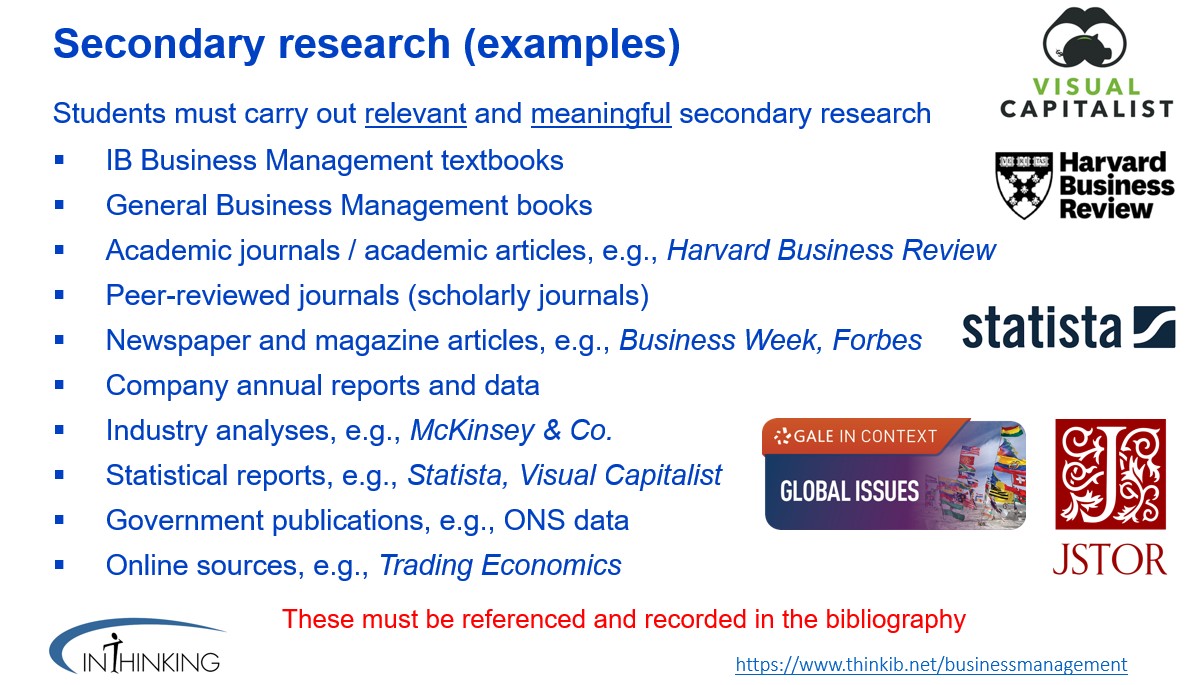
Examples of secondary research sources that can be used in the Extended Essay
(b) Databases for academic research:
Examples include:
- Google Scholar https://scholar.google.com
- JSTOR https://www.jstor.org
- ScienceDirect (Elsevier) https://www.sciencedirect.com
- Business Source Complete (EBSCO) https://www.ebsco.com
- ABI/INFORM (ProQuest) https://www.proquest.com
- Emerald Insight https://www.emerald.com/insight
- SAGE Journals https://journals.sagepub.com
- Wiley Online Library https://onlinelibrary.wiley.com
Some academic databases and journals require a subscription. Students should check whether access is available through their school library.
(c) Academic journals in Business Management:
10 recommended academic journals in Business Management:
The following are well-established journals covering different areas of business management. They are not presented in ranking order.
- Academy of Management Journal (AMJ)
- Academy of Management Review (AMR)
- Strategic Management Journal (SMJ)
- Journal of Management
- Journal of Business Research
- Harvard Business Review (HBR)
- Journal of Marketing
- Human Resource Management
- Journal of Operations Management
- Business Strategy and the Environment
Speak with your school librarian and supervisor for further assistance.
C5 – Contestable: How is the proposed RQ arguable (debatable) on the basis of balanced and contrasting empirical evidence?
Explain why your research question allows for different interpretations, competing arguments, and potentially contrasting conclusions. A strong Business Management Extended Essay should investigate an issue that is genuinely debatable, rather than one where the answer is obvious or predetermined.
Consider whether you can access sufficient relevant and reliable empirical evidence (such as financial data, market research, business performance indicators, and published research) to support different perspectives. Your investigation should enable you to weigh competing arguments, assess the limitations of the evidence, and reach a reasoned judgement.
Top tips!
- Identify competing arguments – Explain why different stakeholders, business analysts, or academic researchers might reach different conclusions about your chosen business issue or strategy.
- Use contrasting empirical evidence – Identify quantitative and qualitative evidence that could support or challenge the effectiveness of a business decision. For example, increased sales revenue may suggest that a marketing campaign was successful, while declining profitability may indicate that its costs outweighed the benefits.
- Consider different measures of success – A business strategy may be successful financially but less effective in terms of employee motivation, customer satisfaction, environmental sustainability, or stakeholder relationships.
- Evaluate the reliability of evidence – Consider whether company reports, industry research, and independent publications present different interpretations of the same business issue. Recognise potential bias, incomplete information, and limitations in the available data.
- Recognise alternative explanations – Business performance may be influenced by several factors. For example, increased market share following a merger may result partly from favourable market conditions rather than the merger itself.
- Avoid predetermined conclusions – Do not select a research question simply to prove that a particular business decision was successful or unsuccessful. Your investigation should remain open to different outcomes.
- Develop a balanced evaluation – Consider the relative strengths and weaknesses of competing arguments before reaching a justified conclusion based on the weight of the evidence.
Example (for illustrative purposes only):
Research question: To what extent has Starbucks' expansion strategy in Hyderabad, India, been financially successful?
Evidence suggesting “success” might include increased sales revenue, growth in the number of stores in Hyderabad, and improved brand loyalty through its customer retention programmes. However, contrasting evidence might include high operating costs, intense competition, and relatively low profitability.
These different quantitative indicators provide opportunities to debate what constitutes business success and evaluate whether the expansion strategy has achieved its objectives.
Remember, a contestable research question is one that allows you to investigate competing claims, critically evaluate contrasting evidence, and develop a reasoned judgement.
Your aim is not simply to present an equal number of arguments for and against a business decision. Instead, you should assess the strength, relevance, and reliability of the available evidence to determine which arguments are most convincing.
Before finalising your RQ with your supervisor, ask yourself: “Could a well-informed researcher reasonably reach a different conclusion using the available evidence?”
If the answer is “yes”, and sufficient reliable evidence exists to support a meaningful debate, your research question is more likely to provide opportunities for the critical analysis and evaluation expected in a strong Business Management Extended Essay.
Final important advice for IB Business Management Extended Essays
Final important advice and top tips for planning your essay can be accessed here.
Important advice for IB Business Management Extended Essays
- Focus on the research question – Every source should help students investigate, analyse, or evaluate an aspect of their chosen business management issue.
- Use a range of perspectives – Avoid relying exclusively on company websites, annual reports, or press releases. Independent sources can help students challenge corporate claims and develop a more balanced evaluation.
- Apply tools and theories appropriately – Sources should provide evidence that can be used with relevant analytical tools, such as SWOT analysis, Ansoff's matrix, Porter's generic strategies, ratio analysis, or investment appraisal. Tools should support the investigation rather than dictate its direction.
- Prioritise relevant and reliable evidence – Use sufficiently recent information where appropriate, especially when investigating business performance, competitive markets, or strategic decisions.
- Distinguish facts from opinions – Evaluate the credibility, potential bias, and limitations of sources, including consultancy reports, business journalism, and company publications.
- Reference all sources accurately – Maintain a complete record of the sources consulted and use a consistent referencing system throughout the Extended Essay.
Finally, remember that a strong Business Management Extended Essay does not simply describe a business or apply several business management tools. It uses relevant evidence, supported by appropriate theories and analytical tools, to develop a focused argument and reach a well-justified, evaluative conclusion that addresses the research question.
All the very best with submitting this planning document to your supervisor!
Download the PDF version of this EE planning form:
If you would like to use a Word version of this document, download it here.
Return to The Extended Essay homepage
