Why I stopped teaching Business, Economics, and Geography as 3 separate subjects
Why I stopped teaching Business Management, Economics, and Geography as three separate subjects, by Ronald Oluoch
This blog has been written by IB Educator, Ronald Oluoch, who has agreed to share this on InThinking.
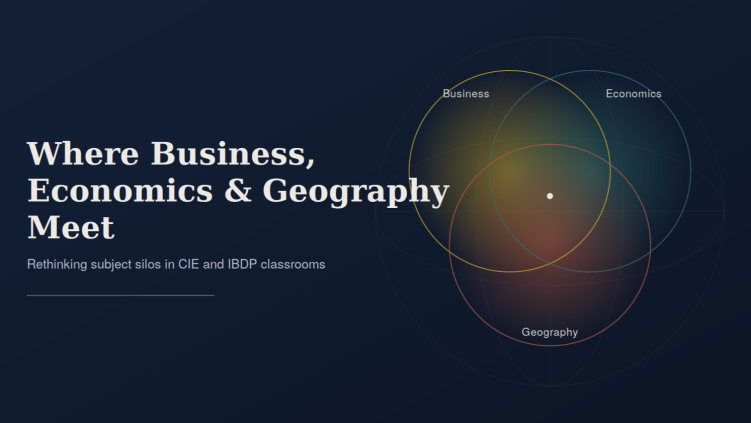
I teach Business, Economics, and Geography at CIE/IBDP levels and I've noticed students often master each subject separately but miss how real-world problems connect all three. In this article, I share why I stopped teaching them in silos, and what changed when I started connecting them instead. WHY? Being the subject question, in Real-world, problems don't care about subject boundaries a shipping crisis is business, economics, and geography all at once. So why do we still teach them separately?
For years, I taught Business, Economics, and Geography as if they lived in different buildings. Monday's lesson was about supply and demand curves. Wednesday's was about trade migration patterns. Friday's was about market structures. Each unit had its own textbook, its own vocabulary, its own exam board mark scheme, and if I'm honest, its own mental compartment in my head as a teacher. Then I noticed something that should have been obvious sooner: my students were not struggling with the content. They were struggling with the connections.
A student could brilliantly explain price elasticity of demand in an Economics essay, and then completely miss that the same concept explained why coffee farmers in a Geography case study were vulnerable to a single bad harvest. Another could map out push-and-pull migration factors perfectly on a diagram, but never once mention the business decision a factory closing, a multinational relocating or what that had actually triggered the migration in the first place.
The subjects were not the problem. The walls between them were.
Real problems don't respect subject boundaries
Think about any major event from the last decade: a shipping blockage that stalled global trade, a drought that reshaped a region's economy, a currency collapse that emptied supermarket shelves. None of these fit neatly into one CIE or IBDP syllabus. They are simultaneously economic, geographic, and commercial. The businesses that succeed or fail, the resources that become scarce or abundant, the people who move or stay, these are not three separate stories. They are one story, told from three angles.
And yet our curricula, understandably shaped by the practicalities of exam boards and assessment objectives, still ask us to teach them as if they were unrelated. We give students the vocabulary of three disciplines without giving them the lens to see they are often looking at the same phenomenon.
What changed when I stopped separating them
Once I started deliberately drawing the threads together, asking "where else have we seen this?" instead of just "what does the syllabus want here?" something shifted in how students engaged. They stopped treating each subject as a box to be filled for an exam and started treating the world as the actual subject, with Business, Economics, and Geography as three different tools for reading it.
A lesson on multinational corporations became richer when we asked not just "what's the business strategy?" but "what economic incentives are pulling this company here, and what geographic factors -labor, climate, infrastructure, made this location possible in the first place?" Students who were strong in one subject started pulling their peers along in another, because the underlying logic was shared even when the terminology wasn't.
This isn't about diluting rigour or blurring assessment objectives. Students still need to answer Economics questions with Economics frameworks, and Geography questions with Geography frameworks. But the thinking that produces strong answers in one subject is often the same thinking that produces strong answers in another and naming that connection explicitly, rather than leaving it to chance, makes students noticeably sharper across all three.
A case for educators who teach across subjects
Not every teacher gets the chance I've had -to sit across Business, Economics, and Geography and see the same real-world event show up in three different classrooms in the same week. But I think there is a lesson here even for teachers who specialize in just one: actively look for where your subject's concepts show up in the news, in other disciplines, in your students' other classes. Ask them where they have seen this idea before. You don't need to teach three subjects to teach students to think across subjects.
The world our students are being prepared for doesn't hand them problems labelled "Economics" or "Geography" or "Business." It hands them messy, overlapping, real situations and expects them to make sense of it with whatever tools they have. Our job isn't just to teach the tools separately. It's to teach them how the tools fit together.
That's the shift I made in my own classroom. I'd love to hear from other educators, especially those teaching across disciplines: have you noticed the same silos, and what have you done to break them down?
Ronald Oluoch teaches at Rowdha International Academy, Kenya. If interested, you can connect with him on LinkedIn here. Many thanks to Ronald to sharing these insights with us.
If you could like to submit a blog of your own to support other educators, please get in touch: [email protected]
