A3.2 Domains and rRNA - reading task
Classification is a method of grouping organisms together. In the time of Carl Linneus evidence was taken from morphological features. This can align with evolutionary pathways if the right features are used, but in recent years DNA sequences or amino acid sequences have improved the evolutionary evidence and supported the development of cladistics. Carl Woese was one of the first to use DNA sequences for classification. This activity explores the way he revolutionised the tree of life, dividing all organisms into three Domains.
Eukaryotes and prokaryotes
Organisms have been classification into Eukaryotes (with a membrane bound nucleus) and Prokaryotes (without a nucleus) for many years. The nucleus is a large organelle, easily seen inside eukaryote cells. It's a morphological feature.
The shape of prokaryotes was also used to classify them, this is the only morphological feature that is easily seen.

Image source: Janice Haney Carr, Dr. Richard Facklam, Centers for Disease Control and Prevention
With the development of modern DNA sequencing technology it seemed like a logical idea to try to use DNA to make comparisons between different species of bacteria. Prokaryotic DNA is found in a central part of the cell: the nucleoid.
In the 1970's. DNA sequencing was slow, and expensive. (The human genome project and the development of rapid DNA sequencing techniques was 30 years away.) Carl Woese was working on classification of bacteria and wanted to find a small gene which was present in all species. Small so he could sequence it, and present in all species so comparisons could cover all bacteria.
Woese knew that all prokaryote cells have 70s ribosomes made of ribosomal RNA (rRNA). Could the rRNA of ribosomes provide a tool to compare all of life? RNA is a molecule known to exist early in the evolution of life on Earth and ribosomes are seen in all cells. (Origin of cells topic A2.1)

Ribosome structure
Ribosomes are composed of two subunits a large subunit and a small subunit. Called 50S and 30S ("S" refers to a unit of density called the Svedberg unit). The two subunits combine during protein synthesis to form a complete 70S ribosome.
Ribosomes are composed of three types of rRNA molecule: 16S rRNA, 23S rRNA, and 5S rRNA and some proteins.
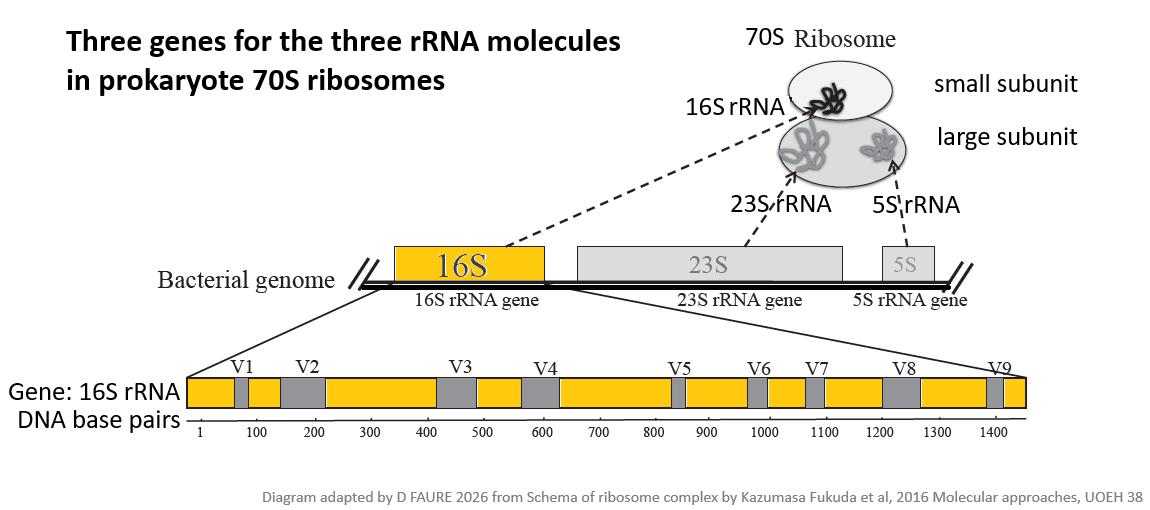
The single strands of rRNAs use hydrogen-bonding between complementary nucleotide bases to form complex folded 3D structures.
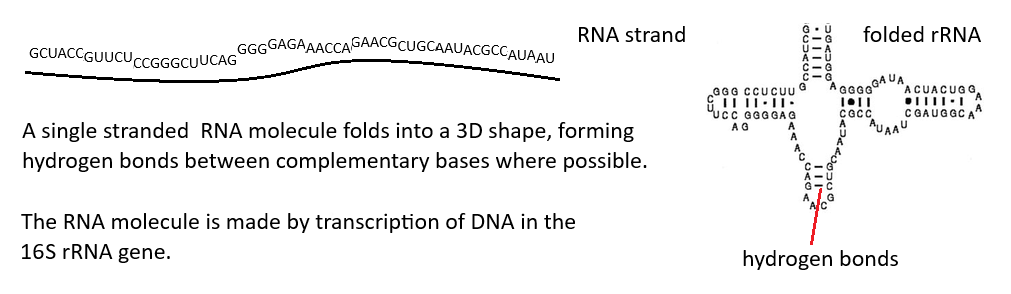
Carl Woese decide to explore differences in the gene which codes from this 16S rRNA molecule from the ribosome small-subunit. It was a good choice, as it is just the right length.
- Long enough to show differences between all the groups, but
- short enough to be sequenced using the 1970s technology available.
Physical features of prokaryotes are insufficient to differentiate between species as they all look similar. Woese’s approach was a great advance, The comparison of DNA and RNA sequences provided a sensitive tool that revealed the extensive variability of prokaryotes.
The RNA, which is transcribed from DNA, allowed Woese to group bacteria together, suggesting a new classification using comparisons of rRNA base sequences.
Woese discovered that prokaryotes could be divided into two broad groups, all of them prokaryotic. He defined Archaea as a new group, and this resulted in a new taxonomic tree. Many organisms belonging to the Archaea domain live under extreme conditions and are called extremophiles.
To construct his tree, Woese had used genetic relationships rather than similarities based on morphology (shape). This could be considered the first example of cladistics.
Three Domains classification system
The pioneering work of American microbiologist Carl Woese in the early 1970s has shown, that life on Earth has evolved along three lineages, now called domains—Bacteria, Archaea, and Eukarya.
Classification of all organisms into these three domains has used evidence from rRNA base sequences.
This reclassification adding the extra taxonomic level 'domain' above kingdoms was first proposed in 1977.

Key points
- Carl Woese defined Archaea as a new domain and constructed the phylogentic tree of life which shows separation of all living organisms. (A3.2.9)
- The three domains are Bacteria, Archaea, Eukarya (Eukaryotes)
- Sequencing of ribosomal RNA genes and comparisons of these sequences was used to classify organisms into these three domains.
- Classification by gene sequence comparisons proved better than morphological cataloguing, which was the traditional way of organizing species into classification groups.
Additional interesting points
- Archaea don't have a membrane bound nucleus, so can be described as Prokaryotes, like Bacteria.
- Eukaryotes and archaea share a more recent common ancestor than either group does with bacteria.
- The three-domain tree, proposed by Woese, places Eukarya as a sister group to Archaea, but there is an alternative hypothesis, the two-domain hypothesis, which suggests that eukaryotes originated from within the archaea domain.
- Evidence points to Eukaryotes branching as a sister group to one clade of Asgard archaea. (A2.2.12 - Endosymbiosis in the origin of eukaryote cells)
- Asgard archaea contain many genes previously thought to be exclusive to eukaryotes.
- In eukaryotic cells, DNA wraps around histone proteins to form compact structures called nucleosomes. These are not usually found in prokaryotes. Except, in some archaea which have histone proteins that bend DNA into a superhelix like eukaryotic nucleosomes. (A1.2.13—Structure of a nucleosome)
Nature of Science
Archaea
- The division of Archaea as different from bacteria was not immediately accepted by scientists.
What are the benefits of this reluctance to accept new ideas, until work has been replicated by several groups, and generally accepted by the scientific community?
Theories in the scientific method.
- Consider this quote, about the struggle to get a theory accepted,
"A theory is a species of thinking, and its right to exist [depends on] its power of resisting competition and extinction by its rivals".— Thomas Henry Huxley, Science and Culture, and Other Essays (1890),
Test yourself with this quiz
Which two Biologists, who are mentioned in the article, made advances in classification?
Thomas Huxley gave us a nice quote about theories, but he didn't work on classification.
Which type of classification group has Archaea become?
The three domain system is now widely accepted.
Which of the following are names of shapes of bacteria?
Shapes are Coccus, Bacillus, Vibrio, and Spirillum.
Which gene did Carl Woese sequence to classify the organisms?
The small subunit of ribosomes contains a 16S rRNA molecules, coded for by a DNA gene.
Cladistics uses data from DNA sequences and Amino acid sequences.
Which of these points best explains how the 13S rRNA molecule relates to one of these sequences?
RNA is made from DNA by transcription.
So the sequence of DNA bases in the 13S rRNA gene matches the sequence of RNA bases in the 13S rRNA.
rRNA is the type of RNA used to produce part of the structure of ribosomes. (With proteins)
Amino acid sequences in ribosomes are unrelated to the DNA sequence in the rRNA gene.
It is true that complementary base pairing occurs in rRNA as well as DNA but this is unrelated to the base sequence.
Why did Thomas Huxley suggest that a theory was like a species?
"A theory is a species of thinking, and its right to exist [depends on] its power of resisting extinction by its rivals".
This idea of a new species appearing and causing the extinction of an established species in ecology is nicely illustrated by the three domain theory of classification. It has largely replaced the five kingdom system.
This page has been adapted for IB students, using information from the page titled 1.4: Carl Woese and the Phylogenetic Tree shared under a CC BY-SA 4.0 license.