IB DP Biology - Introduction
When beginning to teach IB Biology it is important to do some long term planning. There would be nothing worse than arriving at the mock exams in year 2 finding 100 hours of IB Biology still to teach. The DP Biology guide is content rich and if you want to create engaging, concept based learning experiences for your students your topic sequence and the pace of lessons will need careful planning.
The roadmap
There are forty topics arranged into a ‘roadmap’ which is structured around interesting overarching concepts in Biology. The columns represent the size of the biological material which is in focus, molecules, or cells and tissues, are the smallest, but organ sysyems are bigger in scale, sometimes it's best to studty whole organisms which reveals emergent properties, and at the largest scale are biomes or the ecosystems within them where multiple populations interact and evolve.
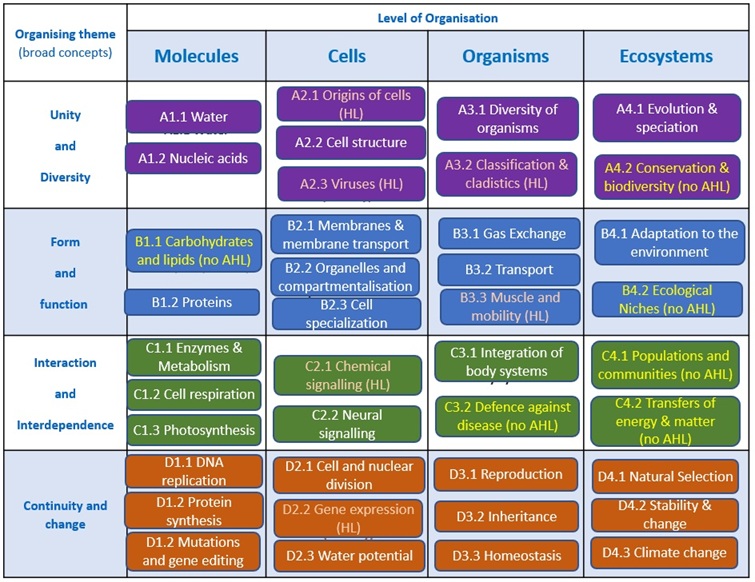
The rows are oranised into themes. Each one contains two concepts that could be viewed from the perspective of any of the levels of size.
Concepts within the organizing themes
Unity - This is the idea that living things all share some characteristics, MRS GREN if you like, but also the possession of genetic material, the division into cells, membership of a classification group and the ability to evolve.
Diversity - While there are shared features there is also a lot of variation, as every species has found it's individual niche in its ecosystem creating a marvelous biodiversity.
Form - The shape of molecules, or cells or even organisms can be described so it is a concept in itself. Form often links with the concept function.
Function - Some might argue that the function of an enzyme or a specialiesd cell is a human construct, but by labelling biological objects with a function we get to better understand how they interact or change in time. The enzyme doesn't deliberately catalyse a specific reaction, but when we understand this activity we go beyond descriptions of appearance and get deeper into understanding biological systems.
Interaction - This describes how different parts of a biological system can affect others, at the molecular level it could be a hormone binding to a target cell, or a phagycyte in the blood engulfing a prokaryote pathogen, at a larger scale the heart and the brain interact to maintain homeostasis of carbon dioxide in the blood and organisms certainly interact in ecosystems, sometimes beneficial mutualistic interactions occur, but these interactions include competition and predation.
Interdependence - No organism lives in isolation, and they are often interdependent, some species provide food or shelter for others. It could be said that arteries are dependent on the heart, or that leaves are dependent on roots and xylem for water. Even at the molecular level the replication of DNA is dependent on enzymes which are themselves proteins coded for in the DNA.
Continuity - For the survival of any species there has to be some continuity, parents have to reproduce creating offspring. At the cellular level, stability is primarily about homeostasis, the maintenance of glucose levels, or osmotic potential.
Change - It is inevitable that there will be change. Mutations in the sequence of bases in DNA will create new alleles. Cells will be lost from the skin, millions or pathogens are distroyed by the immune system every winter. Trees will fall in the forest opening clearings for saplings to grow rapidly. the weather can change, or the activities of humans can destroy a habitat, change the climate, or pollute the seas. Biological systems are remarkably resilient, but we can see tipping points when that change becomes irreversible.
To devise a pathway through the course may seem daunting at first as there are so many options.
There are suggestions of logical pathways in the IB guide but a lot depends on your teaching situation or even personal preference. In an ideal world students may have some voice in the choice of the next topic. In some schools there may be constraints regarding shared groups, laboratory space or special events such as field trips.
This page contains some basic information which will help planning.
Look out for the page about Teaching Sequences for the topics which gives some outline plans for the two years.
Overall Total Timings
There are 150 hours for SL and 240 hours for HL
The Practical Scheme of Work is allocated: 40 hours for SL and 60 hours for HL within these totals.
From these details above it is clear that there is roughly the same quantity of Biology to cover with both SL and HL students despite the reduction from one to two options.
| Outline of the IB Biology topics on the new guide. | Estimated Teaching hours | |
| Theme | SL & HL | Additional HL |
| A: Unity and diversity | 19 | 14 |
| B: Form and function | 26 | 13 |
| C: Interaction and interdependence | 31 | 17 |
| D: Continuity and change | 34 | 26 |
| TOTAL | 110 | 70 |
Note: There are no specific SL options. SL students can study all four options. Each option has extra HL material.
One important area is the practical scheme of work. Section A of paper three will now contain short answer questions about the practical skills students will learn during the course. This ensures that IB Biology remains a practical science course but it will require some careful planning and it could take up a lot of time. To train the students to complete an investigation in just 20 hours of practical activities is quite a challenge.
PSOW - Practical Scheme of Work
| Practical scheme of work | 40 hrs | 60 hrs |
| Practical activities | 20 | 40 |
| Scientific investigation (internal assessment–IA) | 10 | 10 |
| Collaborative sciences project | 10 | 10 |
There are a lot of practical suggestions in the Skills section of the guide.
Many “Applications of skills” are specificed in the syllabus
It is clearly not possible to do all of these in extended lab lesson with just 20 hours total, and so the strategic use of demonstrations, animations, and groupwork will be required.
Scientific Investigation (10 hours - guideline time)
This investigation is the only piece of assessed work required for the 20% internal assessment (IA)
The tasks can include:
- Hands-on lab work collecting data (Qualitative and quantitative data are valid).
- Use of a database as a source of data for analysis and modeling.
- Simulation (interactive and realistic open-ended simulations work best).
- Hybrid hands-on + database.
There are 10 exemplar Scientific investigations in the Teacher Support material released on the myIB website.
For further details about the PSOW please see the Practical Scheme of Work section of this website.