IA uncertainties - intro
Measurements are always estimates to some degree. The estimate always has an uncertainty which gives information about it's precision.
The presentation of the raw data of any biology experiment should show an uncertainty value.
This uncertainty is sometimes confusing, but the rules are easy once you know them. This page de-mystifies raw data uncertainties.
What is an uncertainty?
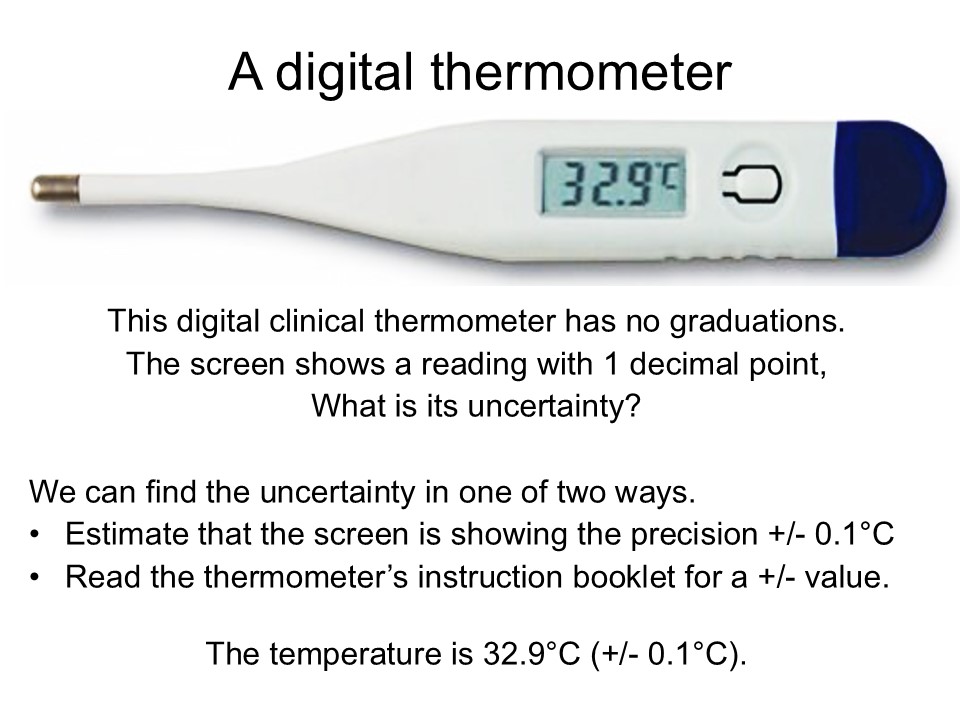
DP Biology students must be aware that all data values are estimates. Whenever a measurement is made there is some uncertainty. A thermometer scale in 1°C graduations may show a temperature of 20°C, but how do we know that it is 20.0 and not 20.1, we don't. This is an uncertainty.
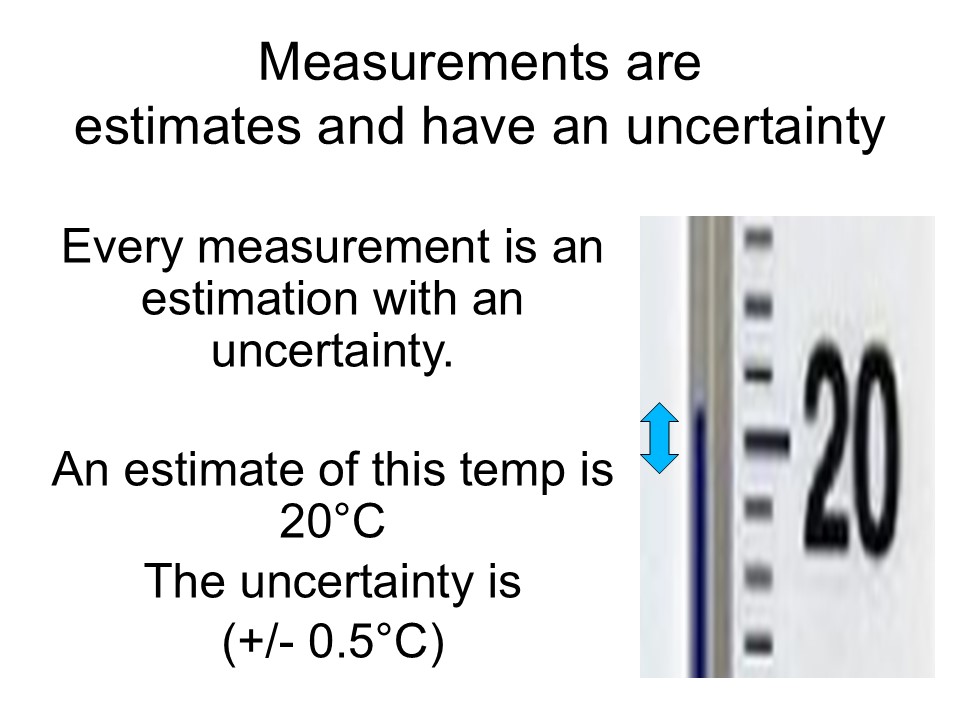
There is a simple method to calculate the uncertainty, see below.
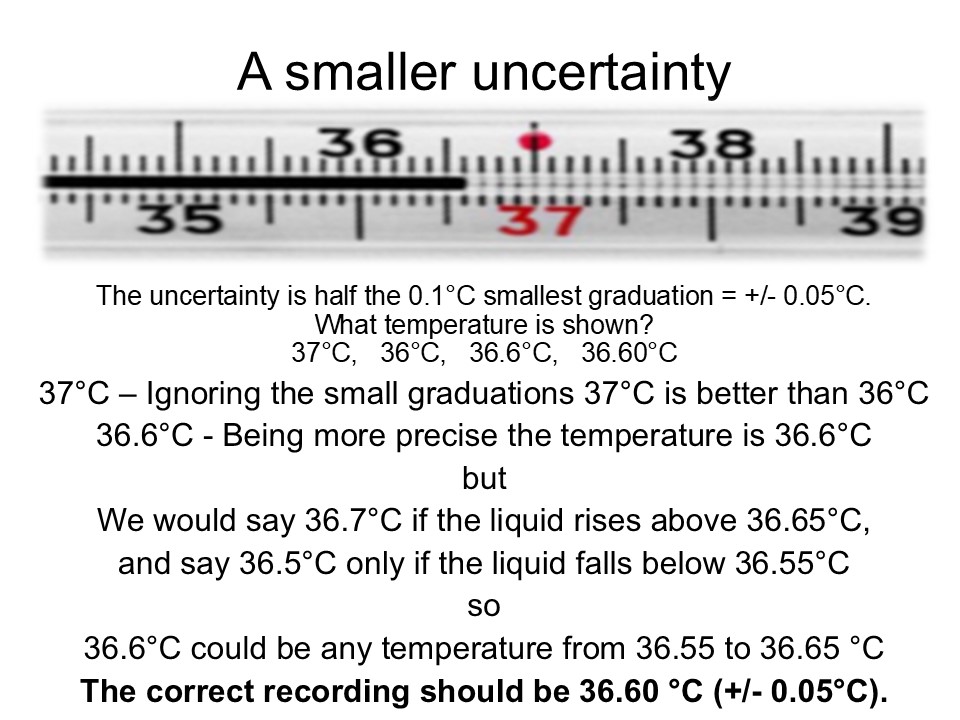
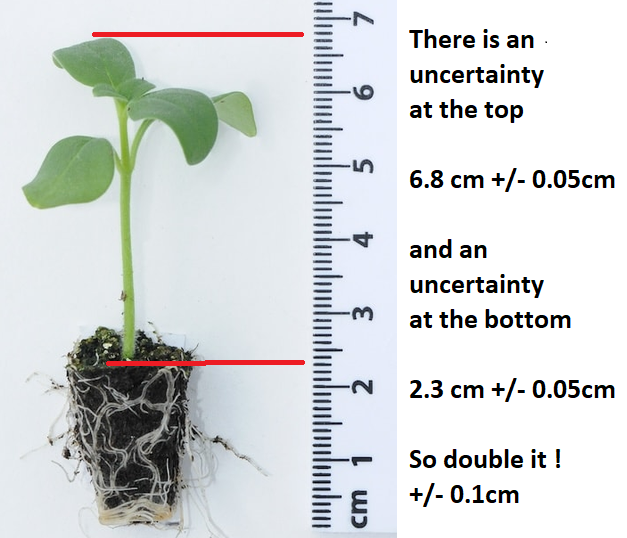
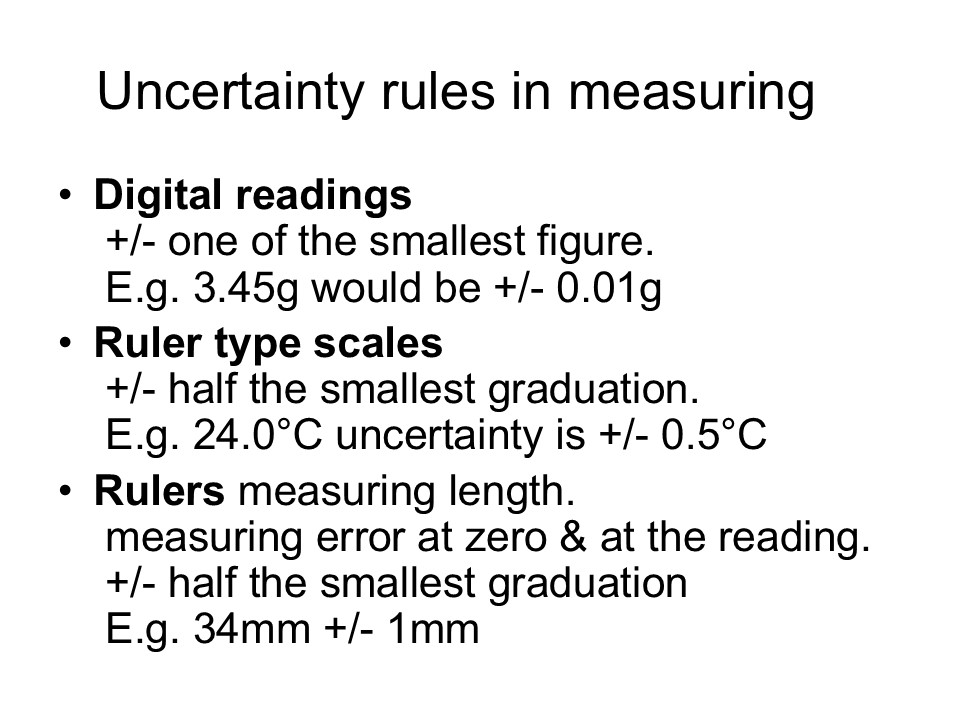
When there is a graduated scale, like in thermometers and measuring cylinders the uncertainty can be calculated by looking at the size of the smallest graduation of the scale. This is shown in the image below.
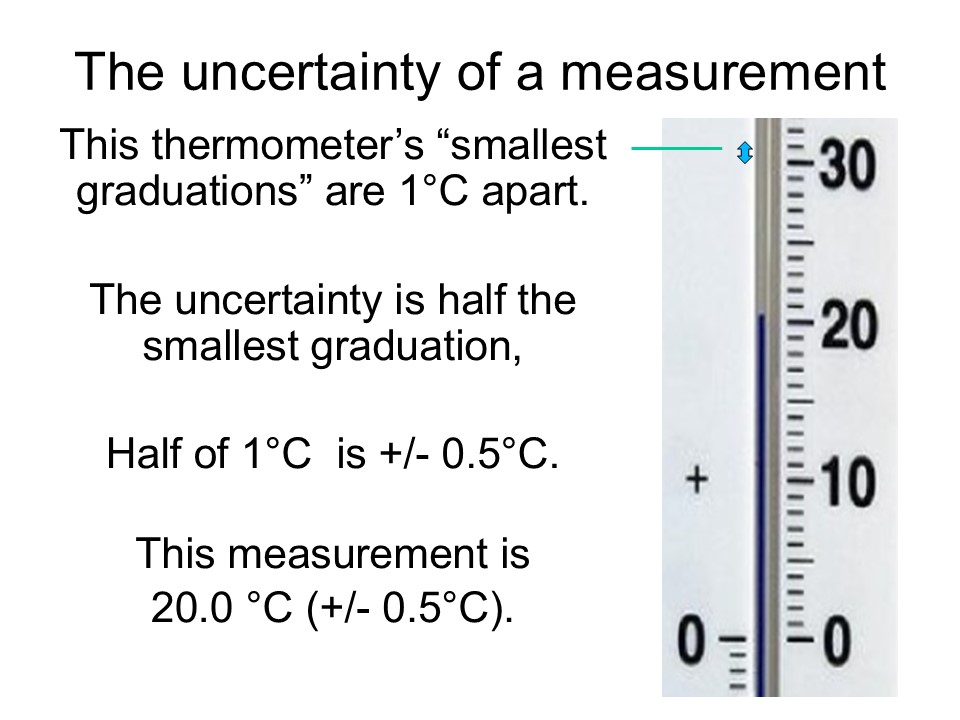
There is a logical explanation for doing this. The principle is explained in the image below.
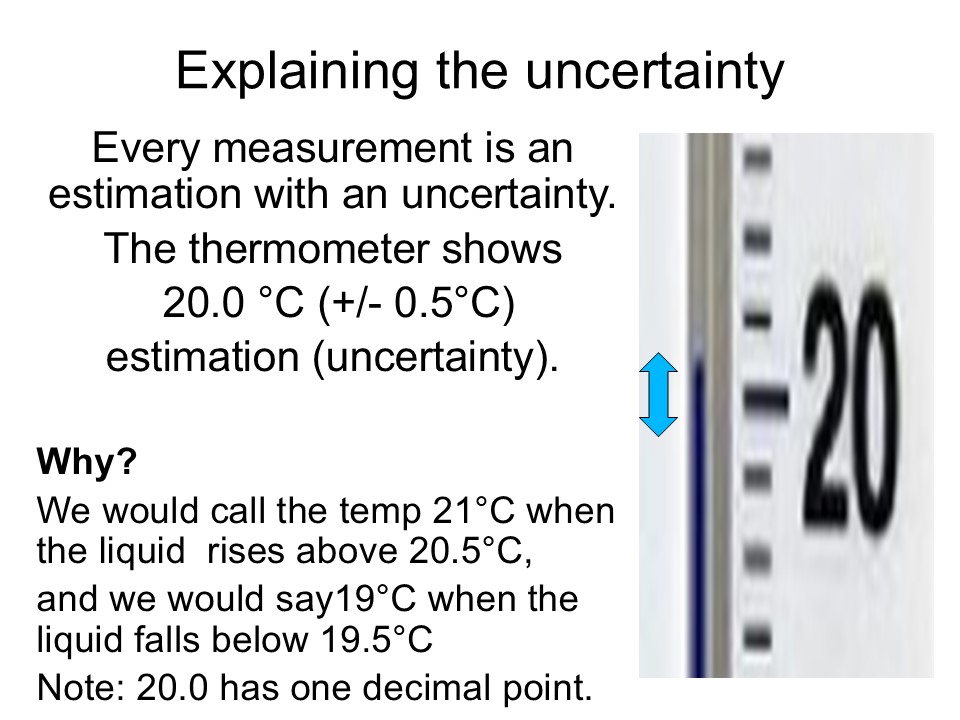
This method works for all apparatus with a scale like this. See below.
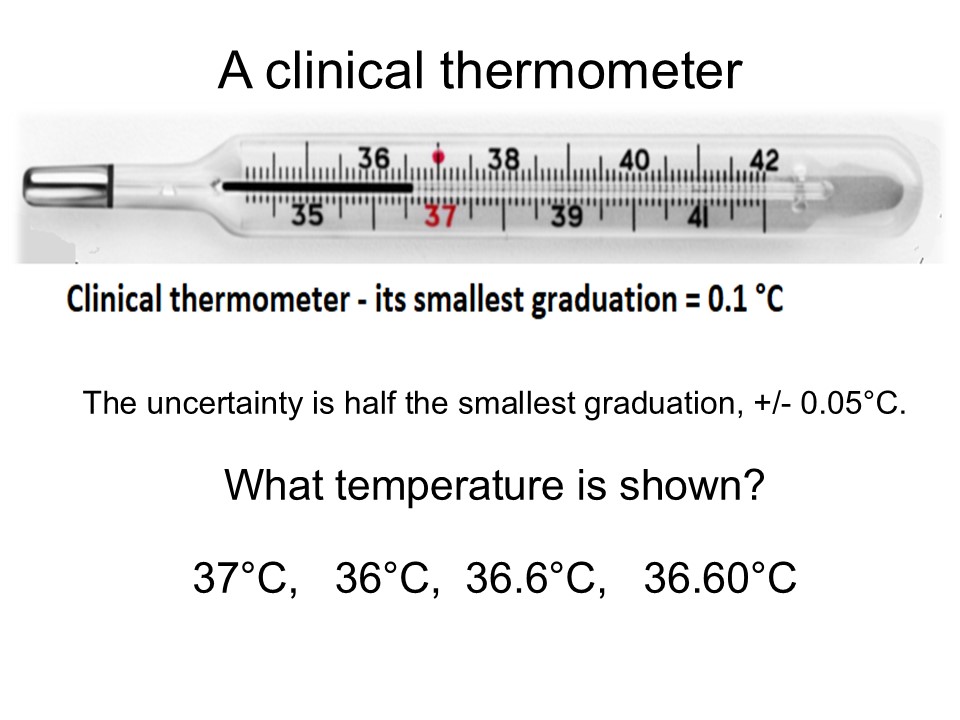
Click the eye icon to reveal the answer, with an explanation why.
Another piece of apparatus that works like this is a measuring cylinder.
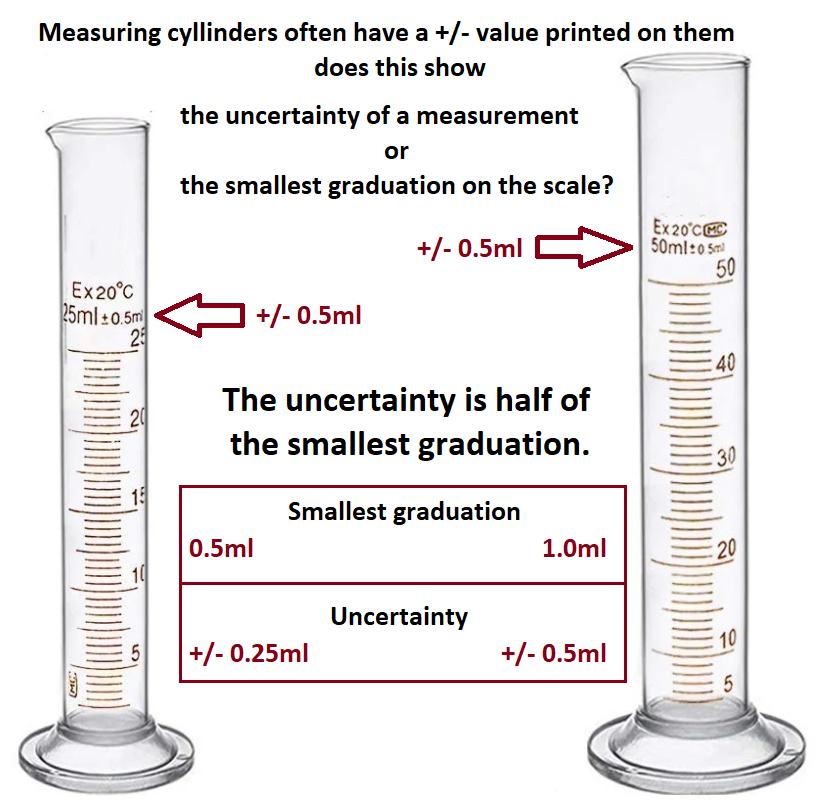
In these two measuring cylinders, manufactured by the same company, one shows the smallest graduation +/-0.5 and the other +/- 0.5 gives the actual uncertainty.
The only way to be sure is to work out the uncertainty using the graduations, as the diagram above shows.
For every measurement in Biology it is good practice to check the size of the uncertainty using the graduations.
Look at the syringe below, it contains 0.81 mL of fluid. What is the uncertainty of this measurement.
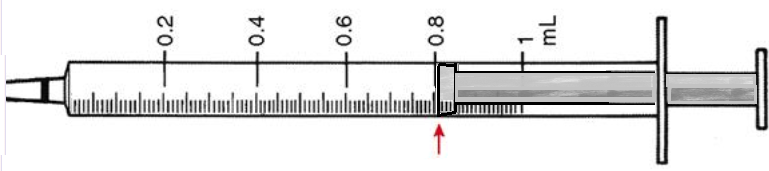
Click the eye icon to see an answer.
- The smallest graduation of the syringe is tricky to work out. Note, between 0.6 and 0.8 there are 20 lines.
- 10 lines make up the distance from 0.6 to 0.7 - this is 0.1 mL
- Therefore 1 graduation = 0.1 mL / 10 = 0.01 mL
- The uncertainty is half of this smallest graduation = 0.005 mL
- So the full detail of the volume shown is 0.810 mL +/- 0.005 mL
For the highest grades your raw data table must include;
- clear labels of what the numbers show, and
- the uncertainty of the measurement.
Try this quiz to see how well you have learned how to calculate uncertainties.
What is the measurement shown on this apparatus?
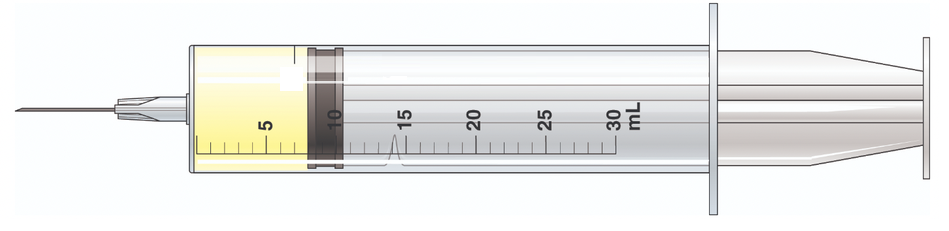
The volume of yellow liquid shown is 8mL, strictly speaking 8.0 mL
What is the uncertainty of the measurement shown in this syringe?
The smallest graduation is 1mL, half of this is 0.5mL which is the uncertainty.
The image shows a measuring cylinder.
What is the volume of the liquid and what is the uncertainty of the measurement?
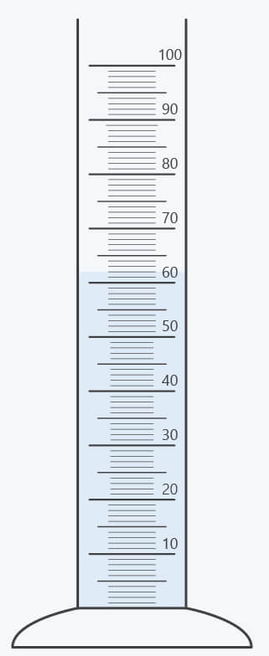
The reading is 62mL, the uncertainty is half of 1mL which is 0.5mL, and so the number 62 needs a decimal point 62.0.
The image shows a thermometer. What is the reading on the thermometer, including the uncertainty?
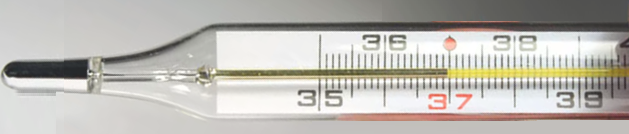
The uncertainty is half of 0.1 = 0.05°C, and the reading is 37.0, better written as 37.00°C +/- 0.05°C
It would be correct to say that this reading was 36.95°C +/- 0.05°C, as the mercury liquid is just below 37.00°C
This apparatus shows a volume of liquid in a syringe. What is the volume and the uncertainty?
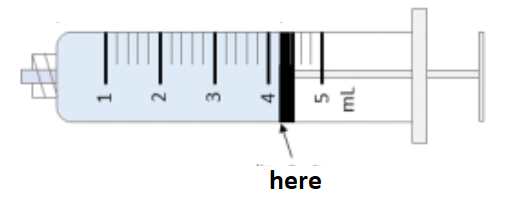
The smallest graduation is 0.2mL, so the uncertainty is half this +/-0.1 with 1d.p. 4.2mL is correct.
This page is an introduction, and there are more details to know about uncertainties.
Different types of measurements have different uncertainties.
- Counts up to 25 don't have any uncertainty, unless the objects are difficult to see.
- Large counts >25 could include a counting error, and an uncertainty can be estimated. One method is to count the objects several times, and see what the range of values recorded is.
- Analogue scales and ruler type scales follow the pattern shown on this page, unless there is something about the method which changes them. For example, if a syringe is used two or three times to measure the total volume. This would double or triple the uncertainty.
- Biological material is sometimes very variable, and this can also affect the uncertainty of the measurement.
- The use of the measuring apparatus can affect the precision. E.g. a stopwatch. Stopwatches often give a time with 1/100ths of a second. A human cannot stop the watch this quickly, so +/-1s is usually a better uncertainty, or possible +/- 0.1s if you are capable.