Making strategy meaningful
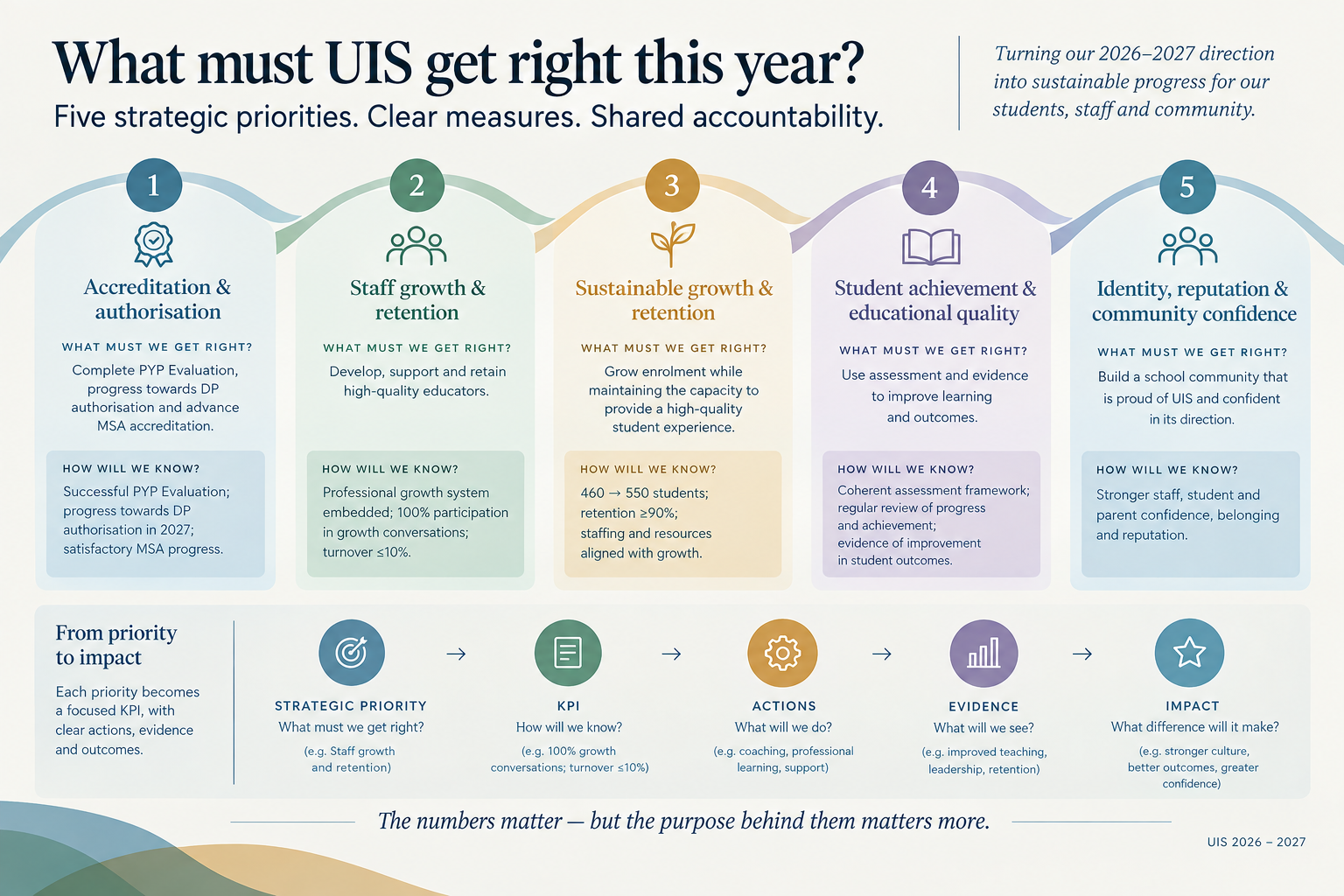 The start of a school year is when strategic plans can either come alive — or quickly disappear beneath the weight of meetings, deadlines, accreditation requirements and the everyday demands of running a school. One of the hardest leadership tasks is not deciding what matters, but deciding what matters most. Schools have no shortage of legitimate priorities: student achievement, professional development, enrolment, retention, accreditation, wellbeing, curriculum development and the expectations of parents, staff and owners. The danger is that when everything becomes a priority, nothing really is. A useful question for leaders at the beginning of a new year is therefore simple: What are the few things we absolutely need to get right?
I have been thinking about this in my work as Director of Education at Uptown International School in Cairo. UIS is entering an important year, with PYP Evaluation, preparation for DP authorisation, MSA accreditation, continued enrolment growth, staff development and retention, and a continued focus on student achievement and the identity of the school. Rather than treating these as a long list of separate initiatives, we have brought them together around five strategic priorities: accreditation and authorisation; staff growth and retention; sustainable student growth and retention; student achievement and educational quality; and identity, reputation and community confidence. The important point is that these are not simply headings on a KPI document. They represent the areas in which the school needs to succeed if its growth is to be sustainable. From there, the KPIs become more meaningful. They tell us how we will know whether we are making progress.
This distinction is important at the beginning of a new school year. A target such as reducing staff turnover or increasing enrolment is an indicator; it is not, by itself, a strategy. The more useful sequence is priority → KPI → action → evidence → impact. What are we trying to achieve? How will we know? What will we actually do? What evidence will show that it is happening? And, ultimately, has it made a difference? The real test of strategy is therefore not whether the Head of School can explain the plan, but whether teachers and middle leaders can see how their work connects to it. In a growing international school, where there are always more things that could be done, strategic leadership sometimes means saying very clearly: these are the things that matter most; this is why they matter; and this is how we will know whether we are succeeding. A good KPI tells us whether something is changing. A good strategic priority tells us why the change matters.