Beyond the binary: Integrating explicit instruction and inquiry
I work with many schools that offer both International Baccalaureate programmes and national curricula, and it’s not unusual to hear a kind of tension emerge in conversations about teaching. On one side, national programmes are often associated with more explicit, structured instruction. On the other, the IB is sometimes interpreted as being almost entirely inquiry-led. Teachers can end up feeling as though they’re being pulled in two different directions, as if they have to choose between two competing approaches.
In reality, that’s not the case. The tension usually comes from a misunderstanding of what each approach is actually for. Once we step back from that binary thinking, a more useful question appears: how do explicit instruction and inquiry work together so students actually learn more deeply and remember more over time?
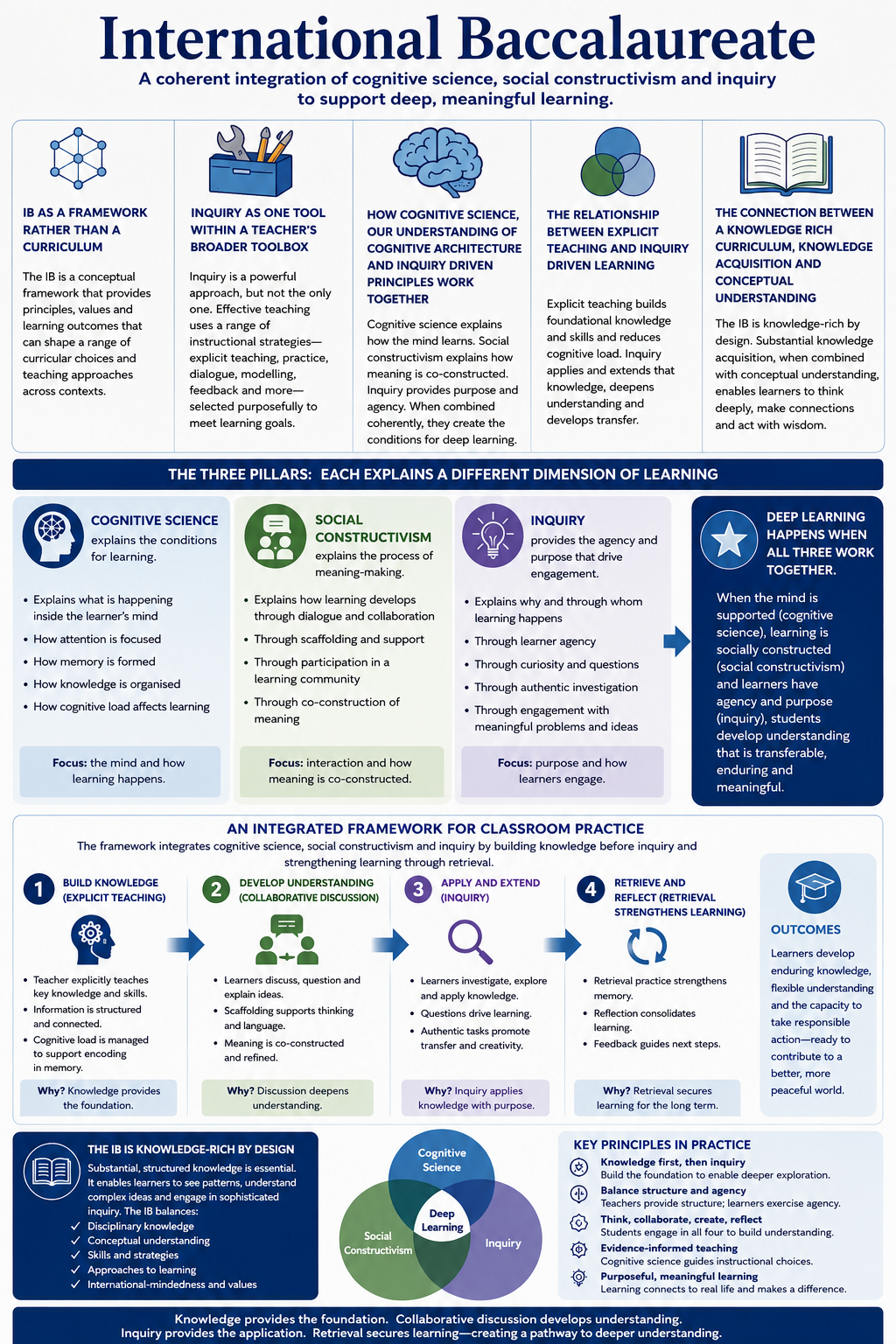
How do we move beyond “either/or” thinking in teaching?
(Cohering cognitive science, social constructivism, and inquiry into one framework)
The debate between explicit instruction and inquiry often gets framed as a choice—you’re either on one side or the other. One is seen as structured and teacher-led, the other as open and student-led. But that framing doesn’t really hold up in practice.
The better way to think about it is that they do different jobs. When they’re combined well, they strengthen each other. Explicit teaching helps students build the knowledge they need. Inquiry gives them space to use it, test it, and make sense of it in different contexts.
Cognitive science helps us understand how learning sticks. Social constructivism reminds us that meaning is built through interaction. Inquiry then becomes the space where that learning is applied and deepened. When these sit together, teaching feels less fragmented and more intentional.
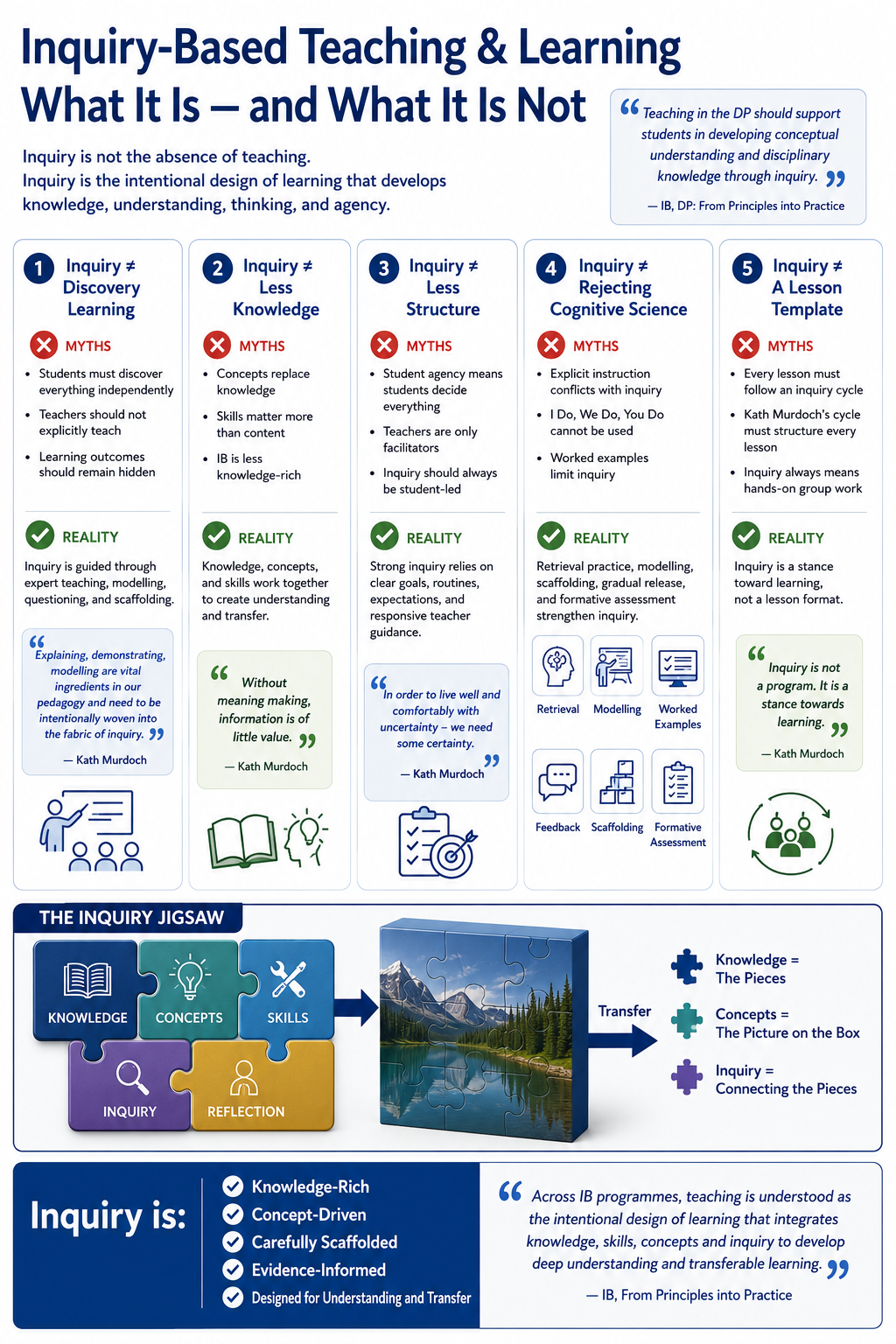
What does inquiry really look like when it is implemented with precision—not myth?
(Clarifying inquiry-based teaching and dismantling misconceptions)
Inquiry in the IB is sometimes misunderstood as meaning students should always “discover” everything for themselves, with the teacher stepping back as much as possible. That’s not really what effective inquiry looks like.
More often, the problems come from taking inquiry too literally. For example, assuming that learning outcomes shouldn’t be shared at the start, or that explicit teaching somehow takes away student agency, or that students should always work things out independently without direct instruction.
In reality, inquiry works best when it’s built on strong foundations. Students still need clear explanations, modelling, and structured support. They need to know what they’re learning and why it matters. Agency doesn’t come from being left alone—it comes from being well taught and then given the chance to think and apply that learning in meaningful ways.
This infographic helps surface these misunderstandings and shows what inquiry looks like when it’s done with clarity rather than confusion.
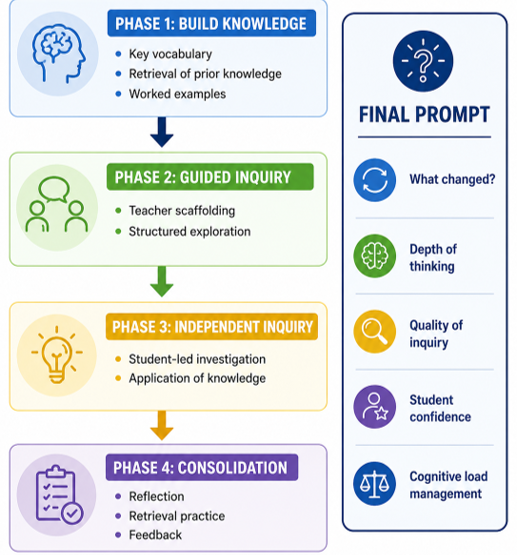
What does effective learning design look like when cognitive science and inquiry are fused?
(A lesson structure that integrates explicit instruction with inquiry thinking)
When you look at strong lessons, there’s usually a clear rhythm to them. Students start with something that helps them recall prior learning. The lesson has a clear outcome so everyone knows where they’re heading. Key knowledge is made explicit so students aren’t guessing what matters.
From there, teachers often model new ideas, guide students through practice, and then gradually step back as understanding grows. Along the way, they check for understanding constantly and adjust based on what they see.
Inquiry sits within this structure, not outside it. It shows up when students are asked to apply what they’ve learned, explain their thinking, make connections, or tackle more open-ended tasks. Talk, writing, and reflection all become ways of deepening understanding rather than activities on their own.
This infographic shows that inquiry and explicit instruction aren’t separate lesson types—they’re different parts of the same learning process.