What does it take to design academic success?
It is a simple question, but one that increasingly separates schools where outcomes are consistent and sustained from those where success depends too heavily on individual teachers or departments.
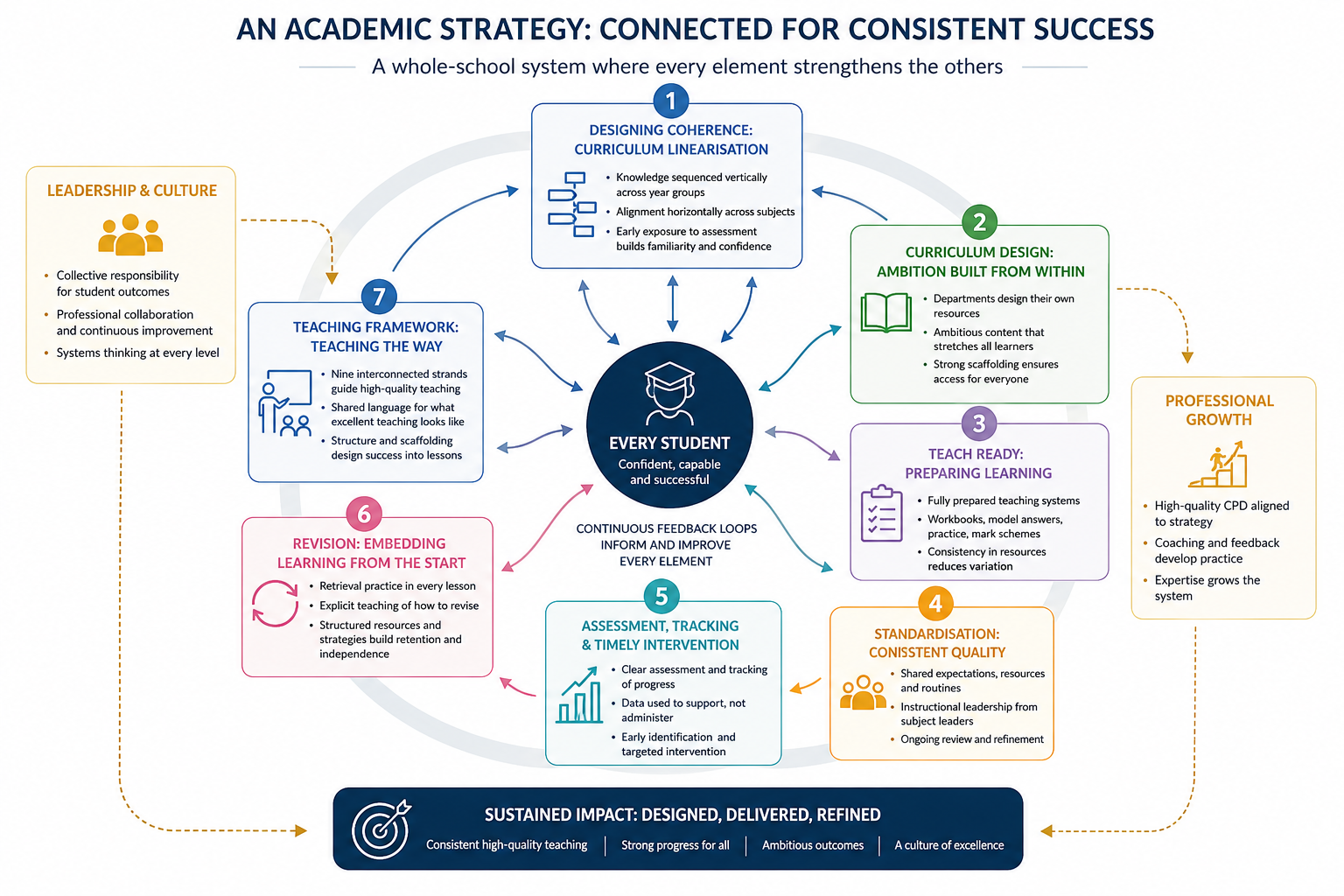
An academic strategy is the intentional, whole-school design of curriculum, teaching, assessment and leadership systems. Its purpose is to ensure that high-quality learning is not left to chance. Instead of relying on pockets of excellence, it creates a coherent framework in which excellence is embedded into the system itself — connecting what is taught, how it is taught, how progress is measured, and how staff work together to secure outcomes for every student.
A recent visit to Hurstpierpoint College provides a clear example of this approach in practice.
Here, the focus is not only on strong outcomes, but on how those outcomes are achieved and sustained. The school is deliberately building systems that embed consistency, ambition and continuous improvement across all departments, ensuring that success is designed into the organisation rather than dependent on individual variation.
So what does this look like in practice?
Building coherence: curriculum linearisation
At the heart of Hurst’s academic strategy is coherence — ensuring that learning builds logically and intentionally over time.
This is achieved through a process of linearisation: the deliberate sequencing of curriculum content so that knowledge is carefully developed both vertically (across year groups) and horizontally (across subjects and departments).
Vertically, curriculum pathways are mapped so that prior knowledge is systematically built upon, reducing unnecessary repetition and ensuring progression is secure. Horizontally, departments align expectations and content so that learning in one subject reinforces and complements others.
A key feature of this approach is early exposure to assessment styles and expectations. Students become familiar with the language, structure and demands of formal assessment from an early stage. This helps to reduce the discontinuity often experienced between key stages, building confidence, fluency and long-term attainment.
Curriculum design: ambition built from within
Curriculum design at Hurst is led internally by departments, rather than relying on external schemes of work. This gives teachers ownership over what is taught, while ensuring that content is carefully shaped around the needs and aspirations of students.
Departments develop their own structured resources, including workbooks, practice materials and knowledge organisers. These are not simply supportive tools; they are deliberately designed to be ambitious, pushing students towards the highest levels of attainment.
At the same time, ambition is balanced with support. Strong scaffolding is built into materials so that all learners are able to access challenging content, ensuring that high expectations are maintained without excluding those who need additional structure.
Teach Ready: preparing learning before it begins
A central strand of the model is what might be described as “Teach Ready” — the idea that effective teaching is underpinned by fully prepared systems before a lesson even begins.
This includes structured workbooks, model answers, curated practice questions, mark schemes and standardised lesson resources. The emphasis is on reducing uncertainty and variation, allowing teachers to focus on delivery, responsiveness and subject expertise.
In practice, this creates clarity for both staff and students. Lessons are built on shared expectations and consistent materials, ensuring that high-quality instruction is not dependent on individual preparation on any given day.
Standardisation: ensuring consistency without limiting expertise
Standardisation at Hurst is not about removing teacher autonomy, but about ensuring that every student experiences a consistently high standard of education, regardless of classroom or teacher.
Shared expectations, resources and routines provide a common foundation across the school. Subject leaders act as instructional leaders, working closely with staff to refine curriculum design and support high-quality delivery.
This is an ongoing process rather than a fixed system. Leadership teams continually review intent and implementation, ensuring that consistency is maintained while allowing for professional growth and refinement.
Assessment, tracking and timely intervention
A structured approach to assessment underpins the school’s wider strategy. Progress is tracked against clearly defined expectations, allowing teachers to identify issues early and respond effectively.
Importantly, data is not treated as an administrative exercise. Instead, it is used as a practical tool to support teaching, inform interventions and improve outcomes.
This enables early identification of underperformance and ensures that support is targeted and timely. Over time, it also helps staff to recognise patterns in learning, informing more effective teaching strategies across departments.
Revision: embedding learning from the start
Revision is not treated as something that begins at the end of a course. Instead, retrieval practice is embedded into everyday teaching, ensuring that students are constantly revisiting and strengthening prior knowledge.
As formal assessment points approach, students are explicitly taught how to revise effectively within each subject. Departments provide structured resources and shared strategies, supporting both knowledge retention and independent study skills.
This approach reframes revision as an ongoing process rather than a final-stage activity, embedding long-term retention into the curriculum itself.
Teaching the Hurst Way: a shared language of high-quality teaching
“Teaching the Hurst Way” acts as the school’s unifying framework for teaching and learning. Rather than being a checklist or performative observation tool, it functions as a shared language for what effective teaching looks like in practice.
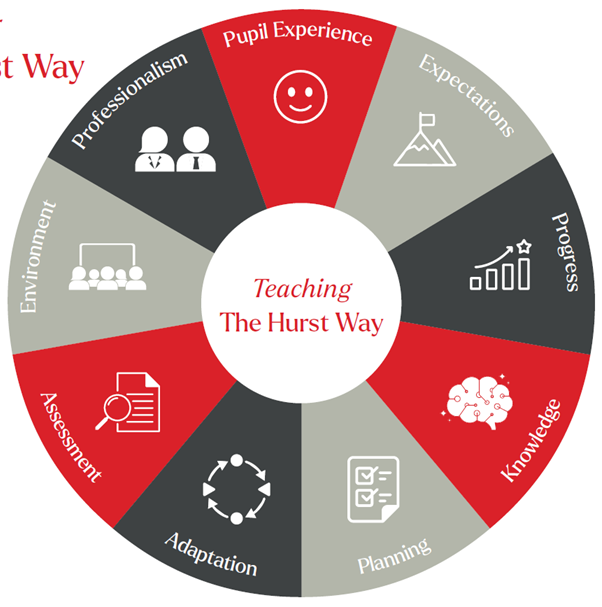
It brings together curriculum design, pedagogy and classroom culture into a single coherent model, ensuring that expectations are consistent while still allowing subject-specific expression. At its core are nine interconnected strands that define, in practical terms, how high-quality learning is planned, delivered and experienced.
- Pupil experience: what does learning feel like for students? This strand focuses on how students experience lessons on a day-to-day basis. The emphasis is on clarity, structure and engagement, ensuring that students understand what they are learning, why it matters, and how it connects to prior knowledge. Lessons are designed to reduce ambiguity and cognitive overload, allowing students to focus on thinking deeply rather than decoding instructions.
- Expectations: what does success look like in every classroom? High expectations are made explicit and consistent across the school. This applies to both academic standards and classroom behaviours. The principle is that success should not vary depending on teacher or subject. Students should encounter the same clarity about what excellence looks like, whether they are in English, science or mathematics.
- Progress: how is learning built over time? Progress is viewed as cumulative and carefully sequenced. Lessons are designed so that new knowledge consistently builds on what has already been taught, rather than existing as isolated episodes.
- Teachers focus on ensuring that students not only understand content in the moment, but retain and can apply it later. This long-term view of progress underpins curriculum planning and lesson design.
- Knowledge: what do students need to know and remember? Knowledge is treated as the foundation of learning. Lessons prioritise the careful selection and sequencing of core concepts, ensuring that essential subject content is explicitly taught and revisited. The focus is not just on exposure to content, but on secure retention and the ability to use knowledge flexibly in new contexts.
- Planning: how are lessons structured for success? Planning is deliberately structured and consistent, reducing unnecessary variation while supporting teacher expertise. Lessons are carefully designed in advance, often using shared resources, model answers and structured tasks. This allows teachers to focus on adaptation and delivery rather than constructing materials from scratch in real time.
- Adaptation: how do teachers respond to learners in the moment? While structure is important, teaching remains responsive. Adaptation refers to how teachers adjust explanations, questioning and support based on how students are learning in real time. This ensures that consistency in planning does not become rigidity in delivery. Instead, it supports flexible, expert teaching within a clear framework.
- Assessment: how do teachers know learning is secure? Assessment is embedded within lessons rather than reserved for end points. Teachers use questioning, retrieval practice and structured tasks to check understanding continuously. This allows misconceptions to be identified early and addressed before they become embedded, while also providing students with regular feedback on their progress.
- Environment: what conditions support learning? The learning environment is intentionally structured to support focus and engagement. This includes classroom routines, behaviour expectations and the organisation of resources. The aim is to minimise distraction and create conditions where students can engage fully with challenging academic content.
- Professionalism: how do staff contribute to the wider system? Professionalism underpins the entire framework. Teachers are expected to engage collaboratively in curriculum development, share best practice and contribute to continuous improvement. Leadership is distributed, with subject leaders acting as instructional leaders who support, challenge and develop practice within their teams.
Why this framework matters
Taken together, these nine strands form more than a teaching policy. They create a shared understanding of what high-quality teaching looks like in practice, ensuring that consistency does not come at the expense of expertise.
Instead, the framework provides structure within which professional judgement can operate — aligning staff around common principles while still allowing for subject-specific nuance.
It is this balance between clarity and flexibility that allows “Teaching the Hurst Way” to function not as a constraint, but as a coherent model for sustained excellence.
Conclusion: success by design, not by chance
What happens when academic success is designed rather than left to chance?
At Hurstpierpoint College, the academic strategy represents a systematic approach to curriculum design, teaching and leadership. It prioritises coherence, consistency and deliberate practice, ensuring that high standards are not isolated but embedded across the entire organisation.
The result is not simply strong performance, but sustained improvement — driven by systems that are continuously refined and collectively owned.
The central message is clear: high achievement is not accidental. It is engineered through deliberate design, consistently applied, and carefully sustained over time.
I am very grateful to Graham Moir, Deputy Head (Academic) for explaining their strategy to me.