Equity Analogies
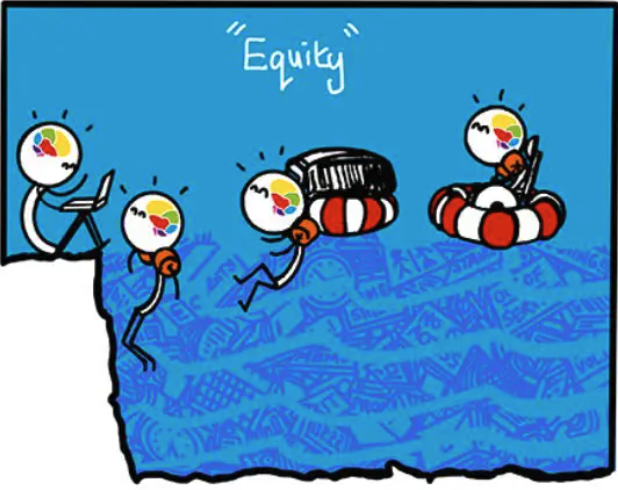
While people often talk about the importance of equality, the concept of equity is closely related. This page explores this concept through a video and an article. Both texts have comprehension questions to help you practise your listening and reading skills for Paper 2. There is also a writing task and some Individual Oral questions for speaking practice.
Paper 2 Listening mark schemes - click the eye icon to view.
Paper 2 Listening
1. What is one example of a difference the speaker gives?
glasses / weight / how much money we have
2. What does the speaker say is untrue?
(that) it's hard to find diversity
3. Which two things is equality often compared to?
fairness AND sameness (both needed for the mark)
4. Equity is rooted in…
access and opportunity (both needed for the mark)
Equality
With a box each:
- The tall person has a clear view
- The shorter person is on tiptoes and can 5. (barely) see.
- As well as 6. struggling to see the game, the wheelchair user is unable to climb on the box.
Equity
- Rather than receiving identical treatment, each person receives tailored support based precisely on 7. what they need to view the match.
- The wheelchair user uses a ramp and the shorter person receives two boxes, while the tall spectator receives no boxes because they required no 8. (extra) assistance to view the game.
9. Other than power and resources, what else is needed to change structures and give opportunities to people who have been excluded?
social responsibility
10. What is one effect of helping students find value in their voice?
increases awareness / a sense of empowerment
Transcript - click the eye icon to view.
Before we can talk about equity versus equality, I want to first define diversity. At Inclusive Communities, we like to say diversity in its simplest definition means differences. We all have differences, from our glasses, to our weight, to how much money we have. That is diversity. No matter how much people say it's hard to find diversity, that's not true. Diversity exists. It's about taking the time to acknowledge its existence and work to ensure action is taken to embrace these differences, not alienate them.
Equality is often equated to fairness and sameness, and is based in the misconception that we all have the same needs and the same solution will work for everyone. Equity is based in access and opportunity, with the understanding that we each start with different advantages and disadvantages and thus have different needs to attain access and opportunity. To understand equity, we have to compare it to equality.
Now, I love this equity versus equality graphic, as it's the best explanation of the difference between the two. On the equality side, you see that we've got three individuals: our tall guy, our short girl, and our friend in the wheelchair. You see that they're all trying to watch this baseball game, but there's this fence. With equality, they've each been given a box to use to be able to see the game, but obviously that's not working, because our tall friend is now super tall and sees very clearly over the fence, while our short girl can just barely see and she's still kind of on her tiptoes and struggling to see the game, while the person in the wheelchair can't see at all, and they can't even get on the box.
On the equity side of this picture, you can see that now we've given each individual exactly what they need to be able to see the game. The person in the wheelchair has a ramp so they can clearly get to the top and see the full game. The shorter girl has two boxes, which is what she needed to comfortably be able to see. And the tall person has no boxes at all, because they didn't need the extra assistance in the first place.
Equity is a process, which means it is continuous. We can't gain equity by changing just one thing. For example, the equity side of this photo shows our friend in the wheelchair has gained equity at this fence, but the work is not done. True progressive equity is about how can we ensure that he has equitable opportunities at all of the hypothetical and real fences in his life.
Equity requires power, resources, and social responsibility to work hand in hand to change the structures and provide opportunities to those who were institutionally left out, marginalised, or oppressed. Equity is hard, but it's essential for us to make change in the lives of those who have been historically depicted as less than: from individuals with disabilities, like physical, developmental, and mental, to people living in poverty without access to food or education or healthcare. It's important for us to understand that there is a long history of discrimination which has created the present-day inequities, which don't allow these individuals the same access to opportunity than those who don't have those differences.
One of the greatest gifts that we give to students that we work with is the opportunity to share their story and to find value in their voice, and this increases awareness and a sense of empowerment. Everyone has their own stuff; everyone is going through something that challenges their emotional and physical capacity to be great, but there is power in connection.
So now, here's your challenge: be brave and seek out those opportunities to have authentic conversations with those that are different than you. Find out what makes them unique and what brings them joy. Then you do the same. Share your story, because you have value as well. Now you've built community, and with community we have power. "We" is always stronger than "me".
Paper 2 Reading mark scheme - click the eye icon to view
1. Choose the FOUR true statements (the order will be mixed up on the smart quiz)
A. One famous example that illustrates equity refers to spectators at a sporting event.
B. One analogy used to explain equity uses trees of different heights.
C. True fairness means giving everyone the same thing.
D. The meaning of fairness can vary according to the type of fairness you are looking at.
E. Equity is sometimes perceived as biased.
F. Equality is about providing different opportunities for people.
G. We can’t always see the challenges people are facing.
H. Barriers that we can see are more important than those we can’t.
Which word or phrase between lines 15 and 24 could meaningfully replace the following:
2. illustrated … represented
3. identifiable … recognisable
4. official … formal
5. deep-rooted … systemic
6. Why did The Brain Charity collaborate with AJ O’Neill?
A. To promote their work through an engaging cartoon
B. To inform people of the change in the definition of the term ‘fairness’
C. To update the equity/equality graphic by considering disabilities that can’t be seen
D. To create a new graphic design that’s easier to understand
7. Greg’s example…
A. Highlights the issue using a personal example from his childhood.
B. Stresses the importance of remembering your daily schedule.
C. Questions the need to carry every book to class.
D. Illustrates the topic through a hypothetical example.
8. The orange armbands represent…
A. …the way in which equality values giving everyone the same tools to succeed.
B. …the need to stay afloat when you have too many tasks to complete.
C. …the most effective solution to multitasking.
D. …an innovative approach to task management.
9. The dry land symbolises…
A. …a stress-free world.
B. …freedom from authority.
C. …the need for stricter deadlines.
D. …quality over quantity.
Paper 2 Listening - the background
This video uses an analogy to explain the difference between equality and equity. An analogy compares two different things in order to explain something more complex.

Watch the video below and answer the questions. Here is a reminder of the different listening question types.
Before you listen, look at the questions. Can you predict any keywords or ideas that might be mentioned?
While you listen, take notes.
Answer the following questions.
What is one example of a difference the speaker gives?
What does the speaker say is untrue?
Which two things is equality often compared to?
Which two things is equity is rooted in…
Complete the following gaps. Use no more than three words for each gap.
Equity Versus Equality Graphic
Equality With a box each:
Equity
|
[ - 5 - ]
[ - 6 - ]
[ - 7 - ]
[ - 8 - ]
Answer the following questions.
Other than power and resources, what else is needed to change structures and give opportunities to people who have been excluded?
What is one effect of helping students find value in their voice?
Paper 2 Reading - the background
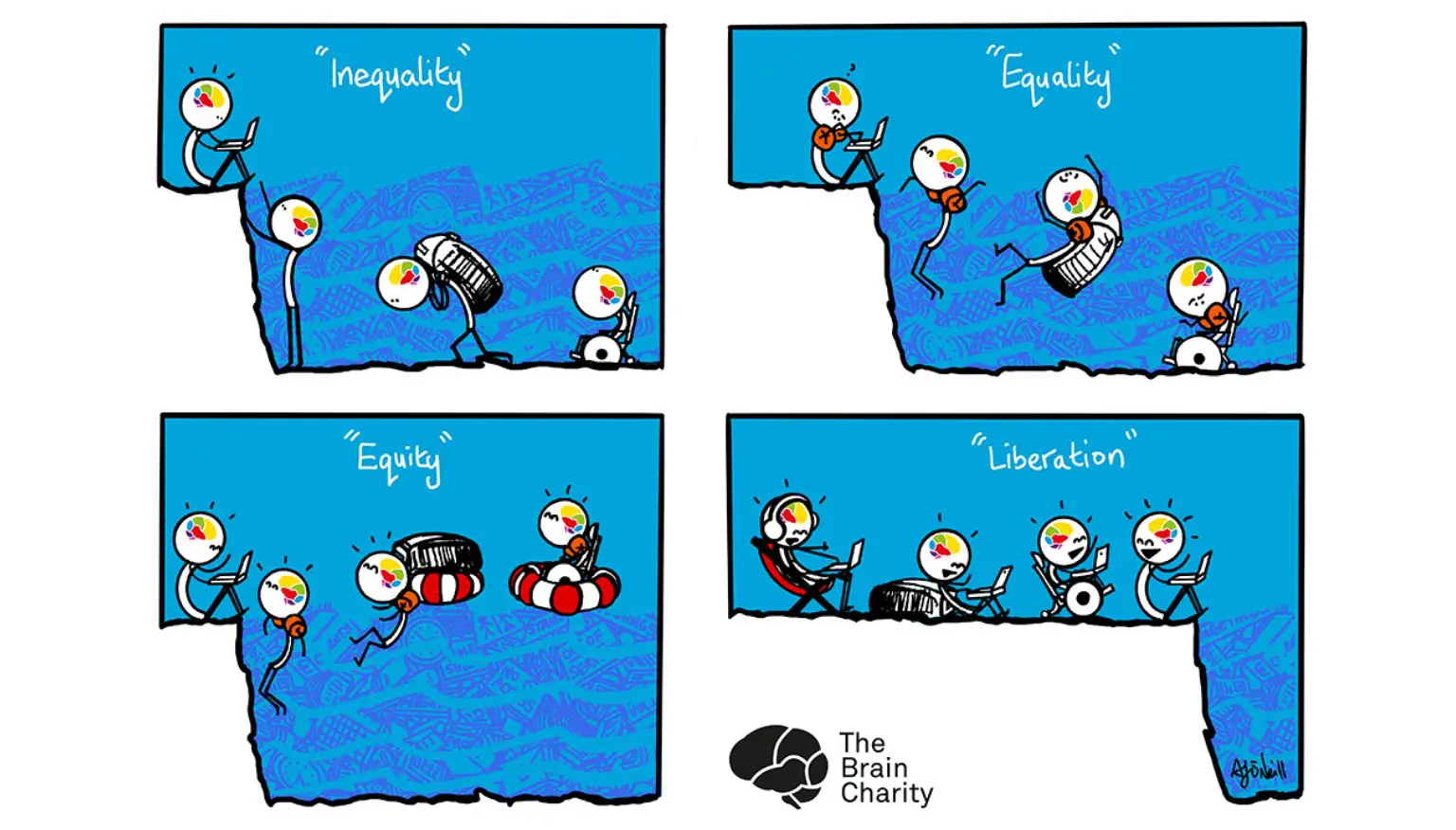
The text below comes from The Brain Charity, a British organisation that champions neurodiversity (the idea that all brains work and think differently) and assists anyone affected by brain conditions to rebuild their lives. The graphic referred to in the text is an updated version of the one referred to in the listening task above.
Before you read the text:
- What do you understand by this graphic?
- How does it differ from the boxes at the baseball game mentioned in the listening activity above?
- Which analogy is more effective?
Source: The Brain Charity
This text is an article on the website for The Brain Charity website. Before you look at the questions, read the text and identify the main ideas. It is an article, so look out for the conventions:
- relevant headline/title
- introduction intended to catch the readers’ attention.
- techniques that engage and interest readers, e.g. direct address
Next, answer the questions below. If you download the PDF, you can place it alongside the questions on your screen, just like in the Paper 2 reading exam.
Choose the FOUR true statements.
Which word from the extract is closest in meaning to the words below?
In striving for fairness, we often assume we can see someone’s disadvantage. In the original graphics, that’s represented by physical height. But what happens when the barriers aren’t visible?
At The Brain Charity, we support people with neurological conditions, like brain tumours, epilepsy, and various forms of dementia – none of which you may see immediately by looking at people. We also raise awareness of neurodivergence through our specialist neurodiversity training, delivered by associate trainers with lived experience. Neurodivergences are not recognisable from the outside, nor can we know what different sensory or processing challenges people are facing. Some people self-identify as neurodivergent without a formal diagnosis, often due to long waiting times or systemic barriers.
illustrated ...
identifiable ...
official ...
deep-rooted ...
Why did The Brain Charity collaborate with AJ O’Neill?
Greg’s example…
The orange armbands represent…
The dry land symbolises…
Use an appropriate text type from the options below the task you choose. Write 450
to 600 words.
You want to organise an event at your school to raise awareness about the importance of striving for equity in society. First, you need to present your ideas to your school principal in order to receive their permission to hold the event. Write a text in which you explain the concept of equity, outline how the event will teach people about it, and explain how this will benefit the school community.
Proposal | Article |
The table below explains why a proposal is the most appropriate choice for this task.
| Text Type | Rationale | |
| Appropriate | Proposal | A proposal is the ideal choice for this prompt |
| Generally appropriate | An email can be used for many things, though its main job is not always to lay out a full project plan | |
| Generally inappropriate | Article | An article is unsuitable for this task |
Ideas to consider before writing:
- Defining equity: How does equity differ from equality? Why might giving everyone the exact same thing fail to be fair?
- Focus area: Which specific aspect of equity will your event address? (e.g. neurodiversity and learning support, physical accessibility, language barriers, socio-economic background, or gender representation)
- Event design: What type of event are you proposing (e.g. an interactive workshop, a panel discussion, an awareness week, or an exhibition), and what specific activities will engage participants?
- Community impact: How will participating in this event change student attitudes, improve school culture, or lead to practical changes across the school?
Proposal Conventions
- Title summarising the overall subject
- Clearly set-out format, e.g. headings, short clear paragraphs, bullets, numbering, insetting etc.
- Style aimed to persuade a specified audience
You can see more detailed expectations for the proposal text type here.

Practise for part three of the Individual Oral (HL) or parts two and three (SL) by discussing the questions below. Pair up with a partner and take it in turns to ask a question. Each question has three keywords in brackets that you might like to use in your response.
For more details on the expectations of parts two and three of the IOA, see here.
- How would you explain the difference between equality and equity using a simple, real-life example? Fairness, identical, individual needs
- How can schools adjust their teaching so that students who think and learn differently can all succeed? Flexibility, support, adaptation
- What difficulties might students from poorer backgrounds face at school, and how can schools help them fairly? Resources, disadvantage, opportunities
- Why is it important for schools to support students whose first language is not English, instead of just expecting them to fit in? Inclusion, communication, integration
- How accessible are schools and public places in your community for people with physical disabilities? Barriers, ramps, independence
- Can school events or posters truly change how people think, or do they only raise temporary awareness? Impact, attitude, long-term
- In an English-speaking country you have learned about, what is one successful project or law that helped reduce unfairness? Rights, reform, protection
- When trying to help a group of people, why is it important to listen to their opinions first? Perspective, respect, representation
- Is it more important to give everyone the exact same starting opportunities, or to ensure everyone gets the specific support they need to succeed? Outcome, starting line, balance
- Can you share a time from your own school experience when treating everyone exactly the same was actually unfair? Situation, difference, adjustment