Socratic Seminars
Have you always wanted to host a Socratic Seminar, but weren't sure how? Or have you been hosting them for awhile and just looking for some fresh ideas?
This page explores step-by-step how to host an interactive Socratic Seminar to improve students' productive, receptive, and interactive language skills. They are great to use when teaching literature or at the end of a unit. Also, they are a wonderful tool to integrate TOK into your classroom. Finally, hosting a seminar is excellent practice for the Individual Oral and Paper 2 listening skills.


Ideally, all the students will have read the text. To ensure this happens, I usually give students 10 questions to answer before they come into class. I tell them, these will be some of the questions to expect.
Students must also write three questions in advance that they will want to pose to the seminar group. This is a great way to get shy students to speak.
Also, students will write three connections to what they read and another text. For example, the protagonist makes me think of Cinderella because…
Finally, students give their opinion: one positive thing they read and one negative thing they didn't like about the text.
They put this on a piece of paper that they prepare before they enter class. This also serves as a crutch for quiet students.
To recap:
- Answer 10 pre made teacher questions
- Create 3 of their own questions
- 3 Connections to other texts
- One positive and one negative - opinion
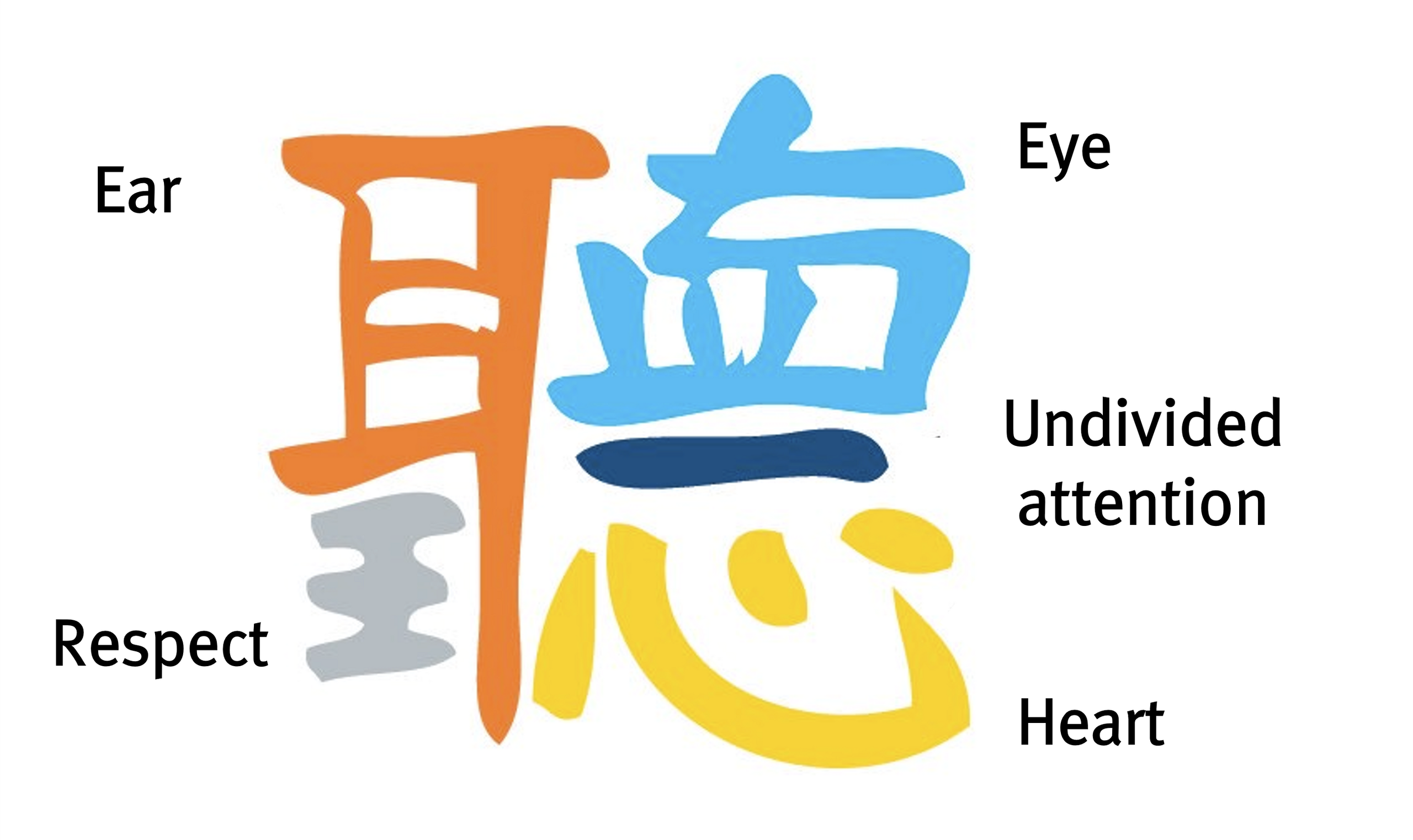
The Chinese character, or more specifically Cantonese, for listen is a great tool to demonstrate the skills needed for a Socratic Seminar. To really engage all of your students, you want to create a contract or set of rules for the seminar. This helps to serve as a set of guidelines to ensure all students participate and learn to conduct themselves as scholars. Below is a set of suggestions.
- All students must speak at least four times. I use a bingo chips and hand them to students. In the center of the circle, I place the jar of bingo chips. After each student speaks, they have the “chance” to throw the chip in the jar. If they get it in the jar they win the prize. The prize can be a homework pass or whatever you decide. I have only ever had one student get a chip in the jar in over twenty years, but they love this part.
- If a student has used all their chips, they must “give the floor” to a student who hasn't spoken yet.
- Each student sets two or more speaking goals before the seminar begins. They can choose any from this list.
- Avoid interruptions when another participant is speaking.
- Listen with your eyes, ears, and heart. Really give your full attention to the speaker.
- Speak like a scholar. Use the speaking stems in the next section.
- Be polite: use names and no hand raising.
- Refer to the text and give evidence in comments.
- Ask at least two questions.
- Come up with at least one original idea.
- Ask for clarification when needed. Say, “I don't understand this part” or “This confuses me” or “Could you please clarify your point?”


Set the physical space for your seminar. A circle works best. Remember, you are just the recorder of the conversation. Students need to be the center and direct the conversation. The teacher should only intervene if the conversation starts to wane. Many people use the spider web or Paideia circle structure for the seminar. After I set up the chairs, I tell the students that I am there to record who speaks, but they will be the ones to carry the seminar. The image is an example of a spider web from a seminar. The tally marks are there to count how many times each student speaks.

Even if some students are quiet, they can still set goals for the next seminar. The goal is growth and reflection on the text and how to improve. Confidence takes time for some students to develop. Other students, need to develop their listening skills. The reflection questions below can serve as a guide for all students.