An excellent EE

Attached is an Extended Essay that received an A. It was written by Paulina Robino Meehan, who studied the IB at the Mark Twain School in Cordoba, Argentina. She graciously gave us permission to share her essay with teachers and students for their benefit. Below are comments on the essay from David Ripley, the founder of our English B site.
Handout


This is a personal commentary intended to highlight the strengths of the essay as we do not have access to the detailed marks awarded.
The key points below are organised by following the sequence of reading the essay, but it also suggests an order in which you might discuss issues with the student you are supervising. These key points are ideas that a student should grasp and take on board, because they are precisely the elements which attract the examiner's attention and will thus influence the marking.
A topic worth discussing, with significant anglophone value - Ireland is an anglophone society and the 'Troubles' over the last fifty years or so form a hugely important element of Ireland's dramatic, tragic history. Anyone who knows anything about Ireland will immediately understand that there will be serious issues to discuss here, and that these issues should tell us something about how anglophone culture works.
An intriguing approach to the topic - the idea of looking at songs about the Troubles is instantly attractive, since popular songs are likely to tell us something about the popular attitudes and values that they express. Such songs, one feels, are likely to tell us more about the human experience of the Troubles than any dry list of socio-economic statistics. So, the essay is likely to be lively and imaginative.
A restricted subject area & time-span - the research question focuses in on 'protest songs' (i.e. NOT 'the arts' or 'the media', which would be far too wide and vague); and there are clear beginning and end dates, limiting the area of research (i.e. NOT 'in the twentieth century' or, heaven help us, 'in Irish history'). Such a tight focus means that neither the student during the research, nor the reader, should be distracted by lots of material that is only vaguely relevant.
A good source of material - in this context, 'good' must mean both 'appropriate' and 'accessible'. The material is appropriate because the essay is based on a specific type of 'cultural artifact': song lyrics - and the IB's official list defining what are recognised as 'cultural artifacts' includes song lyrics specifically (see the page Cat.2 clarified ). These lyrics are accessible because, as the Appendices show, the 55 lyrics used were all found on the internet - presumably after some lengthy searching!
The title / research question - possibly the weakest element, because it is not actually a question. However, the phrase "analysis of the purpose" implies the question form 'what was the purpose?', and so the focus of the research is generally clear. Other ways to phrase a research question might have been 'In what ways did the songs reflect the Troubles...' or 'To what extent did the songs reflect..' It must be good practice to make sure that the 'title' is in fact a question, since the 'research question' is so prominently required.
Well structured - the logic of the argument is evident, in basic terms, in the Table of Contents - although the full sense of the argument only becomes clear once you have read the essay and understand the significance of the four periods mentioned. What is clear is a methodical approach - the term 'protest songs' is defined (B) ... 'criteria for classification and analysis' are explained (C) ... detailed analysis is reported (D 1-4) ... results of analysis are compared (E).
A clear and efficient introduction - explaining in three paragraphs (i) the basic premise, that "songs ... deliver political messages"; (ii) the historical context, through a concise history of the Troubles; and (iii) what the essay is going to do. This lays out a clear framework for what follows.
The theoretical background - section B provides definitions, by quoting authoritative academic sources. Particularly important is that the categories to be used ("deliberative and epideictic") are explained, thus providing a logical justification for sorting out the material researched.
Good use of quotes - throughout, statements are consistently supported by well-selected quotations from the songs - thus providing concrete examples to back up the general argument.

Methodical, meticulous use of footnotes - A good example of this is on the first page, which has 6 footnotes. These are methodical in that they explain anything that the reader might possibly not know (e.g. acronyms like 'NICRA'); and meticulous in that all information needed to cross-check references is provided, including in the case of internet links the date in which the source was consulted (sensible as the internet sources may change through re-editing).
A rigorous overall approach - the essay employs a disciplined academic procedure, apparent in (i) the limited corpus of songs, which (ii) are subjected to a degree of mathematical analysis, which in turn (iii) results in tables presenting the distribution of the evidence. This conveys a sense of lucid presentation of hard facts as opposed to woolly impressions!
A concise, efficient conclusion - summing up the evidence that has been researched, and offering some (tentative) interpretations.
A very full bibliography + appendices - the bibliography is sensibly organised - primary sources for the song lyrics; book sources for the major research into the context; and other online sources for general background. The appendices are lavish, since they provide the full lyrics of all the songs considered in the research process. This might almost be excessive (who's going to read through all those?), but it does suggest that the author really has looked at all of her source material.

Conclusions:
No Extended Essay is perfect, however, this student fulfills most, if not all of the criteria asked of a student.
I felt a certain dissatisfaction at the end, largely because I felt that the Conclusion was a little too tentative. I wanted to see some acute explanations of why there were different types of songs produced in different periods, but there wasn't much. Indeed, there were hints of complex explanations which weren't developed fully - for instance, that there were fewer condemnation songs "...because there was less freedom of expression and fear of punishment". This is a serious allegation, but why "less freedom of expression"? where? and what sort of punishment, by whom, against whom?
In addition, the essay handles the limited sample of 55 songs in some detail and very efficiently, but surely a different type of essay based on the same primary sources might have discussed the images and language of the songs in order to explore the experiences of the Troubles.
Nonetheless, this is an exercise in academic writing required of students at the end of secondary education. We really shouldn't expect grand theories in an EE. My minor complaints above are not really fair to Paulina, who has handled a sensibly restricted subject area extremely well, and been rewarded with top marks.
If a student can manage an original and perceptive insight into the subject, then, wonderful, but that is really over and beyond what is expected in an EE.
Footnote:
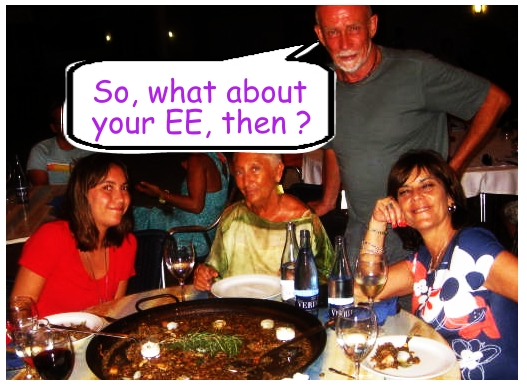
Before David Ripley's passing, he gained access to this essay because he was a friend of Paulina's mother, who is also an examiner. The request to share this essay arose during a dinner when Paulina and her mother were visiting David and his wife in Barcelona. Here is a picture David shared of that dinner.
Two comments from Paulina:
- Paulina pays a warm tribute to her supervisor, Claudia Brunetto, who "guided me a lot" in all of the successful aspects of the EE - so, hats off to Claudia!
- The conclusion wasn't great, comments Paulina, because "By that time I was really exhausted so I think that I only wanted to finish..." Yes, we should not forget how much effort students put into doing a good EE.
.