Practise with Command Terms - can you follow the arrows?

This activity is designed to help you get more familiar with the three most common command terms; describe, explain and outline.
In all honesty, it's a bit difficult to articulate the differences in these command terms. In reality, the terminology is used interchangeably and rather, it's a better idea to understand the similarities in what the examiner is looking for. Please do allow students to access the Answers - Practise with Command Terms to reflect on how well they've done when appropriate.
Three very common command terms in ESS papers are:
- Describe: Give a detailed account.
- Explain: Give a detailed account including reasons or causes.
- Outline: Give a brief account or summary (never a one word answer).

The difference between describe, outline and explain command terms are not particularly easy to understand. In IB questions and mark schemes, sometimes the differences are very subtle or even pretty much non existant! It’s best to ensure your answers always demonstrate cause and effect, using the words “therefore”, “which”, “leading to”, or “due to”.
In this series of worked examples I have indicated “cause and effect” by the use of arrows → to help you understand how a response should be written
Top tip: The issue is that IB questions can have 2 factors in one question which can undermine the clarity of command term, i.e, “describe how x factor can lead to y consequence?” So you do need to give causality in even a describe or outline question! Pay attention to the marking points to ensure you give enough information.
Figure 1: Trend in dairy and beef cow numbers in Northern Ireland 2007-2021
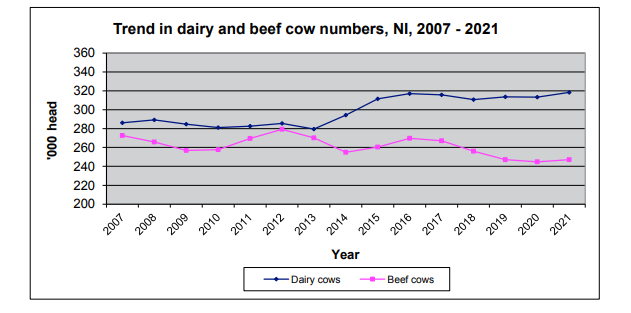
Typical Exam Question: Describe how the change in dairy cows numbers since 2007 shown in Figure 1, may have impacted the water quality of nearby rivers. [1]
Notice this question is really two questions in one. The first is about the change in dairy cows and the second bit is asking to describe how this change impacts the water quality. Therefore your answer should also have two bits. To answer this question well first start by saying how the cattle numbers have changed. Don’t just say they have changed. What is the direction of the change? Then clearly say what impact on the WATER QUALITY the increase in cattle may have caused
Some possible answers include;
- Increase in cattle → may result in increase in nutrients (from manure /faeces /urine/fertiliser runoff) entering rivers →causing eutrophication/increase BOD;
- Increase in cattle →may result in increase in sediments→ (from manure) entering rivers, →increasing turbidity/reducing clarity of the water;
- Increase in cattle→ may result in an increase in sediments (from manure) entering rivers →that smother/kill riverbed organisms;
- Increase in cattle →may increase microscopic pathogens (from manure)→ entering rivers;
- Increase in cattle→ may increase the trampling along riverbanks→ increasing erosion and sediment loading into rivers and reducing overall water quality
- deforestation for increased cattle grazing →exposes the soil to wind and water→, increasing soil erosion and runoff into the rivers,→ increasing turbidity;
- Increased water extraction for dairy farming→ reduces river flow →concentrating pollutants and reducing water quality
Explain how the change in dairy cow numbers since 2007 shown in Figure 1 may impact soil properties. (2)
Again, you should be able to pick out two parts of this one question. The first is about the actual numbers of cows and the second is how that change will impact on the soil. Make sure you articulate how the soil is actually damaged - not just that it is damaged!
Some possible answers include;
- Increase in cattle number → can increase compaction of the soil (via trampling); → therefore/so compaction of soil reduces soil porosity/infiltration rates/plant coverage → which removes nutrients from the soil;
- Increased movement of cattle hooves → can help to aerate the soil/increase porosity of the soil;
- Increase in waste/manure from cattle → can increase organic matter/nutrients of the soil;
- Increased grazing of grass → removes nutrients/soil carbon/nitrogen compounds from the soil/removes the O horizon from the soil →( leading to erosion);
- Increased grazing → can lead to barren areas of soil → contributing to soil erosion (by wind/water which degrades the soil);
Outline two ways in which farming activity in Northern Ireland contributes to climate change.(2)
Again, to answer successfully you must link a chain of knowledge together. You may assume everyone knows Carbon Dioxide or methane is a greenhouse gas but you must prove this to the examiner.
Some possible answers could include
- Cattle (via enteric fermentation/belching/flatulence/flatus) → produce methane → which is a greenhouse gas;
- Decomposition of manure → produces methane, → which is a greenhouse gas;
- Combustion of fossil fuels in farm machinery produces → carbon dioxide/CO2, which is a greenhouse gas;
- Nitrous oxide is released from agricultural soil/fertilizers can release nitrous oxide, → a greenhouse gas;
- Land use change (such as converting forest or scrubland to pasture) → reduces carbon sequestration (and increases CO2 in the atmosphere)/soil erosion →results in CO2 release →, turning it from a carbon sink into a carbon source;
- Irrigation/intensive farming practices →increase combustion of fossil fuels → (e.g. water pumping), → contributing indirectly to greenhouse gas emissions;
- Increased agriculture → can result in increased processing/transport to market/increased export overseas → (which results in fossil fuel combustion) → contributing greenhouse gases to the atmosphere;
Your teacher can choose to let you access the Answers - Practise with Command Terms to check
Try these questions, focusing on the command term, the parts of the question and the arrow technique
Describe two ways in which climate change could affect a tundra*(could be any) ecosystem. (2)
Outline two transfers and two transformations of matter or energy that occur within a forest ecosystem. [4]
Explain how the process of eutrophication can lead to the collapse of biodiversity in a freshwater lake. [4]