Summer Read: New Ways of Thinking
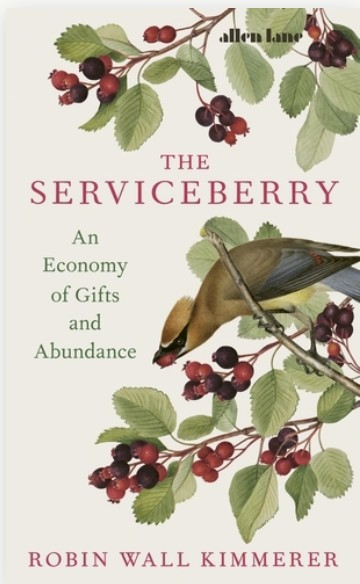
In this activity, we will read The Serviceberry: An Economy of Gifts and Abundance to examine what indigenous knowledge can offer us as a way of thinking about economics. There are two options for the reading engagement, a long essay published in Emergence Magazine and freely available, or the book which needs to be purchased. The book covers more elements of the entangled concepts of ESS.
I read this book when it was first released in November 2024, and it filled me with joy and optimism — a difficult task in the Northern Hemisphere winter! I had the idea that this could be a great collaboration with our Economics teachers; in fact, it would be perfect as a whole DP read for TOK too. All our Economics and ESS students will be reading the essay, but I am encouraging my ESS students to purchase the book as it does cover more ESS concepts, including food webs and more on indigenous worldviews.
In the spirit of the gifting economy, this is a free page, available to anyone, and everyone.
Discussion questions for small groups in your classroom:
- How would you describe your worldview?
- To what extent did you agree with the criticism of market-based economics?
- What features did you use to draw a cycle?
- What ideas did you have for creating gift economies?
- I/we used to think… Now I/we think (is there consensus on this?
The Serviceberry: An Economy of Gifts and Abundance by Robin Wall Kimmerer
If you are reading the book (which I highly recommend), try this reading guide, alternatively, read this abridged essay version published in Emergence Magazine.
ESS Assignment Questions to submit and discuss:
- What do you understand by the term “worldview” and what creates this?
- How do indigenous people think about their relationship with nature?
- What are Kimmerer’s criticisms of market-based economics?
- What have you learned about the relationship between nature and economics?
- Kimmerer talks about cycles in economics, in the book, she also talks about cycles of energy and matter in nature; draw an annotated diagram that illustrates these cycles.
- Where do you see gift economies in your life?
- What gift economies could you create at ISZL?
- What are your reflections on reading this book? (100 words)
Submit your answers as your teacher requests.
If you are also studying Economics, these questions will help your thinking.
Economics Questions on Concepts in The Serviceberry
- How does Robin Wall Kimmerer define "gift economy," and how does it contrast with a market-based economy?
- What are the implications of measuring value through relationships rather than monetary price?
- How does the serviceberry function as a metaphor for a sustainable economic system?
- In what ways does the essay critique scarcity-based economic thinking?
- How does Kimmerer argue that abundance can be maintained without exploitation?
- How does the author address issues of ownership, particularly in relation to land and natural resources?
- What is the role of community in sustaining a gift economy, according to Kimmerer?
- What critiques does Kimmerer offer about the commodification of nature?
- Do you have a calendar plant or plants?
- What goods and services are offered by the Serviceberry tree?
- What is the Anishinaabe worldview?
- How are stories used to connect a culture?
- What is a culture of gratitude?
- How does hyperconsumerism lead to climate change and biodiversity loss?
- What is a gift economy?
- Draw a diagram that represents what happens to the carbon in a Serviceberry (Saskatoon)
- How do cycles of nutrients have different time scales?
- How does the flow of energy and matter differ?
- How does the author equate the sun and the human gift economy?
- How does the author describe a market economy and the ethical problems of commodification?
- How are the origins of the words for ecology and economics related?
- How does the definition of economics by a traditional economist and an ecological economist differ?
- How is status determined in a gift economy?
- How are gift economies characterised?
- Why were Potlatches banned by colonial governments?
- What are relational values?
- How does colonisation affect views on commons and an attachment to place?
- How does the author contrast Adam Smith's Rational Economic Man with her Empathic Mutualist Human?
- What examples are there of gift economies in our community?
- What is the criticism of the "Tragedy of the Commons" narrative?
- How did the indigenous communities of the Great Lakes manage their shared resources?
- Compare the idea of a "property mindset" with "land as gift'.
- What is the Honourable Harvest?
- What is the science of Biomimicry?
- How does the Serviceberry act as a model of an economic system, distributing goods and services?
- Why does the author compare some CEOs to thieves?
- How does ecological economics differ from neoclassical economics?
- Explain how water is treated differently by market economics and by indigenous gift economics.
- What is Windigo and what does it represent?
- How does the invitation to pick Serviceberries build relationships and therefore commercial possibilities?
- How might mutualism be generated in human societies?
- What and how does Doughnut economics aim to achieve?
- Describe how ecological succession is compared to changes in human societies (potentially).
- How might incremental change and creative disruption help create a gift economy?
- What would your metrics of wellbeing be in this new gift economy?
- What is regenerative economics?