A Circuit city
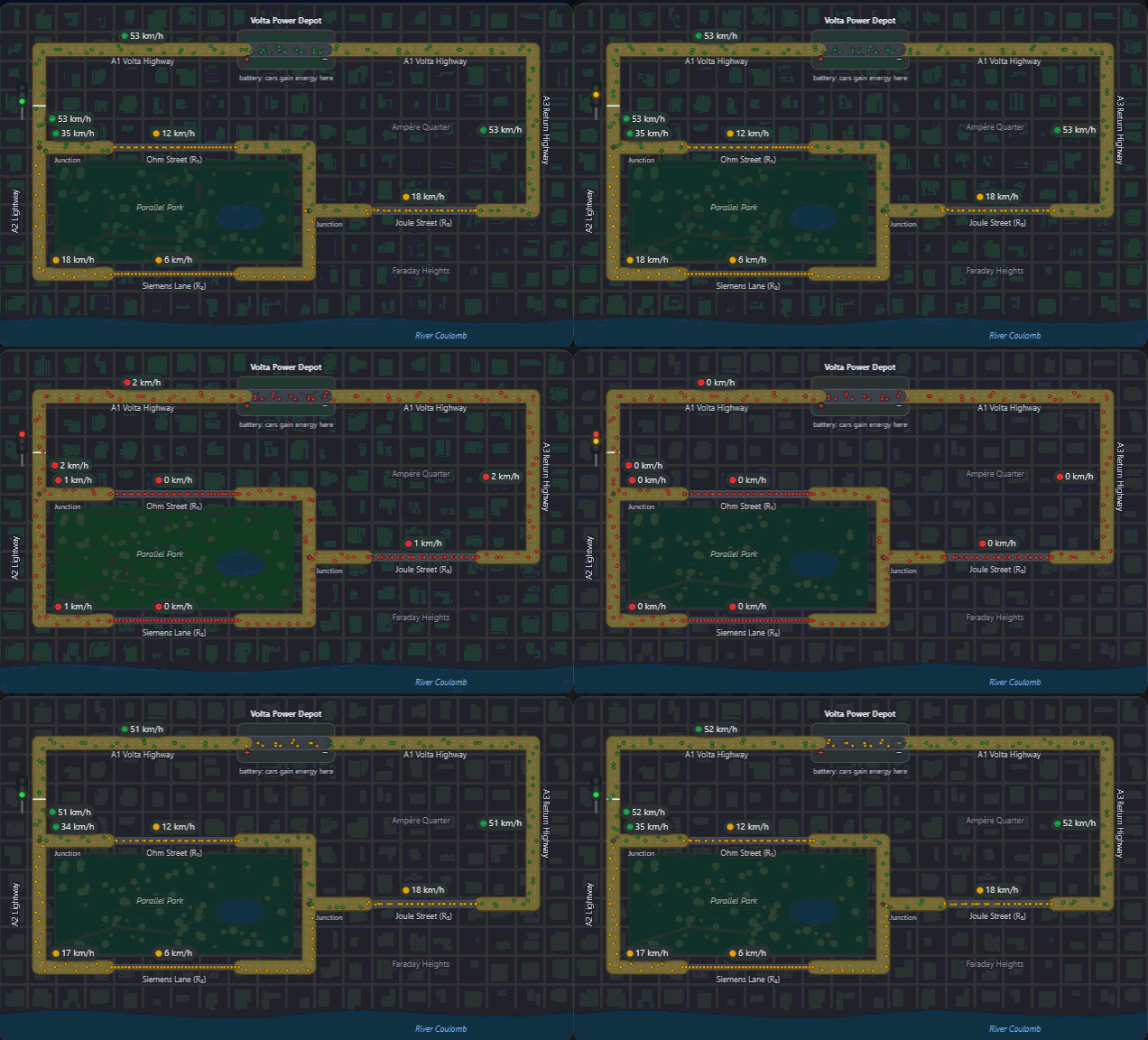
In this activity you will evaluate how effectively we can model traffic flow in a city using electric circuit theory.

Criterion A: Knowing and Understanding

Critical-thinking skills > Use models and simulations to explore complex systems and issues
MYP 4-5 inquiry questions:
Conceptual: How do circuits affect currents and voltages? How do series and parallel circuits affect currents and potential differences? How do the paths in a circuit affect the resistance of the circuit?
This activity links to 5.2.4 Understanding circuits and 5.2.5 Resistors in networks in the student e-course.
Scientific context: electric circuits could be used to ‘model’ behaviour in different contexts. In this activity, you will evaluate how well a electric circuit theory could be used to understand the behaviour of traffic in a city centre.
Use the simulation below or open the simulation in a new window here.
Part 1: Explaining Scientific Knowledge
1. Define electric current and state its SI unit.
[2]
2. Run the simulation at the default settings. State what each of these represents in an electric circuit.
a. The cars:
b. The traffic light:
c. The Volta Power Depot:
d. The narrow streets (Ohm Street, Siemens Lane, Joule Street):
[4]
3. Draw a circuit diagram for an electric circuit which would model the behaviour of the traffic in this city centre. Use correct circuit symbols in your diagram.
[5]
4. Turn the traffic light red. Outline what happens to the traffic all round the city, and use the correct circuit term to explain why this happens
[3]
5. Look at the junction where the traffic splits into Ohm Street and Siemens Lane. Describe how the flow of cars divides there, and state the law this shows.
[3]
6. Explain the role of the power depot and the narrow streets in terms of energy.
[2]
Ohm Street and Siemens Lane are in parallel.
7. Explain why the traffic flow in Siemens Lane is smaller than the traffic flow in Ohm Street.
[2]
8. Explain why in the electric circuit model the potential difference across R₁ is the same as the potential difference across R₂.
[2]
Part 2: Applying knowledge to solve problems
9. Calculate the combined resistance of Ohm Street and Siemens Lane, then the total resistance of the circuit.
[3]
10. Calculate the current from the battery. Check that your answer matches the simulation.
[2]
11. Calculate:
a. the current in Ohm Street, I₁, and in Siemens Lane, I₂
b. the potential difference across Joule Street (R₃)
c. the potential difference across the parallel pair.
[4]
12. Roadworks close Siemens Lane completely, so no traffic can use it. The battery and the other resistors stay at default. Calculate the new current in Ohm Street. State whether the traffic on Joule Street speeds up or slows down.
[3]
Part 3: Analysing and evaluating
13. In Circuit City, when the light turns red every car stops at the same moment, even on the far side of the city. On a real road, only the cars behind the light would stop at first. Interpret this difference: which behaviour matches an electric circuit, and why?
[3]
14. In the simulation, cars move slowly and crowd together on the narrow streets. A student claims: “So in a real resistor, charges drift more slowly than in the connecting wires.” Evaluate this claim using the equation I=navq , where n is the number of charge carriers per unit volume, A is the cross-sectional area, v is the “drift speed” of electrons and q is the charge on each carrier (electrons).
[5]
15. Evaluate Circuit City as a model of an electric circuit. Discuss at least two strengths and at least two limitations, and reach a supported judgement about how useful it is for learning about current and potential difference.
[6]
Prompt for students to reflect on their work using the assessment objectives, e.g.
When you have finished, check your work against the assessment objectives (i- iii) for criterion A:
Criterion A: Knowing and Understanding
At the end of year 5, students should be able to:
i. explain scientific knowledge
ii. apply scientific knowledge and understanding to solve problems set in familiar and unfamiliar situations
iii. analyse and evaluate information to make scientifically supported judgements.
In your work, highlight an example of where you have done each of the objectives.
Teaching notes for the activity, including links to assessment notes / task-adapted criteria: A Circuit City ATTL
and links to downloadable student reflection sheet for criterion A.
Tags: electricity, current, voltage, resistance, transfer, simulation