MYP Physics concepts
What are concepts? How do we encourage students to think conceptually? How do concepts facilitate deep understanding? How do concepts enable transferable understandings?
Why concept-based learning?
I already mentioned in the discussion about Inquiry in MYP Physics how the IBO defines six pedagogical principles for an IB education, amongst which:
"In all IB programmes, teaching is:
…
- focused on conceptual understanding: Concepts are explored in order to both deepen disciplinary understandings and to help students make connections and transfer learning to new contexts.
…"
- What is an IB Education? (IBO, 2019) p.6
What are concepts?
Concept-based pedagogy was given a framework and greater profile by the work of Lynn Erickson and Lois Lanning. Their original characterisation of a concept as timeless, universal and abstract - although open to debate[1] - is a useful way to start thinking about it. I also see it as useful to look at how other disciplines see ‘concepts.’
For example, in the philosophy of theory of mind, a concept is a mental representation that allows an individual to categorise and make sense of the world. Notice that it is an individual mental construct - so might vary from one person to another.
In psychology a concept is a cognitive category that groups objects, events, or ideas sharing common features, allowing the mind to process experience more efficiently without treating everything as unique. Identifying a concept then means we identify common or prototypical features that allow experiences to be grouped.
In education theory, a concept is an abstract, generalisable idea that sits above specific facts. So as educators we can distinguish concepts from information: facts can be memorised, but concepts must be understood, connected to prior knowledge, and transferred to new situations.
What does this look like in Physics education?
When occasionally met with skeptical squints in some science teacher workshops I have led, I have often challenged learned colleagues “can you really argue that Physics is not all about concepts?” I'd argue that we Physics teachers have been concept-based educators long before Erickson, Lanning et al - my own initial teacher training sometime in the last century was all about challenging misconceptions in science[2] and High Schools and Colleges in the US have been offering Conceptual Physics courses since the 1960s[3], which to this day focus on developing students' ability to identify the concepts which can explain physical phenomena. This, I would dare to say, is what Physicists do. So we should model that in the learning experiences that we create for physics students.
In my own teaching and curriculum writing, I try to embed concepts in these three phases in the inquiry cycle (as discussed here in Inquiry in MYP Physics)
1. Identification
In the inquiry stage, I try to present students with situations / phenomena that intend to both activate prior learning, and to stimulate questions about the target inquiry to be followed. This may take the form of a Visible Thinking (see Making thinking visible ) routine about an image or short video, a classroom demonstration, a media item (such as an article from the popular science press or a social media posting)… whatever I find as I pick around like a magpie at what is out there in the world! I then try to guide discussion in class (or through a resource of some kind) to encourage students to identify what the physics ‘big ideas’ might be that could unlock and explain the situation and the phenomena.
In the unit planners, this stage is frequently associated with learning objectives of the first kind:
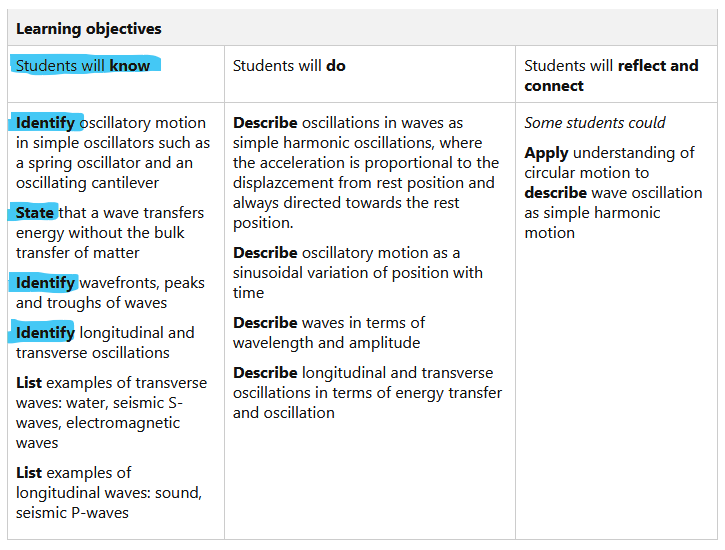
Notice that these are typically command terms that are lower-level in Bloom's modified taxonomy, but that's OK, as we have to start out with something we have identified, or a definition - some sort of factual knowledge on which we will build conceptual understanding.
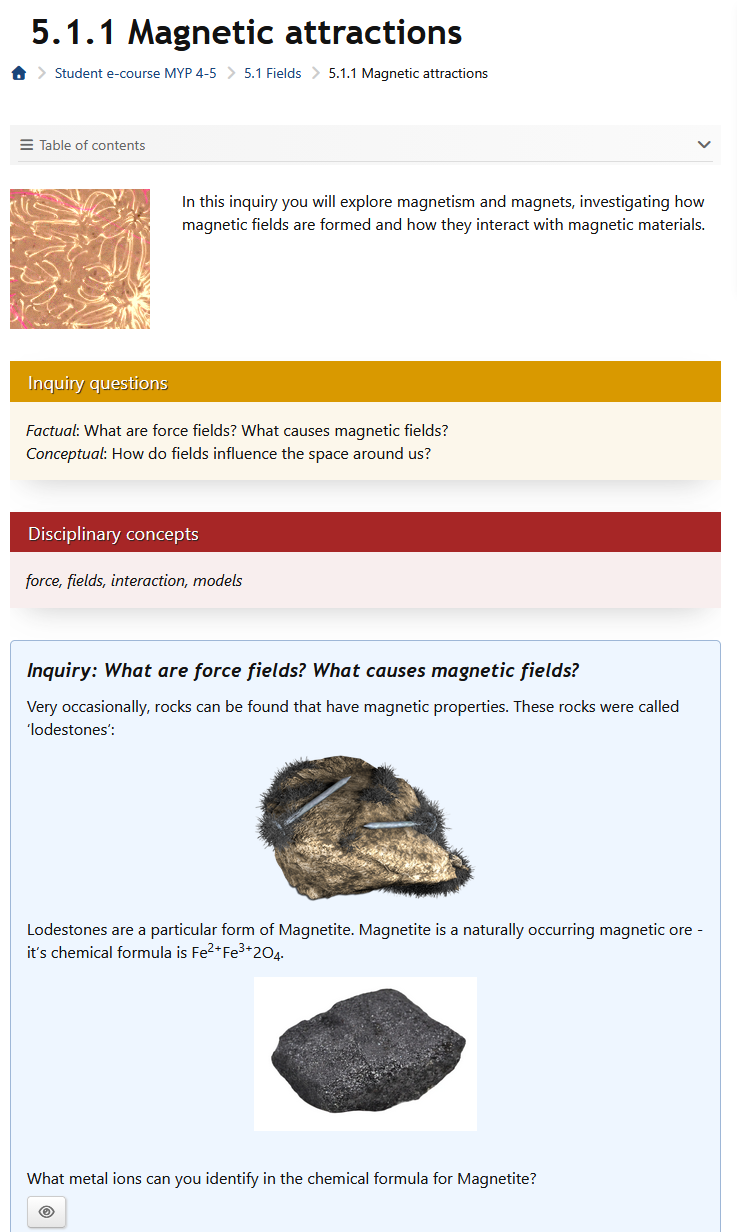
In the student-facing resources - so the activities under the Learning menu and in the Student e-course MYP 4-5 - this is going on in the first ‘inquire’ boxes:
2. Connection
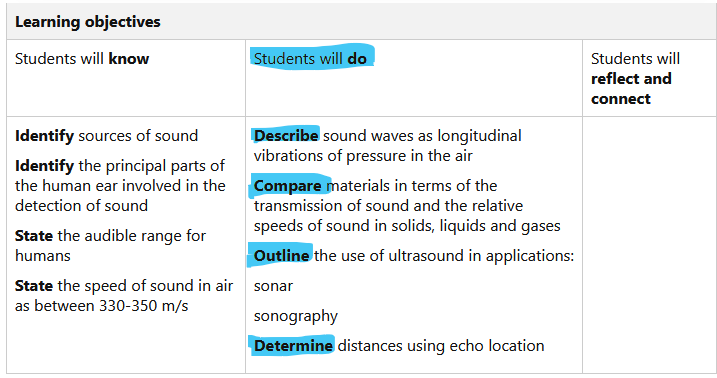
As students take action to realise their inquiry, they hopefully develop understanding of the concepts through application in whatever the task is. This is framed in the unit planners in the second type of learning objective, which concern active application and expression of their understanding:
3. Transfer
The final stage is both action and reflection in the inquiry cycle. Having identified their ‘proto-concepts’, developed and firmed up their understanding of concepts through action, students are then prompted to transfer that understanding to in different ways and in different contexts. This can take a variety of forms. The third type of learning objective in the unit planner is about students reflecting in order to connect their understanding. This usually looks like applying their understanding in a new context or through a new skill.
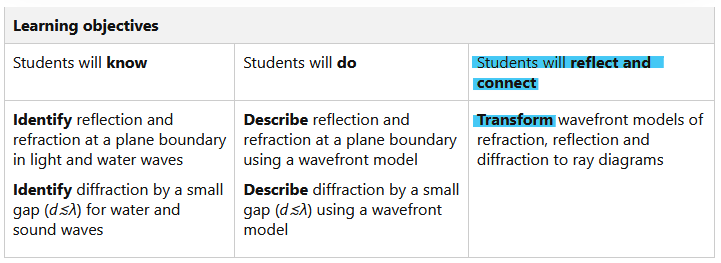
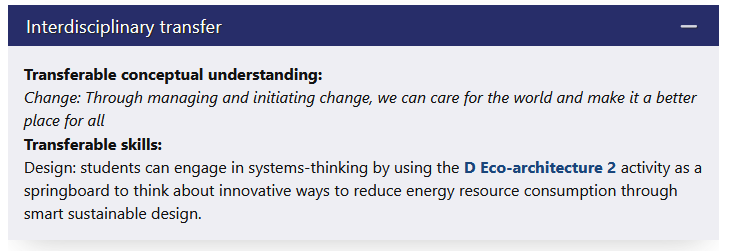
Students are also prompted to reflect both within activities, and also at the end of each unit in the unit reflections (see Reflection.) Unit planners are designed around the transferable conceptual understandings I describe in Subject Group Overviews (SGOs) and these are linked to other subjects where it seems meaningful to do so:
Footnotes
1. Are concepts timeless and universal? How does this framing of concepts account, for example, for the historicity of a concept such as “freedom”?
2. I was very influenced in my early days of teaching in UK state-funded schools by the Children's Learning In Science project https://www.stem.org.uk/resources/library/collection/3069/1
3. See for example the classic text Conceptual Physics by Paul G. Hewitt, now in its thirteenth edition.