Inquiry in MYP Physics

How do we develop students' skills for inquiry in MYP Physics? What role does reflection play?
How can we make teaching and learning more student-centred?
Look at this ‘spectrum’ or 'continuum' for approaches to teaching and learning. I used this in a school workshop I ran recently around the idea of ‘student-centred learning.’
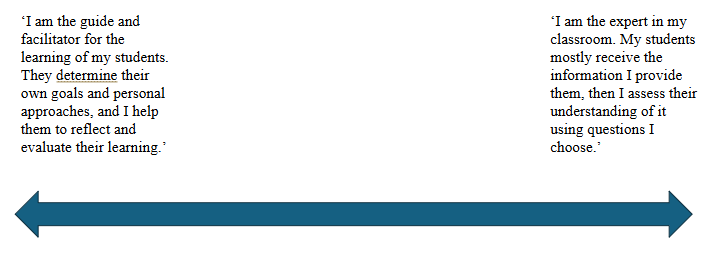
Where would you place yourself? Be honest!
Possibly the answer is ‘it depends’ and I think this is fair enough. We all change our approaches to teaching according to the situation and that is as it should be. The issues tend to arise when we have only one mode of operation in our classrooms and learning spaces.
I suggest that the IB guides are moving from the language of ‘student-centred learning’ and ‘differentiation’ to ‘collaborative learning’ and ‘personalisation’, which perhaps reflects a deeper paradigm-shift towards a diversification of approaches reflected for example in the interest around Universal Design for Learning and probably driven by the exigencies of hybrid and online learning that COVID-19 brought on many.
But here I will use ‘student-centred learning’ to denote any approach which starts with the student, rather than with the content. Inquiry-led learning is one model that ‘hardwires’ student-centredness in what we do.
What is inquiry-led learning?
The IBO identifies inquiry as one of its six fundamental pedagogical principles
"In all IB programmes, teaching is:
• based on inquiry: A strong emphasis is placed on students finding their own information and constructing their own understandings.
• focused on conceptual understanding: Concepts are explored in order to both deepen disciplinary understandings and to help students make connections and transfer learning to new contexts.
• developed in local and global contexts: Teaching uses real-life contexts and examples, and students are encouraged to process new information by connecting it to their own experiences and to the world around them.
• focused on effective teamwork and collaboration: This includes promoting teamwork and collaboration between students, but it also refers to the collaborative relationship between teachers and students.
• designed to remove barriers to learning: Teaching is inclusive and values diversity. It affirms students’ identities and aims to create learning opportunities that enable every student to develop and pursue appropriate personal goals.
• informed by assessment: Assessment plays a crucial role in supporting, as well as measuring, learning. This approach also recognizes the crucial role of providing students with effective feedback."
- What is an IB Education? (IBO, 2019) p.6
Inquiry-based learning has been developed for a number of years by significant practitioners such as Kath Murdoch. The approach I'm calling inquiry-led learning is one where we frame the desired learning outcomes as questions, so that students always encounter knowledge as open-ended and open to (reasoned, informed) critique. No doubt you can see the ‘synergy’ and overlap here with critical thinking as a key AtL skill area.
As students ‘journey' through our units of inquiry they are hopefully stimulated to think this way about the knowledge they encounter, and to formulate their own questions.
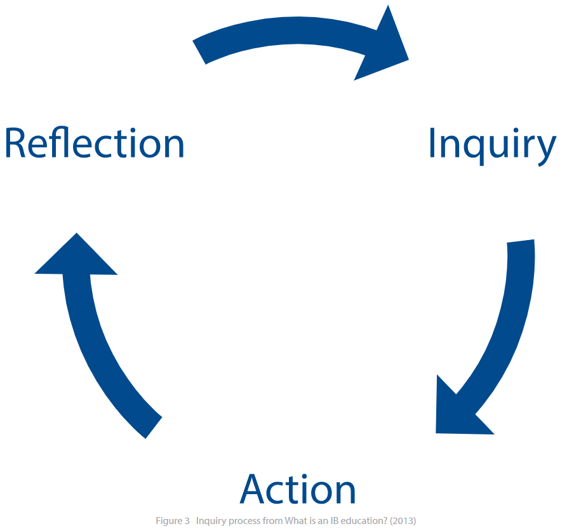
To this end, all student activities in this site are structured using the simplest 3-stage inquiry cycle as it is presented by the IBO:
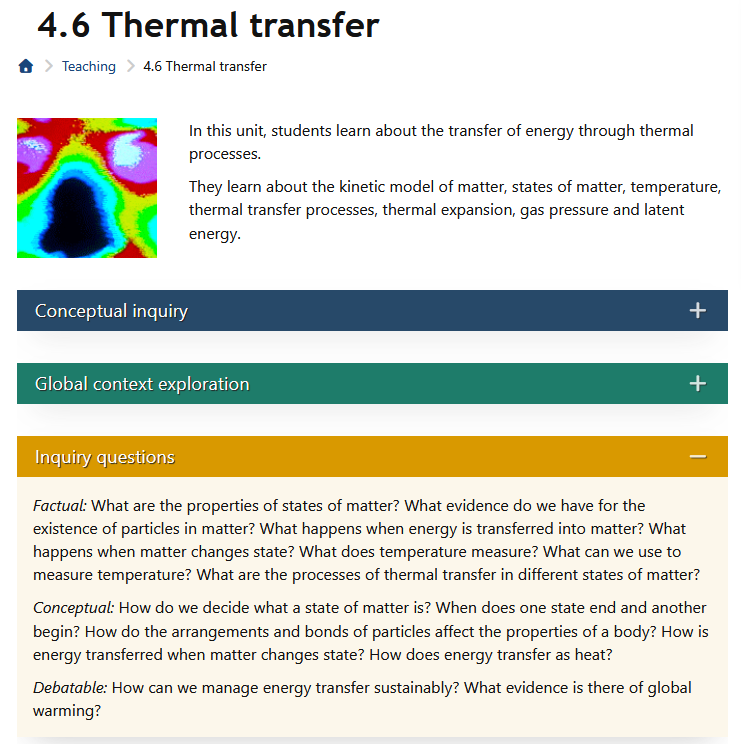
In the MYP units of inquiry are ‘framed’ (defined in scope) using inquiry questions that are factual, conceptual or debatable in form:
The nature of inquiry-led learning can vary in terms of the degree of teacher direction and structuring applied.
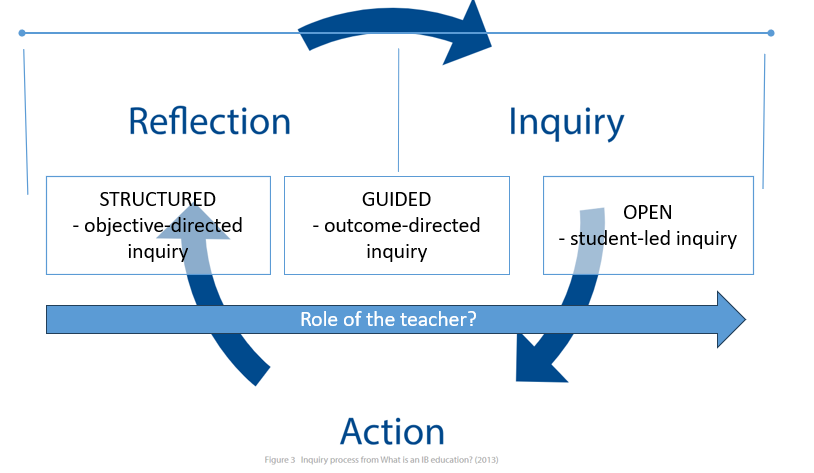
In this course, units of inquiry are structured because they prompt students to inquire to develop their understanding of certain learning objectives that are knowledge, skills, understanding or transfer-based. The learning activities sit somewhere between this and guided inquiries because they are generally tasks directed to a particular outcome. And occasionally - particularly in prompts for global context explorations or community engagement - students are given the ‘springboard’ for a more open inquiry.
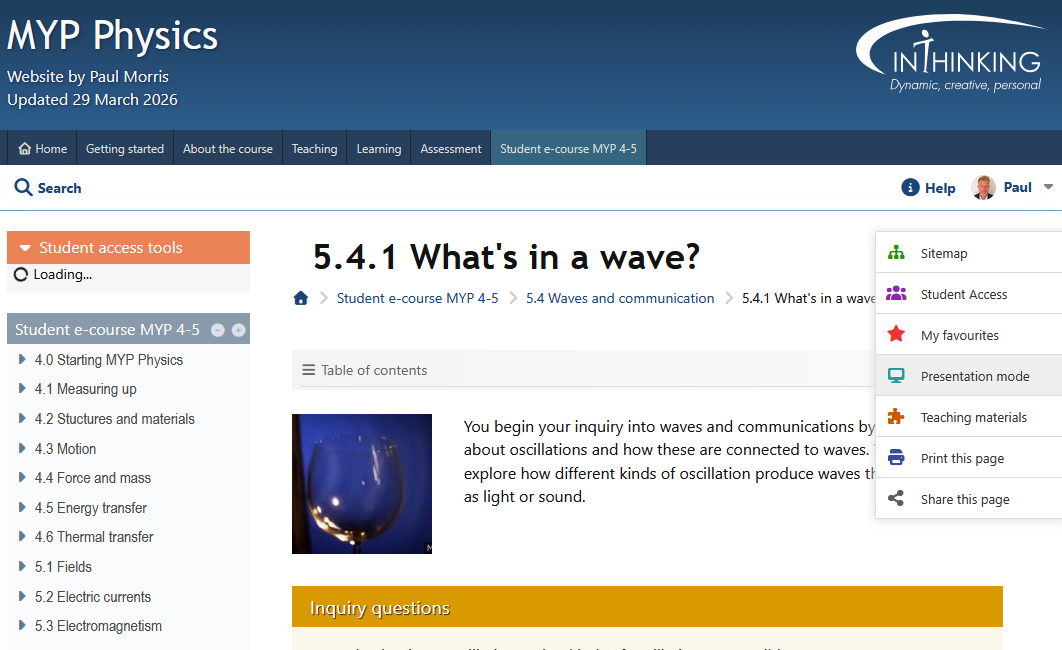
The role of the teacher thus varies according to the stucture given to an inquiry. The resources on this site are written such that teachers operate more often as the ‘guide on the side’, although teachers will want sometimes to bring the class together for some direct instruction as ‘sage on the stage’[1], also to generate discussion around the guiding questions so that the class can ‘crowd source’ their ideas for the inquiry questions. Remember that the site includes a ‘presentation mode’ if you wish to show pages on-screen in the classroom:
Inquiry-led learning does NOT mean…
-The student always gets to do whatever they want (or nothing)
-They can spend their time surfing online
-That knowledge isn’t important
Inquiry-led learning DOES mean…
The student has AGENCY
+
ACCOUNTABILITY
= RESPONSIBILITY
in their learning.
I make use of the Visible Thinking Routines from Harvard Graduate School for Education's Project Zero and you will see that each unit also contains various points where students are prompted to reflect on their learning - including a full unit reflection at the end of each unit of inquiry.
Making thinking visible
This page introduces Visible Thinking routines from Harvard Project Zero.
Reflection
Reflection is the last stage of the inquiry cycle. The strategies used to prompt reflection on inquiry in this course are presented here.
Footnotes
1. Alison King (1993) “From Sage on the Stage to Guide on the Side: College Teaching: Vol 41, No 1”