A Modelling electricity with water
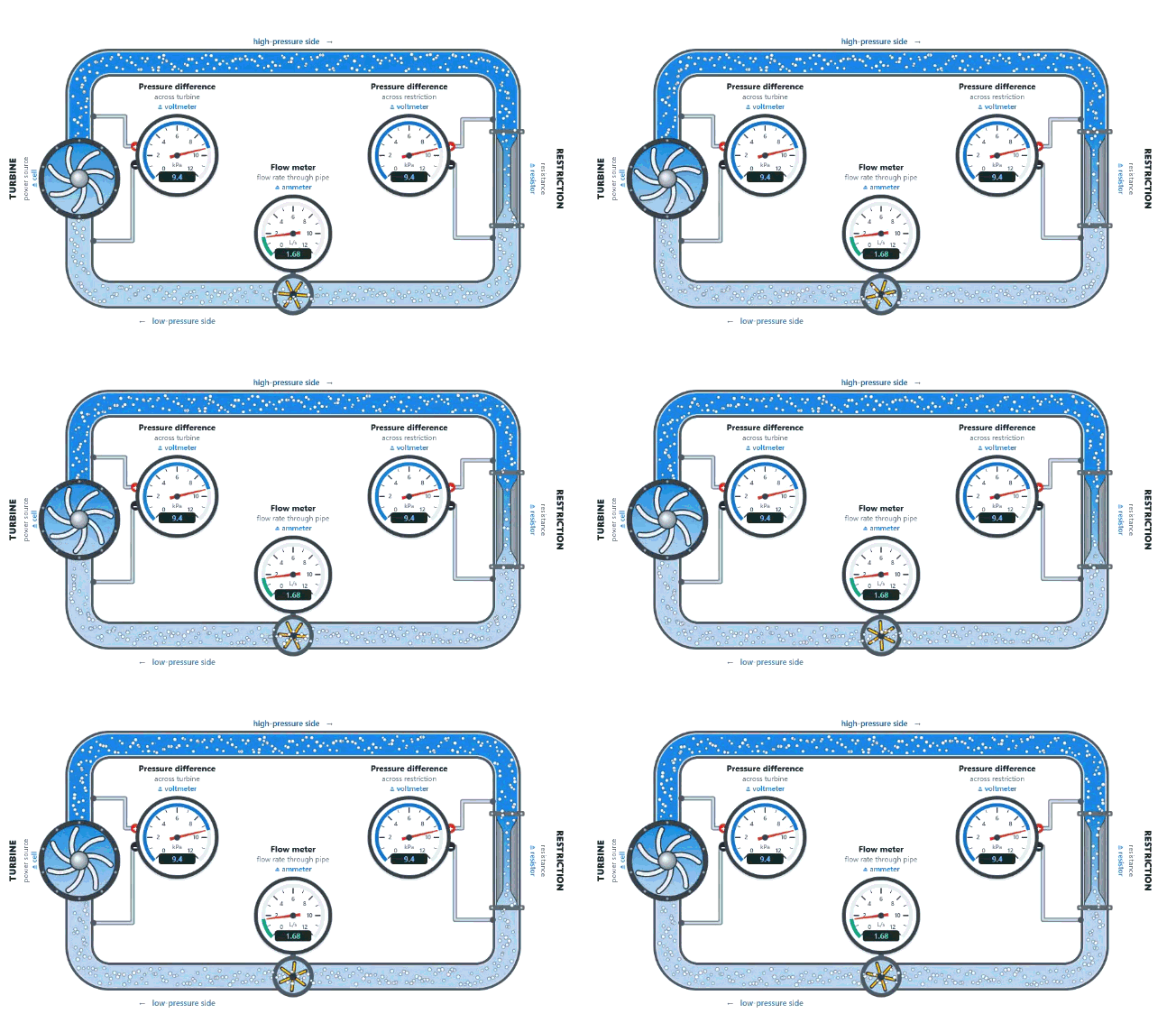
In this activity you will explore and evaluate how a water circuit can be used to model the behaviour of electricity.

Criterion A: Knowing and Understanding

Critical-thinking skills > Use models and simulations to explore complex systems and issues
MYP 4-5 inquiry questions: What does a circuit need to have, in order to work? How do circuits affect currents and voltages?
This activity links back to 5.2.4 Understanding circuits in the student e-course.
Before you start:
Discuss with a learning partner:
• In what ways is the flow of water in a pipe like the flow of electric current in a wire?
• In what ways might it be different?
Open the water circuit simulation here or use the simulation below:
Keep Show electrical equivalents switched off until Question 8 tells you to switch it on.
Part A: Investigating the water circuit
1. Analyse the parts of the circuit. Explain the role of each part in the flow of water around the circuit:
a. the pump
b. the restriction
c. the flow meter.
2. Increase the pump pressure.
a. Describe how the pressure difference across the restriction changes.
b. The two pressure gauges always show the same reading. Explain why, in terms of the energy given to the water and the energy transferred from it.
3. Set the restriction to 3.0 kPa·s/L. Record the flow rate for four different pump pressures, then describe the relationship between pump pressure and flow rate.
| Pump pressure (kPa) | Flow rate (L/s) |
|---|---|
4. Keep the pump pressure fixed and change the restriction. Describe how this affects:
a. the pressure difference across the restriction
b. the flow rate.
Part B: Applying the model
5. The pump pressure is 6.0 kPa and the flow meter reads 1.5 L/s. [A ii]
a. Calculate the resistance of the restriction. Include the unit.
b. Predict the flow rate if the pump pressure is increased to 9.0 kPa with the same restriction.
c. Check both answers using the simulation.
6. A second restriction, identical to the first, is added to the circuit. Each restriction has a resistance of 3.0 kPa·s/L and the pump pressure is 6.0 kPa.
a. The second restriction is added in series: one after the other in the same pipe. Predict the pressure difference across each restriction and the flow meter reading. Explain your predictions.
b. Instead, the second restriction is added in parallel: the pipe splits into two branches with one restriction in each, then joins again. Predict the flow rate in each branch and the flow meter reading in the main pipe. Explain your predictions.
c.The simulation has only one restriction. Suggest how you could use it to test your predictions, then test them.
Part C: Evaluating the model
7. Switch on Show electrical equivalents. For each of the following, state what it models in an electric circuit and explain why the comparison works:
a. the pressure difference across the pump
b. the restriction
c. the pressure difference across the restriction
d. the flow meter reading.
8. Click Break the pipe and watch carefully. Describe what happens to the water and to each reading. Compare this with what happens when a wire in an electric circuit is broken.
9. Evaluate the water circuit as a model of an electric circuit. In your answer:
a. identify at least two ways in which the model behaves like an electric circuit
b. identify at least two ways in which it does not
c. reach a conclusion: what is the model useful for, and when should we stop relying on it?
Prompt for students to reflect on their work using the assessment objectives, e.g.
When you have finished, check your work against the assessment objectives (i- v) for criterion .
Criterion A: Knowing and Understanding
At the end of year 5, students should be able to:
i. explain scientific knowledge
ii. apply scientific knowledge and understanding to solve problems set in familiar and unfamiliar situations
iii. analyse and evaluate information to make scientifically supported judgments.
In your work, highlight an example of where you have done each of the objectives.
Teaching notes for the activity, including links to assessment notes / task-adapted criteria: A Modelling electricity with water ATTL
and links to downloadable student reflection sheet for criterion A.
Tags: electric circuits, current, potential difference, resistance